The Cognitive Bias in Leadership
📝 Transcript
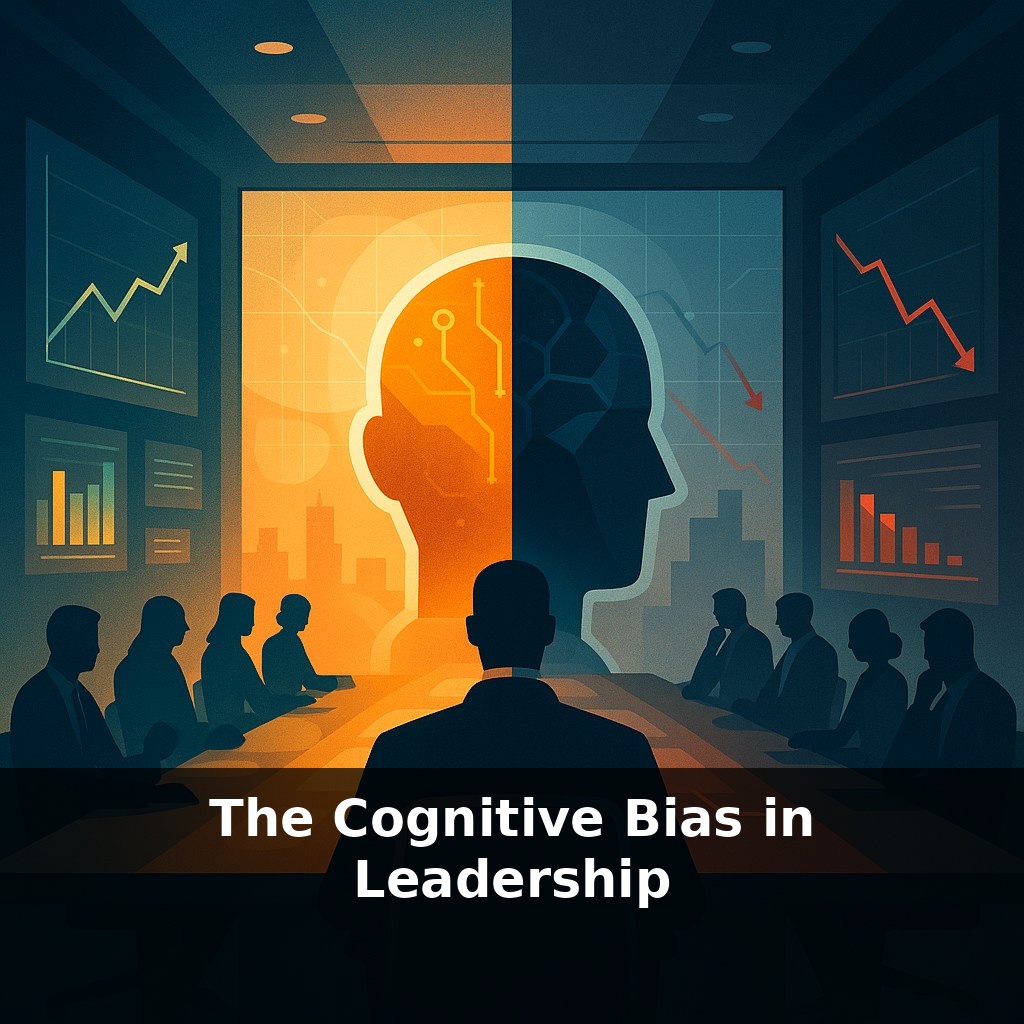
A global survey found most CEOs admit they’ve trusted their gut even when data disagreed. Now jump into a tense boardroom: two forecasts, one rosy, one bleak. Same numbers, same market—yet leaders split. Why do smart people see what they want, not what’s there?
That boardroom split isn’t about who’s smarter; it’s about how our brains quietly edit reality before it reaches our conscious mind. Leadership decisions feel deliberate, but much of the filtering happens on autopilot. Confirmation bias spotlights evidence that flatters our existing view. Availability bias lets the most vivid recent story shout over boring but crucial trends. Over-confidence shrinks our sense of risk just when stakes peak. Group dynamics then amplify these distortions, especially when status or speed is prized over dissent.
Think of a leadership team debating a major acquisition: one person can’t shake a recent success story, another is anchored to the price from an early pitch, a third stays silent to avoid looking “negative.” On paper, it’s strategy. In practice, it’s psychology driving billions in capital, careers, and culture.
Most leadership cultures unintentionally reward those hidden distortions. We praise “decisiveness” even when it’s just fast, untested instinct. We label careful challengers as “not on the bus.” Over time, the same voices speak first, the same stories are retold, and the same mental shortcuts become policy. Neuroscience adds another layer: our brains are wired to protect our status and sense of competence, so we literally feel discomfort when evidence undercuts our view. That’s why smart leaders can’t “willpower” their way out of bias; they need structures that make seeing clearly safer than being right.
Most leaders assume better decisions come from more information. Yet the research points somewhere else: the real performance gap comes from how deliberately you *handle* the information you already have.
McKinsey’s finding—that simply forcing teams to seriously challenge their first hypothesis can move EBIT by several percentage points—isn’t about slowing everything down with bureaucracy. It’s about building one disciplined pause into the decision rhythm: “What would have to be true for us to be *wrong*?” That single question shifts the brain from defending a position to testing it.
The PwC data showing CEOs admitting they’ve sidelined inconvenient evidence is the same pattern in action. Under pressure, intuition feels faster and safer than re-opening the case. Add Tali Sharot’s work on optimism: when the upside story lights up the reward circuits, the downside literally feels less “real,” even when it’s equally probable. Leaders don’t just *say* they’re optimistic; their nervous system is rewarding them for it.
This is why structural tools matter more than one-off bias workshops. A premortem, for example, isn’t just a clever exercise. It gives people sanctioned space to voice everything that could derail the plan, with the benefit of HBR’s observed drop in overruns. Red teams, devil’s advocate roles, and rotating “chief skeptic” duties serve a similar function: they convert what would normally be seen as criticism into an assigned responsibility.
Notice the leverage point here: none of these mechanisms require people to be less confident or less decisive. They ask leaders to separate *decision speed* from *option closure*. You can still move quickly, but only after you’ve intentionally opened a window where contradictory evidence and minority views are pulled in, not pushed out.
That’s also why the Deloitte finding on board training is so striking. If only a tiny fraction of the most powerful governance bodies are taught to recognize these mental traps, most organizations are steering with uncalibrated instruments. The upside for anyone who *does* install these practices is disproportionate: your competitors are still arguing about who’s right; you’re building a system that makes being wrong visible early, cheap, and correctable.
Consider a product leader weighing two launch options. On the surface, both look solid. But listen closely to the discussion: one idea gets more airtime because a senior sponsor loves it; the other quietly dies because its champion is less politically secure. No one names this as a bias problem—it just feels like “momentum.” In practice, the room is editing reality before it ever hits a spreadsheet.
You’ll see the same pattern when financial assumptions are treated as sacred. The first model built becomes the “baseline,” and every revision is framed as a deviation that must be justified. That’s anchoring disguised as rigor.
Here’s where a simple, tech-inspired habit helps: run “A/B tests” on your own judgment. Before a major decision, craft two distinct narratives—one where your preferred option fails, one where the alternative wins. Force your team to specify the signals that would support each. You’re not abandoning conviction; you’re pressure-testing it against concrete, observable markers instead of whoever argued most confidently.
Leaders who ignore bias will soon look as dated as executives who once dismissed cybersecurity. As AI starts flagging blind spots mid-meeting, the premium shifts from having answers to updating your thinking in public. Expect investors to probe *how* you reached a decision, not just *what* you chose. Careers will hinge on leaders who can say, “Here’s where my reasoning might be wrong,” and then adapt fast—turning intellectual humility into a visible, strategic asset.
Treat your mind like a constantly-updating operating system, not a fixed tool. Bias work isn’t self‑doubt; it’s performance tuning. As stakes scale, so does the cost of mental bugs. The leaders who’ll stay ahead are the ones who turn bias-spotting into a shared craft—debugging decisions together before reality does it for them.
Start with this tiny habit: When you’re about to approve a decision in a meeting, pause and quietly ask yourself, “Whose perspective is missing here?” and mentally name one specific person on your team who thinks differently from you. Then, before you move on, add one sentence out loud that starts with, “If I look at this from [that person’s name] point of view…” and finish it as best you can. This 10‑second check gently disrupts your confirmation bias and trains you to lead with broader input, even when you’re moving fast.
From this course
Leadership Psychology: Behind the Decision
8 episodesUnlock all episodes
Full access to 8 episodes and everything on OwlUp.
Subscribe — $1.99/monthLess than a coffee ☕ · Cancel anytime