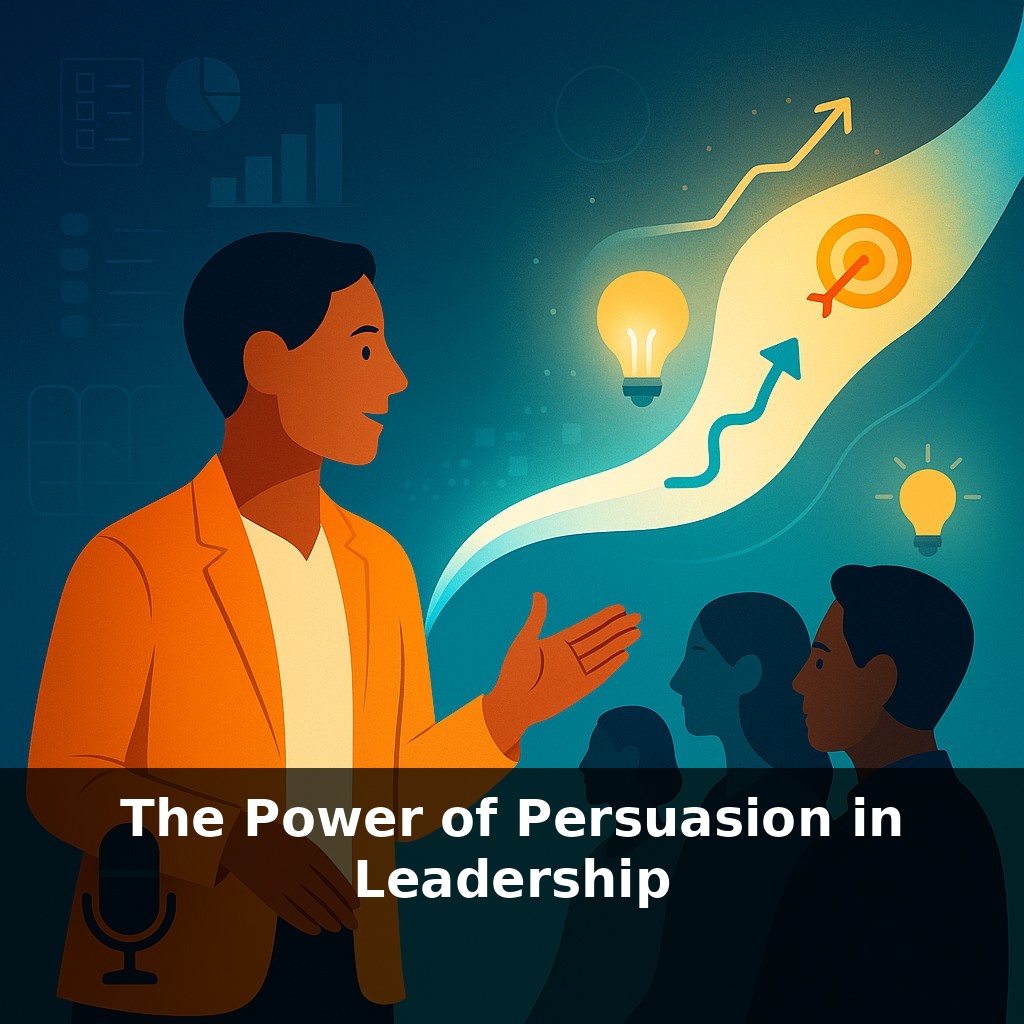
A Stanford survey found people remember story-based talks vastly more than data-dumps. Now place two leaders in the same room: one floods you with charts, the other tells a sharp, simple story. Same facts, different feeling—and one quietly rewires what you’re ready to do next.
A 2019 Gallup study found that when managers communicate a clear, compelling vision, their teams’ engagement jumps by 15 points. Yet most leaders still default to status updates and bullet lists, then wonder why no one seems energized. The gap isn’t information; it’s persuasion. Not the sleazy, arm-twisting kind, but the skill of lining up three forces at once: your credibility, your logic, and the emotional “click” that makes people care enough to move. Modern research adds something sharper: how social proof, timing, and even cognitive biases tilt decisions long before anyone “decides.” This is where leadership quietly becomes a performance multiplier. Used well, these tools help people see themselves inside the vision—and perform beyond their job description. Used poorly, they feel like a sales pitch, and your authority starts to leak.
Leadership persuasion really lives in the micro-moments: the way you phrase a decision, who speaks first in a meeting, how you react to the first objection. Neuroscience shows our brains lean on shortcuts—cognitive biases—to manage all this incoming information. That means people are constantly asking, often unconsciously: “Do I trust you?” “Do I see myself in this future?” “Is this the safest option?” High-impact leaders design their messages to answer those questions upfront. They don’t just state goals; they frame choices, sequence information, and use timing the way a skilled coder structures clean, efficient logic.
When you look under the hood of “persuasive” leadership, three patterns show up again and again: how leaders **sequence** ideas, how they **use emotion safely**, and how they **exploit or correct for biases** without crossing into manipulation.
Start with sequencing. Transformational leaders don’t begin with tasks; they begin with meaning, then move to method. In Judge & Piccolo’s meta-analysis, the 27 % performance lift isn’t magic charisma—it’s often the order in which they line up the case for change: why this matters, what’s at stake, then what to do. Poor persuaders invert that: they lead with instructions, sprinkle in a bit of rationale, and never quite answer “why now?” or “why me?”
Next, emotion. A lot of technically strong managers try to stay “neutral,” but the brain doesn’t. Neuroscience shows we tag information with feeling first, then justify it after. Ethical leaders don’t fake feelings; they surface real ones that already exist in the room—anxiety about disruption, pride in craft, frustration with waste—and connect them to a constructive outlet. Nadella’s “growth mindset” push at Microsoft worked partly because it gave language to something engineers already sensed: the old culture was punishing smart risks. Once that emotion had a name, revenue followed the behavior change.
Then there are cognitive biases. Confirmation bias means people filter new proposals through what they already believe about you. If they see you as “numbers-only,” even your most human-centered pitch will be heard as a cost-cutting move. Skilled persuaders preempt that by briefly acknowledging the stereotype, then violating it: “You know I usually start with the spreadsheet. Today I want to start with what this feels like for our customers.” That small pattern-break makes minds more receptive.
Framing risk is another lever. Loss aversion means people are twice as sensitive to losing something as to gaining it. Leaders can use this ethically by pairing opportunity with clear, realistic consequences of inaction—not horror stories, but specific missed benefits or competitive slippage.
Used like this, persuasion is less about “getting a yes” and more about **designing the conditions** where the most rational, energizing choice becomes the easiest one to make.
A product lead faces pushback on a new roadmap. Instead of repeating the slide deck, she quietly reshapes the conversation: first, she asks two respected engineers to share how recent customer calls changed their thinking. That’s not an accident; she’s activating peer voices before reintroducing her proposal. Then she reframes the choice from “Do we like this roadmap?” to “Which version of our next six months are we willing to own?” Suddenly, staying the same feels like an active decision, not the neutral default.
You can see the same mechanics in a different setting: a CFO arguing for a major systems upgrade doesn’t open with savings projections. He starts with a brief story of a near-miss audit, then lays out two clear paths on one page: the cost of action versus the compound cost of delay. Numbers haven’t changed, but the **structure** around them has—and that’s where quiet influence lives.
In the next decade, leaders may need “communication audits” the way companies now need financial ones. As AI helps tailor messages like a GPS constantly rerouting, followers will ask: *who programmed the destination?* Expect boards to probe how influence tools are used, not just whether targets are hit. The leaders who thrive will treat transparency logs, feedback loops, and consent like seatbelts—slightly inconvenient, but non‑negotiable for going fast without crashing.
Real influence grows when you treat every message as a prototype, not a verdict. The leaders who stand out test language like product features, notice where attention spikes or dies, then refine. Over time, your conversations become less like announcements and more like shared design sessions for the future you’re asking people to help build.
Before next week, ask yourself: Where in my current work (a specific project, stakeholder, or team member) am I relying on authority or job title instead of storytelling and shared values to persuade, and how could I reframe that conversation using a concrete story from our team’s recent wins or failures? Whose perspective or objections am I currently guessing about—could I schedule a 10-minute chat with that person this week to ask what truly matters to them and listen without defending my idea? In your next meeting, what is one decision you want to influence, and how can you prepare a clear “because” (the why), a vivid example, and one compelling question that invites others to co-own the idea instead of just agreeing to it?