The Dawn of Civilization: Why Cities Emerged
📝 Transcript
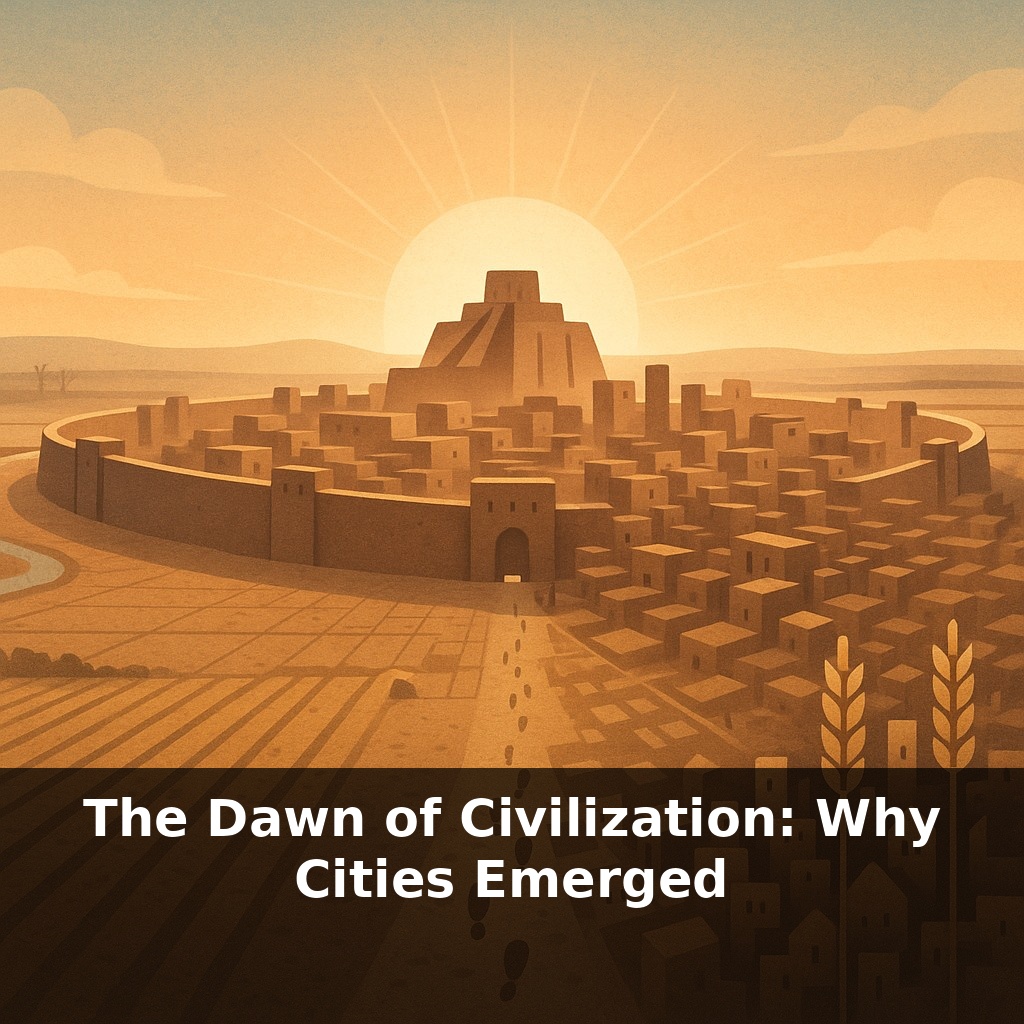
A wall once stretched nearly ten kilometers around the city of Uruk—yet no one had planned a “city” before it existed. People just kept staying. Keep listening as we drop into those first crowded streets and ask: why did humans choose cities over freedom to roam?
Grain was the first great city architect. Not stone, not kings—grain. Once people learned to coax harvests from the same plots year after year, they were effectively pouring concrete into their own footprints. Fields needed tending in every season; stored harvests demanded guards, counters, and planners. Think of a huge shared pantry: the more food in it, the more rules, labels, and arguments you need. Around those bulging pantries, something new crystallized. Specialists appeared—potters, weavers, metalworkers—people whose hands no longer spent every daylight hour in the soil. Long-distance traders followed, drawn to these dependable stocks of food like caravans to an all-night market. With them came ideas, tools, and stories, until some settlements began to hum at a different frequency—dense, busy, and impossible to manage without new kinds of power and organization.
Those early hubs didn’t just grow wider; they grew taller, stranger, more ambitious. In Uruk, a nine‑kilometer wall wrapped around temples and workshops, signaling not just defense but a shared identity worth enclosing. Far to the east, at Mohenjo‑Daro, planners carved streets into neat grids and built the Great Bath, an engineered basin that turned water into something public and ritualized. At Jericho, discarded seeds and animal bones reveal diets broad enough to support artisans, guards, and priests, all living close enough that conflict and cooperation became daily negotiations.
If fields and storehouses were the skeleton of early urban life, what we see next are the nerves and heartbeat forming: who controls the surplus, how it moves, and how you prove what belongs to whom.
One clue lies in those first clay tablets from Uruk that list rations. They’re not just lists; they’re evidence that someone was counting on a scale too big for memory or gossip. Once you track grain, labor days, or livestock in marks that outlast a conversation, you can coordinate hundreds or thousands of people who never meet. That shift quietly forges a new kind of power: authority backed not only by muscle or charisma, but by records. Written signs turn promises into obligations and favors into taxes.
A second clue comes from trade routes that stitched distant landscapes together. Copper from Oman, lapis lazuli from Afghanistan, timber from Lebanon—none of these lie beside the fields of southern Mesopotamia. Yet they show up in temples and elite houses. That means caravans, porters, dockworkers, translators, and guards, all depending on the city as marketplace and broker. Each successful journey encourages the next, thickening those routes until they resemble arteries pulsing with materials and news.
Religion and ritual also scale up. In many early centers, the tallest buildings are not palaces but platforms and shrines. When hundreds gather at predictable times for ceremonies, leaders can speak to a crowd, display wealth, and stage cooperation: building a ziggurat stair by stair or repairing a canal becomes a sacred duty rather than a negotiated chore.
Defense pushes in from the outside. Surplus and valuables attract raiders; neighbors watching one settlement grow rich may decide to test its walls. Fortifications, garrisons, and alliances are expensive, but they’re easier to maintain when people and resources are concentrated. Over time, those pressures discourage scattering into smaller hamlets and reward staying inside the ring of protection.
Taken together, these forces—accounting, exchange, ritual, and conflict—don’t make cities inevitable, but they do make them sticky. Once they coalesce, walking away means not just leaving a house; it means stepping out of a dense web of opportunities, obligations, and protections that only exist at that scale.
In those early neighborhoods, daily life quietly rewired how people thought about time, risk, and obligation. A weaver in Uruk no longer measured seasons only by floods but by delivery deadlines etched on tablets. A porter knew that missing a shipment didn’t just anger a client; it left a permanent mark in clay that others could later point to. At Mohenjo‑Daro, shared facilities demanded schedules—who cleaned, who guarded, who went first—nudging households to accept rules set beyond their own doorway. Diets widened too, and with them, vulnerabilities: more mouths reliant on bread from one kiln, water from one well, security from one gate. The benefits of dense living came with new failure points. Yet people stayed because the network paid off. Ideas spread faster along those streets: a better plow design, a new healing herb, a fresh myth. One innovation could ripple through thousands of lives in a single generation, making the crowded experiment worth its daily frictions.
Dense living doesn’t just stack people; it stacks risks and solutions. When floods, heatwaves, or pandemics hit, an interconnected street grid can spread damage fast—yet it also lets responses move like a well‑tuned kitchen line, from prep to plate in seconds. Future megacities may borrow from modular ancient neighborhoods: micro‑grids for power, pocket wetlands for flood control, rooftop farms for food. The challenge is turning shared vulnerability into shared insurance instead of fertile ground for inequality.
We’re heirs to that first decision to cluster around stored harvests, still testing how tightly we can pack lives together. As towers rise and data replaces tablets, the old question returns in sharper form: how much coordination feels like support, and when does it tip into control? The next chapters of urban life depend on where we draw that shifting line.
Try this experiment: for one day, turn your home or neighborhood into a “proto-city” lab by assigning each room or nearby spot a specific ancient-city role—storage (granary), ritual (shrine), trade (market corner), and governance (decision spot). As you move through the day, only “trade” objects, favors, or info in your designated market spot, only make shared decisions in your “council” space, and keep all shared resources (snacks, tools, chargers) in your “granary.” Notice how simply concentrating functions in specific places changes who you interact with, how often you move, and what informal “rules” start to emerge. In the evening, walk through your improvised “city” and see which spots feel central, sacred, or powerful—then compare that to how ancient cities used temples, markets, and storage to shape daily life.
From this course
Lost Civilizations: The Great Societies Before Rome
7 episodesUnlock all episodes
Full access to 7 episodes and everything on OwlUp.
Subscribe — $1.99/monthLess than a coffee ☕ · Cancel anytime