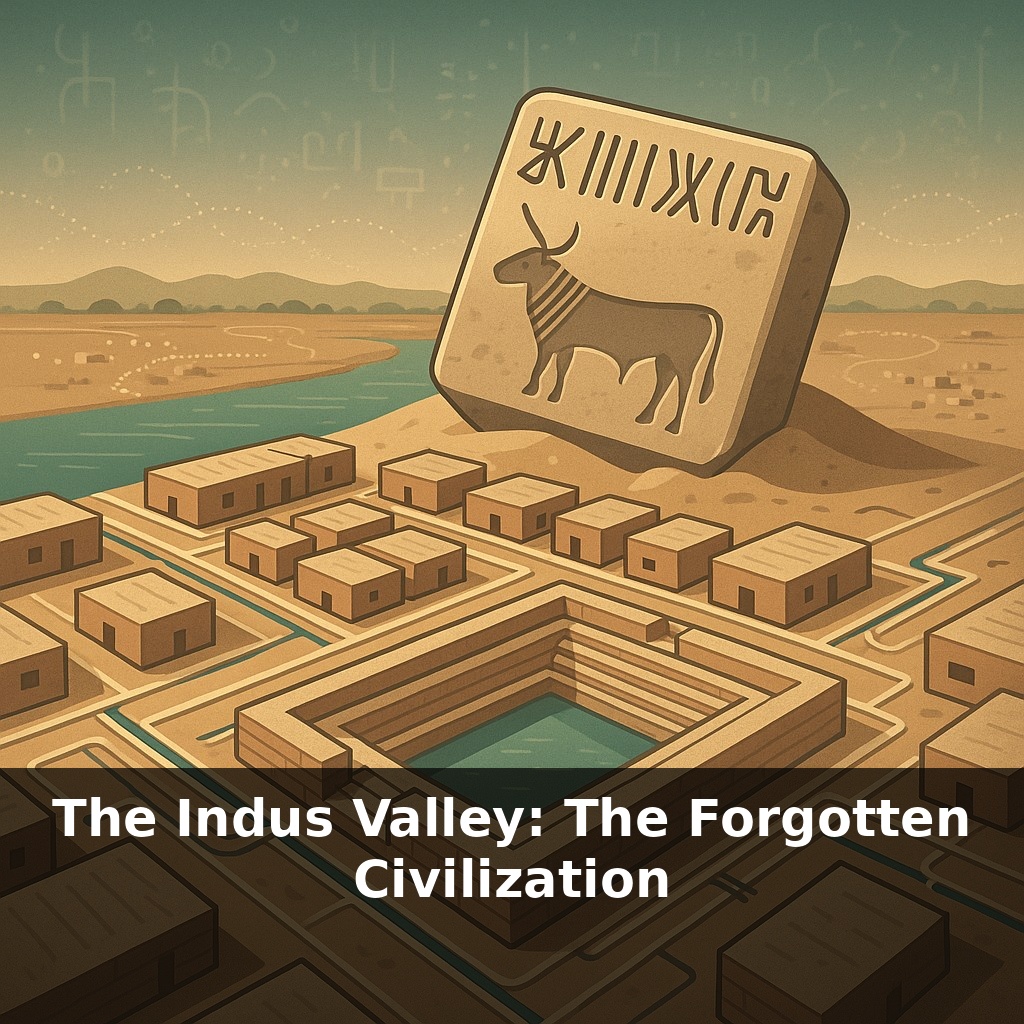
A civilization larger than ancient Egypt and Mesopotamia quietly rises, then disappears—leaving behind spotless streets, advanced plumbing, and thousands of mysterious symbols no one can read. No recorded kings. No epic wars. Just a question: how do you lose a world that organized?
At its height, the Indus world may have held more than a million people, scattered across a thousand settlements linked by trade routes that reached from Oman’s copper to Mesopotamia’s cities. Yet we don’t find towering pharaoh statues or victory steles boasting of conquered lands. Power here seems quieter, embedded in habits: the same brick proportions used across a region twice the size of modern Germany, streets aligned to cardinal directions, and storage areas that hint at careful control of grain and goods.
Archaeologists keep turning up clues: a tidal dockyard at Lothal on India’s western coast, standardized weights turning up hundreds of kilometers apart, traces of long-distance trade in beads and shells. It’s like opening a well-organized kitchen drawer—everything in its place—but with the recipe book missing. So we’re left to reverse‑engineer how such order was maintained, and why it eventually unraveled.
When the first rail lines cut across Punjab in the 19th century, British engineers casually used bricks from a “mound” near Harappa as track ballast—unknowingly stripping one of humanity’s great cities for spare parts. Only later did scholars realize those bricks belonged to a civilization already ancient when the pyramids were young. Since then, excavations from coastal Gujarat to the plains of Haryana have sketched a network of cities and villages whose shared styles in pottery, beads, and house layouts hint at common ideas moving even where written voices are silent. The puzzle now is to read that unity without a key.
Stand in the middle of Mohenjo-daro’s “lower town,” and what strikes you first isn’t a palace or a temple—it’s the absence of anything that screams, “Here is the ruler.” Streets meet at right angles, houses cluster in blocks, some with private wells and bathing areas, but the usual markers of a command‑and‑control elite are curiously muted. There are larger buildings, yes—granary‑like halls, raised platforms—but nothing like a ziggurat or pyramid dominating the skyline.
This has led some archaeologists to float a radical possibility: that the Indus may have been governed less by god‑kings and more by committees, councils, or mercantile groups. Urban investment seems directed toward things everyone uses—drainage, streets, wells—rather than ostentatious tombs. It’s as if status was expressed in access to cleanliness, good location, and quality craftsmanship instead of colossal monuments.
Inside houses, standardized layouts hide small variations: an extra room here, a better-built staircase there. Artifacts echo this blend of order and individuality. Indus seals repeat certain motifs—unicorn‑like animals, ritual scenes—yet artisans played with horn shapes, ornaments, and script placement. Jewelry workshops turned out carnelian beads and gold ornaments, but many finds are modest, suggesting adornment wasn’t reserved for a tiny elite.
Religious life is equally elusive. We get hints: terracotta figurines (some interpreted, cautiously, as fertility symbols), trees and animals placed in what look like sacred scenes, the famous “proto‑Shiva” seal that some link to later Indian traditions. But there’s no unequivocal temple complex. Ritual may have been woven into courtyards, platforms, water spaces—more integrated into daily life than cordoned off in towering sanctuaries.
Then there’s their reach. Mesopotamian texts mention “Meluhha,” likely the Indus region, sending timber, ivory, beads, and perhaps cotton—the earliest in the world. Indus‑style seals and beads show up far from their home cities, while foreign materials appear in Indus workshops. The civilization looks less like an isolated kingdom and more like a mesh of production hubs feeding into ocean‑ and river‑based exchange.
Yet by around 1900 BCE, that mesh frays. Major cities shrink or are abandoned; new, smaller settlements appear in different patterns. Climate data hints at a weakening monsoon and shifting rivers, including the gradual drying of the Ghaggar‑Hakra system some link to the “Saraswati” of later texts. Without a deciphered script or conquest inscriptions, we see not a single catastrophe but a slow, uneven reorganization of life: craft traditions continue, some symbols persist, people move. The cities fade; the culture doesn’t vanish so much as dissolve into new forms we are only beginning to trace.
Archaeologists piece this world together the way a doctor reconstructs a patient’s history from scattered test results: no single scan gives the story, but patterns across data do. In village sites far from big cities, for instance, we find the same bead‑making debris and shell‑working tools, suggesting cottage industries feeding wider networks. At Dholavira in today’s Kutch, massive water reservoirs hint at local responses to a harsh, variable climate—stone‑lined tanks catching every drop. Coastal sites yield fish bones and marine shells, while inland granaries point to surplus grain; mapped together, they sketch complementary economies rather than copy‑paste cities.
We also see regional “dialects” of style: Gujarat sites favor certain pottery paints; northern settlements tweak house layouts to suit colder winters. Even after major urban centers contract, some of these craft styles and symbols linger in later village cultures, like faint accents surviving long after an empire falls silent. The question isn’t just how such a system collapsed, but how its habits quietly shaped the societies that followed.
If the script yields even a few full sentences, South Asian history could be rearranged like a map turned right‑side up: names, titles, perhaps even jokes or contracts might surface. Genomics may further unsettle tidy origin stories, revealing layered ancestries rather than a single “founding” population. Urbanists already mine Indus layouts for clues to low‑energy cooling and flood‑tolerant streets, much as chefs borrow old techniques—fermentation, slow cooking—to solve modern food problems sustainably.
Your challenge this week: the next time you walk through your neighborhood, treat it like a future archaeologist would. Note three small design choices—gutter placement, window styles, corner shops—that silently steer how people move, meet, or avoid each other. Ask yourself: if all our texts vanished, what story would those details tell about who held influence and what we valued most?
In the end, the Indus story stays half-shadow, half-outline: farmers adjusting to fickle rivers, artisans tuning their crafts like musicians to a shared but unwritten scale. As climate, water, and movement reshaped their world, their choices left quiet fingerprints in later village plans and rituals—subtle as spice in a dish whose original recipe is long forgotten.
Before next week, ask yourself: 1) If I walked through Mohenjo-daro or Harappa for a day, what would I *actually see, hear, and smell* in the streets, homes, and marketplaces—and what does that imagined everyday life reveal about what I value in my own city today? 2) Looking at how the Indus people standardized weights, bricks, and city planning, where in my own work or home life could I experiment with a similar kind of quiet, behind-the-scenes organization that makes things flow more smoothly for everyone? 3) Since their script is still undeciphered, what is *one* part of my own story, culture, or family history that I’ve never really “decoded,” and what concrete step can I take this week—like talking to an older relative or revisiting a forgotten place—to start uncovering it?