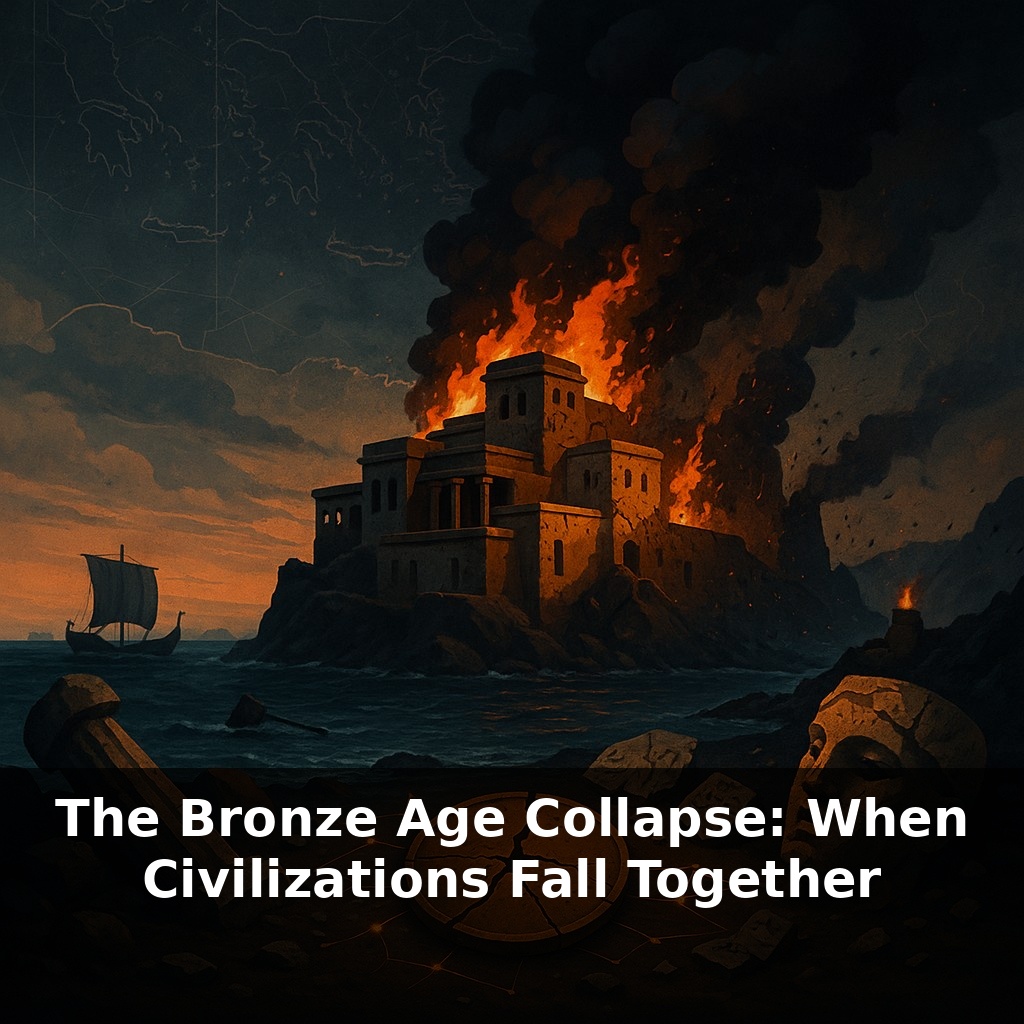
Flames rise over a coastal palace. In less than a human lifetime, dozens of proud cities across the eastern Mediterranean go silent. No single villain, no single war. Here’s the puzzle: how does an entire connected world fall apart almost at once—and stay broken for centuries?
In the Late Bronze Age, power didn’t just mean armies and gold—it meant access. Copper from Cyprus, tin from Central Asia, grain from Egypt, timber from Lebanon: each elite palace was plugged into a vast web of specialists, sailors, and scribes who kept goods and information flowing. When one kingdom faltered, others could usually step in. But this time, the safety net failed. Letters from desperate kings beg for grain and military aid that never arrives. Trade ports fall silent. Professional scribes stop copying tablets. Even writing systems vanish in some regions for centuries. This isn’t just a story of thrones toppling; it’s a story of ordinary people suddenly cut off from the networks that fed and protected them, forced to improvise or disappear as the old order crumbled around them.
Across this landscape, the first visible cracks aren’t epic battles but small distortions in everyday life. Clay tablets hint at delayed shipments, short rations, kings apologizing for sending “too little” grain. Archaeology adds texture: storage jars refilled with cheaper contents, imported luxury goods replaced by local knockoffs, fortifications hurriedly thickened like a hastily patched wall before a storm. Climate data from ancient pollen and seafloor cores shows drying trends turning fertile zones brittle. Local crises pile up, turning resilience into strain, then into a slow, uneven unravelling that only later looks like “collapse.”
Start with the survivors, not the ruins. In Egypt, Ramesses III still carves triumphs on temple walls, but behind the bombast his scribes record something new: foreign mercenaries on the payroll, grain shortages, workers at Deir el-Medina striking because their rations haven’t arrived. Power narrows. The state that once shipped food abroad struggles to feed its own specialists.
North along the Levantine coast, cities like Ugarit leave us a different kind of evidence: panic in real time. Tablets from the final years pile up unfinished in the palace—letters begging for ships, copper, and troops; legal disputes never resolved; cargo lists for fleets that may never have sailed. Then a burn layer, collapsed roofs, and silence. No one comes back to reoccupy the palace; the administrative center simply ceases to function.
Further inland, the Hittite capital Hattusa shows a staggered retreat. Archives are cleared out, gates dismantled from the inside, key buildings deliberately abandoned before the final destruction. That suggests not just invasion, but decisions—leaders choosing which core territories to defend, which to let go. Secondary cities in Anatolia show similar patterns: some violently destroyed, others slowly thinned out, as if the state’s nervous system were shutting down its extremities to keep the heart going—and failing.
Meanwhile, on the Greek mainland, Mycenaean palaces burn, yet pottery styles, burial customs, and village layouts continue with tweaks rather than total breaks. Big centralized storerooms disappear, replaced by smaller household facilities. Power diffuses from a few great halls to many modest farms and hamlets. It’s less an overnight apocalypse than a long, grinding reorganisation of who controls surplus and security.
Weapons, too, tell a story. Hoards and burials begin to feature more iron alongside bronze, and new kinds of swords and javelins optimized for slashing and mobility appear in the record. Chariot warfare—expensive, elite, and infrastructure-heavy—gives way to more flexible infantry tactics. States that had invested heavily in chariot corps and highly trained specialists now face opponents who can arm and field fighters more cheaply.
The so‑called Sea Peoples enter here not as a single invading nation, but as a symptom of this volatility: groups on the move by land and sea, sometimes raiders, sometimes refugees, sometimes new recruits in foreign armies. Egyptian reliefs show ox-carts, women, and children amid the warriors. These aren’t just enemies at the gate; they’re fragments of a broken order searching for somewhere—anywhere—still stable enough to absorb them.
Across the region, you can trace a similar pivot: from palatial economies to smaller, more local systems; from long-distance luxuries to nearby resources; from rigid hierarchies to more fragmented, sometimes more egalitarian, village landscapes. Not every shift was catastrophic for everyone. For some rural communities, the fading of palace demands may even have felt like a loosening of a grip.
Yet the loss of that overarching framework had lasting costs. Diplomatic archives vanish, monumental building slows or stops, and for many regions, historical “voices” go quiet. What we call the Bronze Age Collapse is less a single fall than a drawn-out, uneven transition—one that closed a chapter of connectivity so thoroughly that, centuries later, new kingdoms would rise on the same shores with little memory of the intricate world that had once bound them together.
Think of how a hospital functions under normal strain versus during a cascading emergency. In routine times, triage is calm, specialists are available, equipment circulates, and the pharmacy is stocked. But stack a power outage on top of an influx of patients, a supply truck that never arrives, and key staff stuck off‑site, and medicine shifts from precision to improvisation. That’s close to what we detect in the Late Bronze Age when we zoom in on specific places.
On Cyprus, for example, some coastal centers show hurried metalworking before destruction, as if artisans were racing to turn stockpiled copper into usable tools or weapons. In inland Syria, rural sites start to produce their own coarse pottery instead of relying on imported fine wares, hinting at workshops refocusing on “good enough” basics. In parts of Greece, new hilltop refuges appear, suggesting communities rethinking where to live and how to watch the horizon. These aren’t just ruins; they’re snapshots of people under mounting pressure, reorganizing daily routines in ways that still ghost through the archaeological record.
Today’s researchers probe this collapse with tools those kingdoms never imagined: DNA from ancient skeletons tracing migrations, climate models testing which shifts could topple harvests, even network simulations stress‑testing trade like a chef removing ingredients from a recipe to see when the dish fails. Your challenge this week: spot one modern system that feels similarly over‑connected—and list three ways to make it less brittle.
In the centuries after, new peoples stitched fresh maps over the wreckage: Phoenician traders probing wider seas, early Israelites settling inland highlands, Greek communities experimenting with assemblies and alphabet. Like a forest after wildfire, unfamiliar growth filled every gap. The old canopy never returned, but its ashes fed the soil for the next age.
Start with this tiny habit: When you finish a meal, glance at one object in your home (like your phone charger, a favorite mug, or a notebook) and quietly ask yourself, “What would happen if this suddenly disappeared for a year, like tin or trade routes in the Bronze Age?” Then take 10 seconds to imagine how that loss would ripple through your day—who you’d depend on instead, what you’d have to change, or how you’d adapt. This tiny mental drill trains you to spot hidden dependencies in your own life the way historians trace fragile links between Mycenaeans, Egyptians, and Hittites.