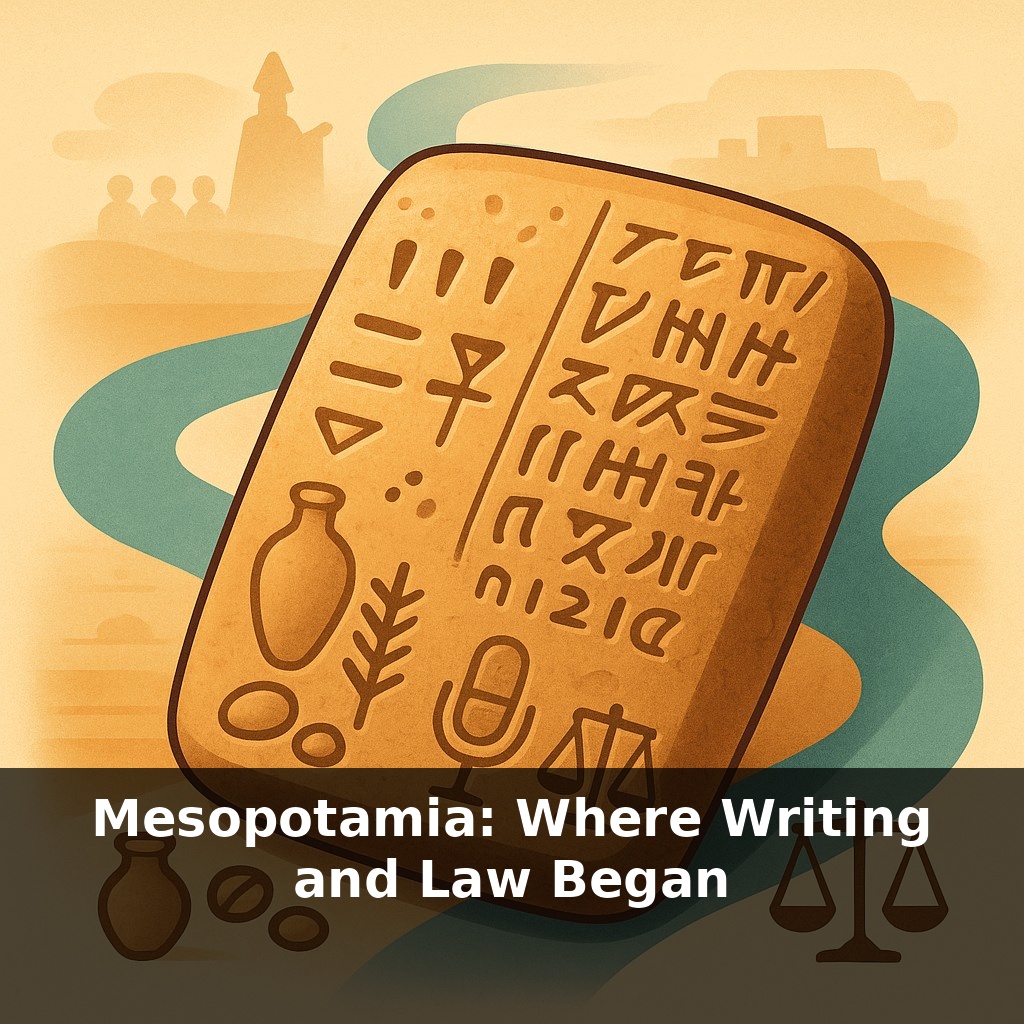
A world-changing technology began as a way to track beer rations. In the mud between the Tigris and Euphrates, a few careful marks on wet clay slowly turned into full sentences, laws, and stories. Stay with this, because those tiny wedges still shape how your life is organized today.
The twist is that once those clay marks existed, people quickly realized they could do much more than count things. Rulers could broadcast commands without standing in the marketplace. Merchants could strike deals with partners they might never meet. Priests could schedule rituals years in advance, timing offerings like a farmer plans the seasons. And eventually, kings could carve rules into stone so that justice didn’t depend only on who had the loudest voice. In Mesopotamia, power began shifting from memory and gossip to whatever was pressed into clay. That shift turned arguments into “cases,” debts into contracts, and customs into laws. It’s here that we see the first real struggle over a question we still argue about: who controls the words that control everyone else?
Soon, whole careers formed around those tablets. Young apprentices sat in edubba schools, copying signs until their hands cramped, much like medical interns drilling the same procedure until it became automatic. After more than a decade, a few emerged as full scribes—the human interface between spoken orders and written records. Their work covered everything from temple inventories to boundary disputes. And in this world of specialists, someone had to decide which words were merely notes…and which were powerful enough to be carved in stone as law.
Scribes didn’t just copy whatever crossed their desks. They learned to rank information. Daily notations on rations or land parcels might live on a small tablet for a season and then be recycled—soaked, kneaded, reused. But some texts were promoted. Legal decisions that resolved tricky disputes, standard weights and measures, or royal decrees that changed taxes could be recopied into more durable formats and stored in temple or palace archives. A few, like Hammurabi’s laws, went further still: they were carved into stone, turned outward toward the public, and placed in plazas where anyone literate—or with a literate ally—could consult them.
This created layers of permanence. At the bottom were quick notes; at the top, effectively, were “immortal” rules. That hierarchy forced a new question: what deserves to last? In practice, the answer often came from whoever controlled the biggest building. Temples, with their storerooms and staff, became early data centers. Palaces followed, keeping parallel archives. When archaeologists dig in Mesopotamia today, they sometimes find rival tablet collections less than a walk apart, preserving two versions of what mattered.
The content of those surviving tablets shows how wide the scribes’ reach became. There are contracts for adoption and divorce, lists of temple singers’ duties, letters from governors complaining about shortages, even complaints about poor-quality copper. Law, in this setting, was less a single book and more a living conversation between kings, judges, merchants, and priests, all filtered through the stylus of trained writers.
By Hammurabi’s time, that conversation gained a new frame: divine endorsement. His stele doesn’t just list penalties; it begins and ends by stressing that the sun-god of justice has entrusted him with making the weak secure against the strong. The claim is political, but it also stabilizes expectations. If the rules are presented as more than one man’s whim, officials in distant towns can apply them with greater confidence, and subjects can appeal to something above a local boss’s temper.
Your challenge this week: notice every time you sign, accept, or click through a rule you didn’t personally write—from a workplace policy to an app’s terms. For each one, ask yourself four questions: Who wrote this? Who benefits most if it’s enforced? Who decides when to enforce it—and when to ignore it? And finally: where is it stored so that, if challenged, someone can say, “It’s written down; here are the terms”?
In one Mesopotamian city, archaeologists uncovered a room where fallen shelves left thousands of tablets strewn across the floor—letters, court decisions, grain tallies all jumbled together. It looks less like a solemn archive and more like the aftermath of a crashed inbox. Some tablets are countersigned by witnesses whose names never appear again, the ancient equivalent of cc’ing colleagues so no one can later deny agreeing. Others carry seal impressions, tiny images pressed into clay, functioning like secure logins that proved which official authorized a shipment or verdict.
Occasionally, we glimpse pushback. A governor might write to the king protesting a previous ruling, carefully citing earlier decisions to strengthen his case. That move—leveraging old texts to challenge new power—turns writing from a tool of control into a tool of negotiation. Over centuries, cities compiled model contracts and sample verdicts so judges-in-training could rehearse tricky situations, much like a chef practicing classic recipes before improvising. The goal wasn’t rigid uniformity; it was to make surprise less dangerous.
In the next few decades, nearly every known tablet may sit online as a zoomable, searchable object, its faint wedges sharpened by algorithms that never tire. Scholars could “ping” thousands of contracts at once to trace how risk, trust, and punishment shifted when harvests failed or wars loomed. That same pattern-hunting might reshape today’s systems: if we can see when rigid rules once snapped societies, we can stress‑test our own codes before crisis does it for us.
Those tablets also carried lullabies, jokes, and school exercises—scribbles where trainees practiced signs the way musicians rehearse scales. Law and ledgers shared space with daydreams and mistakes. That mix is our real inheritance: not just how to organize people, but how to leave traces of what they feared, hoped for, and taught their children.
To go deeper, here are 3 next steps: (1) Pull up the Cuneiform Digital Library Initiative (cdli.ucla.edu) and zoom in on a few actual clay tablets—try comparing an early accounting tablet with a later legal text like the Code of Hammurabi to see how writing evolved from bookkeeping to law. (2) Read the Epic of Gilgamesh in a modern, accessible translation (e.g., Stephen Mitchell’s) and jot a quick comparison of how its ideas about kingship and justice line up with the laws discussed in the episode. (3) Open Google Earth or an online map, locate Uruk, Ur, and Babylon, and layer this with a short video lecture from the free Yale Open Courses “Introduction to the Ancient Near East” to visualize how these city-states became the backdrop for the birth of writing and legal codes.