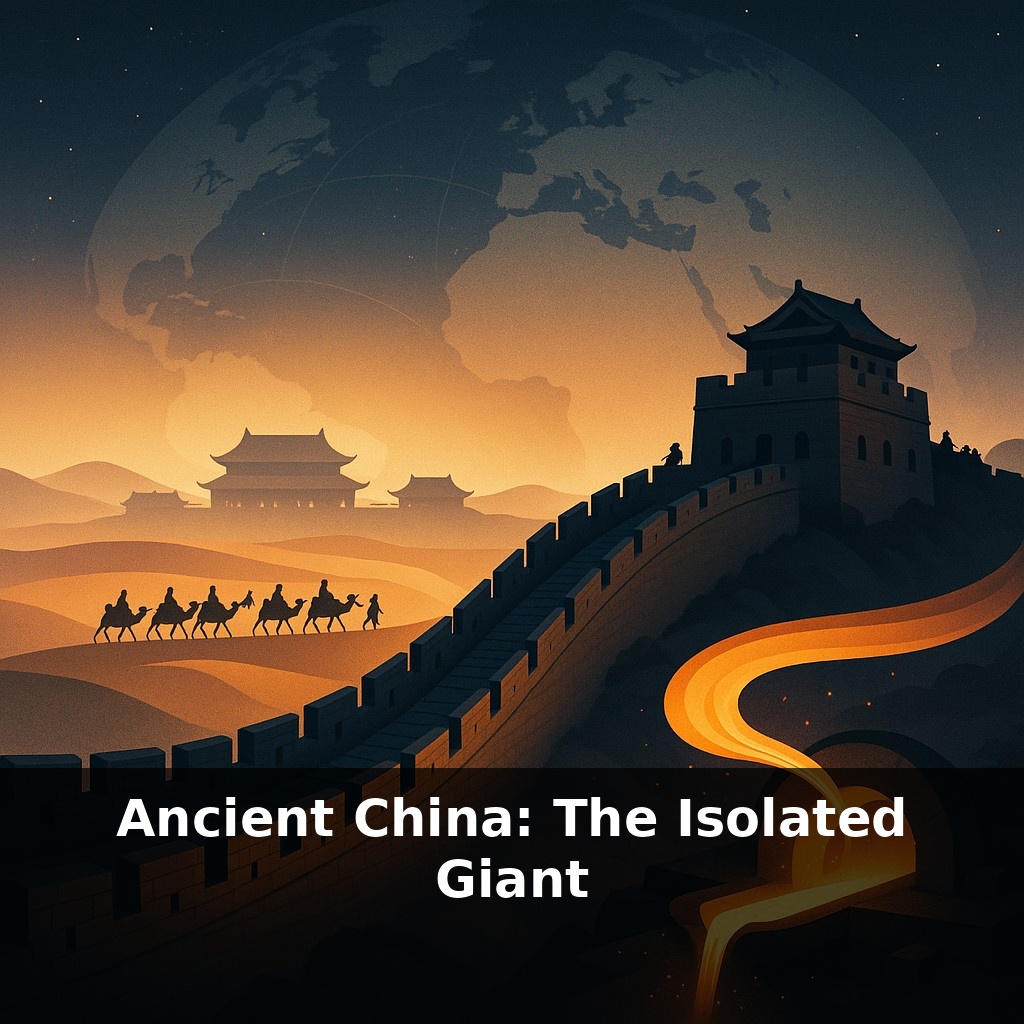
A single empire, on one side of the world, once forged about three‑quarters of the planet’s iron—without regularly meeting the people who wore its silk or used its inventions. In this episode, we step into that paradox: a civilization both shut in and quietly shaping the globe.
The numbers alone feel unreal: a defensive system stretching over twenty‑one thousand kilometers, caravans crossing months of desert to swap silk for glass, and a capital city where officials logged the comings and goings of visitors from dozens of foreign lands. Yet for most farmers tilling the soil along the Yellow and Yangtze Rivers, the outside world was as distant as the moon. Mountains, deserts, and ocean didn’t just mark the edge of a map; they shaped what people could eat, whom they could marry, even which stories they heard at night. Still, those same barriers funneled movement into a few narrow corridors. Like storm drains in a paved city, they concentrated the flow of traders, diplomats, and ideas into specific routes—the Great Wall frontier, the Silk Roads, the great ports—where China quietly rewrote the rules of global exchange.
To understand how this isolation worked, zoom in from the map to daily life. A peasant in the Yellow River plain might never travel farther than a day’s walk from home, yet his taxes could help fund expeditions pushing deep into Central Asia. Court edicts dispatched from Chang’an or Luoyang rippled outward like a stone dropped in a pond, reaching villages that had never seen a foreigner. Meanwhile, caravans arriving at distant border markets carried not just goods but stories—rumors of Roman glass, Indian astronomers, or Arab sailors—that filtered slowly inward, reshaping China’s sense of the wider world.
Stand on a ridge in northern China in, say, 200 BCE, and the pattern snaps into focus. To the south and east: dense cropland, walled towns, and a bureaucratic web reaching from village elders to the emperor’s scribes. To the north and west: steppe and desert, territories of mobile horse‑riders who could raid, trade, or vanish. Geography squeezed interaction into a narrow band between these worlds. That liminal zone forced Chinese rulers to innovate, not just with earthworks and watchtowers, but with policy.
One response was to professionalize knowledge. Instead of power flowing only through aristocratic birth, key posts increasingly depended on mastery of texts. Over centuries this hardened into written examinations, an early version of “pass the test, get the job.” In a land where travel was slow and dialects varied wildly, shared characters and canonical books became glue. A scholar from the south and one from the north might speak differently, but they could both parse the same line from the “Analects” or annotate the same law.
Another response was technological. Heavy plows and iron tools made the loess soils of the north extraordinarily productive, while hydraulic engineering turned the Yangtze basin into a rice powerhouse. Linking these zones demanded massive canal projects, knitting rivers into an inland shipping network. Grain could move hundreds of kilometers by boat more cheaply than a few days by cart, feeding armies on distant frontiers and swelling the markets of inland capitals.
Yet the supposedly “far away” world kept seeping in along the seams. Buddhism arrived via Central Asian oases, translated by teams of foreign monks and local literati in bustling monasteries. Later, Islam and Nestorian Christianity left inscriptions and stele in Chinese cities. Foreign styles of music, polo, and new fashions filtered into elite culture, while Chinese silks, lacquerware, and even paper traveled outward.
If China’s terrain was the locked door, these routes were the keyhole: narrow, controlled, but enough for light—and occasionally fire—to pass through.
Think of China’s heartland less as a sealed vault and more as a kitchen with very limited doorways. Inside, cooks controlled the menu, but once in a while a trader slipped in with a new spice that permanently changed the house recipe. Paper is a clear case: Cai Lun’s refinements made it so cheap that local officials could suddenly keep routine tax lists, land deeds, even complaint records on durable sheets instead of bulky bamboo. That bureaucratic “paper trail” outlived the people who wrote it, anchoring property rights and court precedent. Far away, when the technique finally filtered to the Islamic world and then Europe, it collided with alphabetic scripts and, much later, printing presses, turbocharging literacy there too. The compass followed a similar path in reverse: first a tool for Chinese geomancers, then for coastal pilots edging along familiar shores, and only gradually a device that let sailors trust an invisible north on open seas, stitching together oceans that most Chinese farmers would never see.
China’s old habit of guarding frontiers while guiding select exchanges echoes today in its stance on rare earths, sea lanes, and data cables. Like a chef choosing which ingredients leave the kitchen, it may export AI tools or batteries while ring‑fencing core algorithms and grids. Preserving caravan towns and ports as joint heritage sites could soften rivalries: shared digs, shared stories. Exam‑driven talent filters, once literary, now shape coding bootcamps and civil‑service hiring from Seoul to Singapore.
Today’s borders of China barely trace the shifting seams of those early states, yet their habits linger like old paths under new pavement. The same river valleys now host megacities; fiber‑optic “caravans” rush data where camels once trudged. And the question endures: when do high walls preserve a culture, and when do they stunt what it might become?
Here’s your challenge this week: choose one ancient Chinese geographic barrier (like the Himalayas, the Gobi Desert, or the Pacific coast) and deliberately “remove” it in a short, alternate-history scenario you create—no more than 300 words. Then, based on that change, map out exactly three concrete ripple effects on Chinese development: one political (e.g., different dynastic power balance), one economic (e.g., new trade routes or resources), and one cultural (e.g., different religious or philosophical exchanges). By the end of the week, share your scenario with one other person and ask them which of your three ripple effects feels most believable—and which feels least believable—and tweak your scenario based on their feedback.