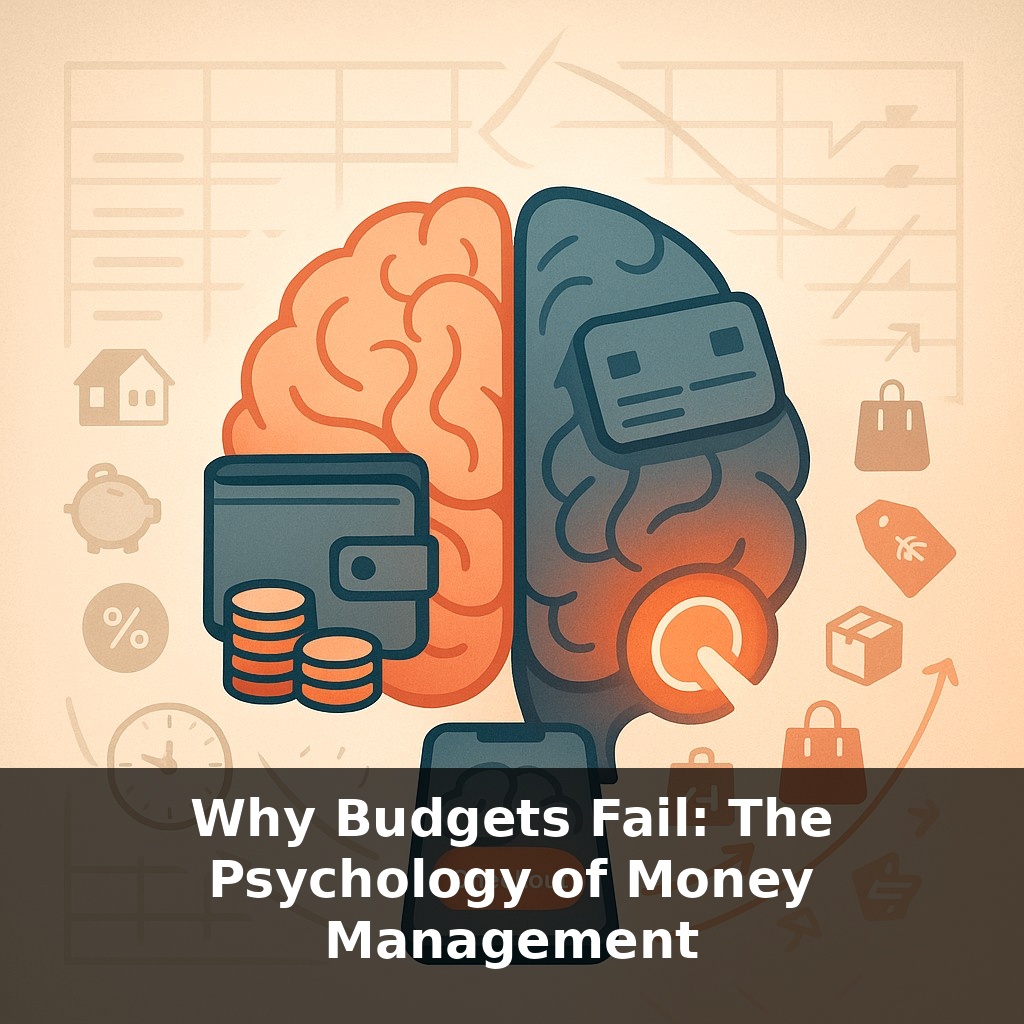
Why Budgets Fail: The Psychology of Money Management
📝 Transcript
Your budget isn’t failing because you’re bad with money; it’s failing because your brain is doing exactly what it was designed to do. One moment you swear you’ll save for the future, the next you’re tapping “confirm purchase” on something you didn’t plan. Why does that keep winning?
Most money plans are built like spreadsheets, but your daily life runs on habits, emotions, and shortcuts. That mismatch is why a “perfect” plan on Sunday night can be wrecked by Thursday afternoon. The problem isn’t the $200 you meant to save; it’s the $27 takeout here, the $14 ride share there, the $39 “limited-time” sale that sneaks in through your phone.
Researchers find we misjudge these decisions constantly: in one study of 6,000 Mint users, 80% lowballed irregular yearly costs—things like car repairs or subscriptions—by more than 30%. That’s how a budget that *should* work on paper collapses in real life.
In this episode, we’ll break down the specific psychological traps that quietly drain your money—and then turn those same tendencies into tools that make your budget easier to follow, not harder.
Psychologists can actually measure how skewed our money choices are. Present bias, for instance, can make $100 today *feel* as valuable as $150 a year from now—Laibson’s work suggests we can discount future rewards by up to 50%. Layer on loss aversion: Kahneman and Tversky found we feel a $50 loss roughly twice as intensely as a $50 gain. Put those together and you get a pattern: skipping a $60 dinner “hurts” far more than adding $60 to savings “feels good,” even if you’re carrying $3,000 in credit card debt at 24% interest. Your budget keeps colliding with that emotional math.
Mental accounting is the next quiet saboteur. You don’t see “money”; you see separate buckets: “rent,” “groceries,” “fun,” “bonus,” “tax refund.” That can help—until those categories trick you. Someone might be strict about a $500 “fun” limit, but treat a $1,200 tax refund like “free money” and blow $800 of it in a weekend. Same dollars, different mental labels, totally different behavior.
This is why people can carry $4,000 on a credit card at 20% interest while letting $3,000 sit in a checking account “for peace of mind.” Mathematically, paying $2,000 to the card and keeping $1,000 in cash is better in almost every case. Psychologically, though, that big round checking number feels safer, so the debt lingers and costs about $800 a year in interest.
Willpower fatigue adds another layer. At 8 a.m., saying “no” to a $6 latte feels easy. By 8 p.m., after 50+ tiny money decisions (transport, lunch, subscriptions, shared bills, kids’ requests), that same “no” feels like a heavy lift. That’s ego depletion in action: your brain’s decision fuel is low. Left unplanned, late-day choices skew toward “I deserve this” and “I’ll fix it later.”
Here’s where friction becomes your ally. In a field experiment, households using envelope-style cash systems cut discretionary spending by 12–18%. The math of their intentions didn’t change; the *path* to spending did. Having to break a $100 bill or see an envelope thin out slows you down just enough to reconsider a $40 impulse.
Digital tools rarely add this kind of friction by default. One-tap pay, stored cards, buy-now-pay-later, and auto-renew all remove tiny “speed bumps” that would otherwise trigger a second thought. When every purchase is three clicks instead of one, some “maybe” decisions quietly turn into “actually, no.”
Finally, complexity itself kills follow-through. A 32-category spreadsheet with color codes and pivot tables feels virtuous on day one and unbearable by day ten. Every extra rule is another chance to fail, and each perceived failure nudges you toward “this isn’t working anyway” spending. The most effective systems are often brutally simple: a few big categories, a couple of hard rules, and automation doing most of the work.
Think about three typical days:
Day 1: You get paid $2,400. You tell yourself, “I’ll be careful this month,” but nothing actually changes. By Day 5, $180 has drifted to food delivery, $90 to random Amazon buys, $60 to ride shares. None of those decisions feels big—but you’ve quietly spent $330 of what you meant to direct elsewhere.
Day 10: A $700 car repair hits. Because you didn’t park even $50 per paycheck in a “repairs” bucket, it goes on a card at 22%. That one surprise now adds roughly $150 in interest over the year if you only make minimums.
Day 18: Your friend suggests a weekend trip costing $400. Saying “no” feels like a loss, and the trip is concrete; your longer-term goal is vague. You go—then feel guilty enough to “give up” and overspend another $150 that week.
Now flip it.
Someone earning the same $2,400 auto-routes 10%—$240—out on payday, plus $60 into a “surprises” bucket. They still spend on food, rides, and fun, but inside simple limits, and the repair + trip don’t wreck their month or their mood.
AI will soon act less like a calculator and more like a *coach*. A system that sees you average $260/month on takeout could nudge: “Lock in $200 and auto-move the extra $60 to your travel fund?” If your card spend spikes 30% in 48 hours, it might trigger a 12-hour “cool-off” before large buys. At scale—say 10 million users shifting just $75/month—this could redirect $9 billion a year from leakage into goals, quietly rewiring norms for what “normal” money behavior looks like.
Treat this as a design problem, not a character flaw. Build around your brain: set one “friction rule” (e.g., any buy over $40 waits 24 hours), one automation (move $75 every payday to a separate account), and one pre-decision (cap food apps at $120). Those three moves can redirect over $3,000 a year without demanding constant self-control.
Here’s your challenge this week: For the next 7 days, every time you’re about to make a non-essential purchase (like takeout, online shopping, or subscriptions), pause for 60 seconds and say out loud which “money story” is driving it (e.g., “I deserve this after a hard day” or “I might miss out if I don’t buy it now”). Then, deliberately choose one of the podcast’s alternative actions instead—like waiting 24 hours, putting that same amount into a named savings bucket, or swapping it for a no-spend reward (walk, call a friend, library movie). Track how many times you do this in your notes app and aim for at least five “pattern interrupts” by the end of the week.
From this course
Master Your Money: Budgeting That Actually Works
7 episodesUnlock all episodes
Full access to 7 episodes and everything on OwlUp.
Subscribe — $1.99/monthLess than a coffee ☕ · Cancel anytime