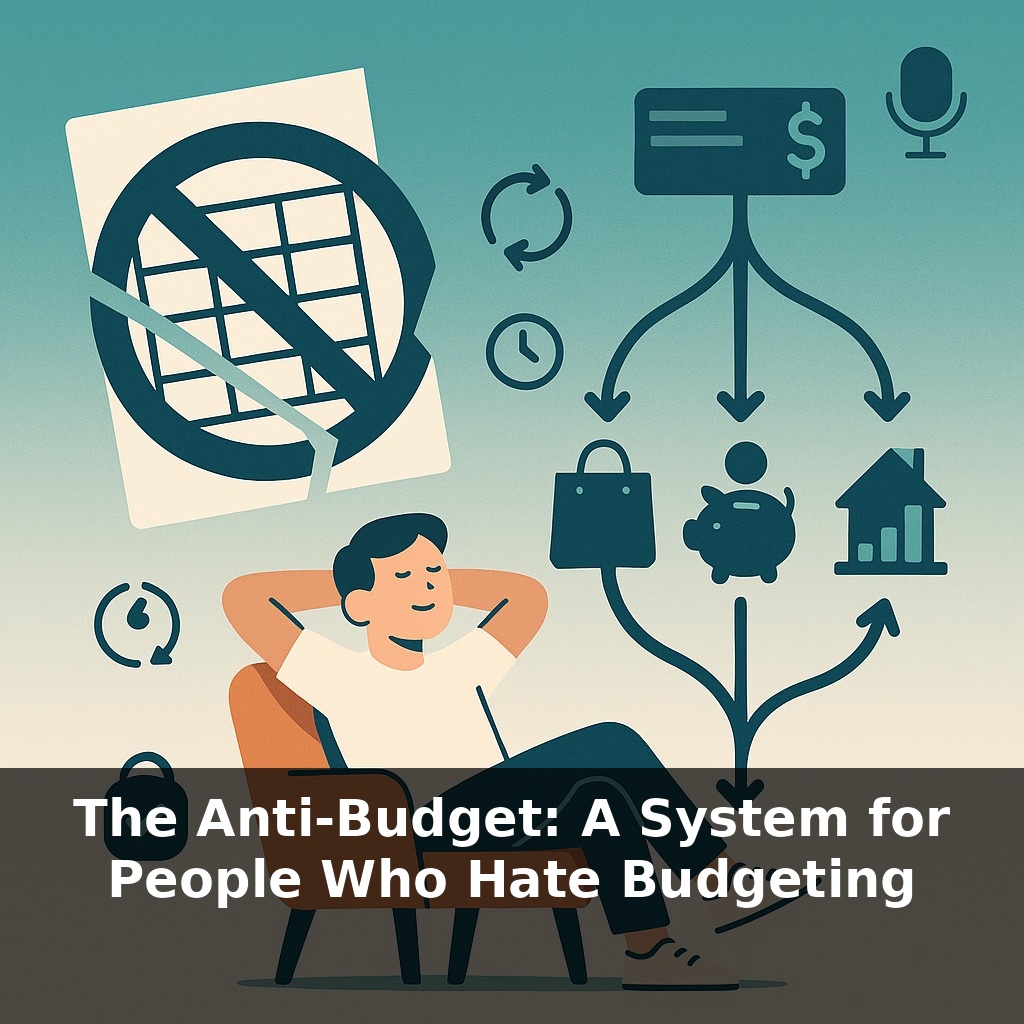
Most people say they hate budgeting, yet keep trying the same spreadsheet-and-receipts routine. Here’s the paradox: research shows people who automate just one key money decision often end up saving far more than the folks carefully tracking every latte and grocery run.
Here’s the twist: the problem usually isn’t that you “lack discipline” — it’s that your money system demands constant attention, like an app that only works if it’s always open. Most of us are juggling work, family, and a thousand browser tabs in our brains already. Adding a meticulous money routine on top is like trying to run a complex software program on a phone with 3% battery left. No wonder it crashes. The Anti-Budget takes a different angle: instead of asking, “How can I control every dollar?” it asks, “What’s the minimum setup that quietly keeps me on track even when I’m tired, busy, or distracted?” This isn’t about becoming a “money person.” It’s about building guardrails so you can be your normal, imperfect self and still make steady progress.
Instead of obsessing over where every dollar goes, we zoom out and ask a different question: “What *has* to happen with my money each month for future‑me not to panic?” That means thinking less about coffee categories and more about big rocks: protecting your essentials, funding your goals, and avoiding nasty surprises. Many people already do a loose version of this in other areas: you don’t track every step you take, you just make sure you move enough to stay healthy. Here, we’re going to formalize that same principle with money, using simple rules that run quietly in the background.
Here’s how the Anti‑Budget actually works in real life, beyond the theory.
Step one is choosing your “pay-yourself-first” number. Instead of thinking, “I should save more,” you pick a concrete target: a percentage or dollar amount that leaves room for a decent life *now* and meaningful progress for *later*. Research from Vanguard shows people save dramatically more when this number is locked in automatically, but you still have to choose it. For many, that starts smaller than you’d expect: 3–5% if money’s tight, 10–20% if you have more slack. The point isn’t perfection; it’s a default that fires without you.
Next, you decide *where* that chunk goes. It could be split across: - Retirement accounts (401(k), IRA) - Short‑term goals (vacation, moving fund, wedding) - Safety nets (emergency fund, car repair cushion) - Extra debt payments (on top of minimums)
You’re designing a simple routing map, not a detailed itinerary. For example: “8% to 401(k), $150 to emergency fund, $100 extra to student loans.” Once set, you rarely revisit unless your income or priorities change.
Then you line up your fixed commitments. List the bills that appear like clockwork—rent or mortgage, utilities, insurance, minimum debt payments, subscriptions you actually use. Wherever possible, you put them on auto‑pay from a single “bills” account so they’re covered before you see that money as available. This shrinks the amount of decision‑making you face each month and cuts the risk of late fees and overdrafts.
What’s left, after your savings chunk and recurring obligations, is your “free‑spend” pool. Crucially, you don’t pre‑slice this into 20 categories. Instead, you monitor just two things: 1) Does the account balance trend down too fast between paychecks? 2) Do your card statements show patterns you don’t like?
If either answer is yes, you adjust one lever at a time: trim a recurring expense, nudge your savings rate down or up, move your due dates, or give yourself a loose weekly cap for a single hot‑spot area (like takeout). You’re tuning the system, not micromanaging your day.
Over time, your main job shifts from “track and restrict” to “observe and tweak.” That’s the core of the Anti‑Budget: fewer knobs to turn, but turning them more deliberately.
Mia’s paycheck hits on the 1st and 15th. Instead of dissecting every transaction, she sets a rule: once her savings move and core bills clear, she checks just one number—the “leftover” in her spending account. She knows that if it’s above $600 after rent, she’s on track for the month; if it’s closer to $200, she dials back non‑essentials for a week. No color‑coded spreadsheet, just a single glance that tells her whether to coast or tap the brakes.
Think of it like setting a minimum battery level on your phone. When it drops below 20%, you switch off background apps or dim the screen. You’re not auditing which app used 3% vs. 5%—you’re responding to a simple signal.
Over a few months, Mia notices a pattern: her “leftover” keeps shrinking faster after weekends. Instead of labeling it “bad spending,” she experiments—chooses one weekend activity to swap (brunch for a potluck, rideshares for a bus pass) and watches how that one tweak shows up in her balance. Each adjustment becomes a small test, not a moral judgment.
As these tools spread, money might feel less like homework and more like a background app quietly optimizing for you. But there’s a twist: when decisions move into code, *who* programs your defaults matters. A future paycheck could land already split between investing, buffers, and fun—yet tuned by an employer, bank, or app designer. That convenience raises new questions about consent, data use, and whose goals your “set‑and‑forget” choices are really serving over decades.
Treat this as an evolving prototype, not a finished product. As raises, kids, or new cities enter your life, you can “push an update” by nudging the dials: bump your rate after each promotion, reroute cash when a goal is hit, even add a small “guilt‑free splurge” stream. You’re not locking yourself in; you’re designing software that grows with you.
Try this experiment: For the next 7 days, send a fixed percentage of every dollar that hits your checking account (say 20–30%) straight into a separate “Future You” savings account the same day it arrives, and then completely ignore every other spending category. Turn off all budgeting apps and tracking, and just use your checking account balance as your only “signal” for how much is left to spend. At the end of the week, look at two numbers only: how much automatically piled up in “Future You” and whether you ever actually felt constrained day-to-day. Adjust the percentage up or down for week 2 based on how stressed or relaxed you felt, and repeat.