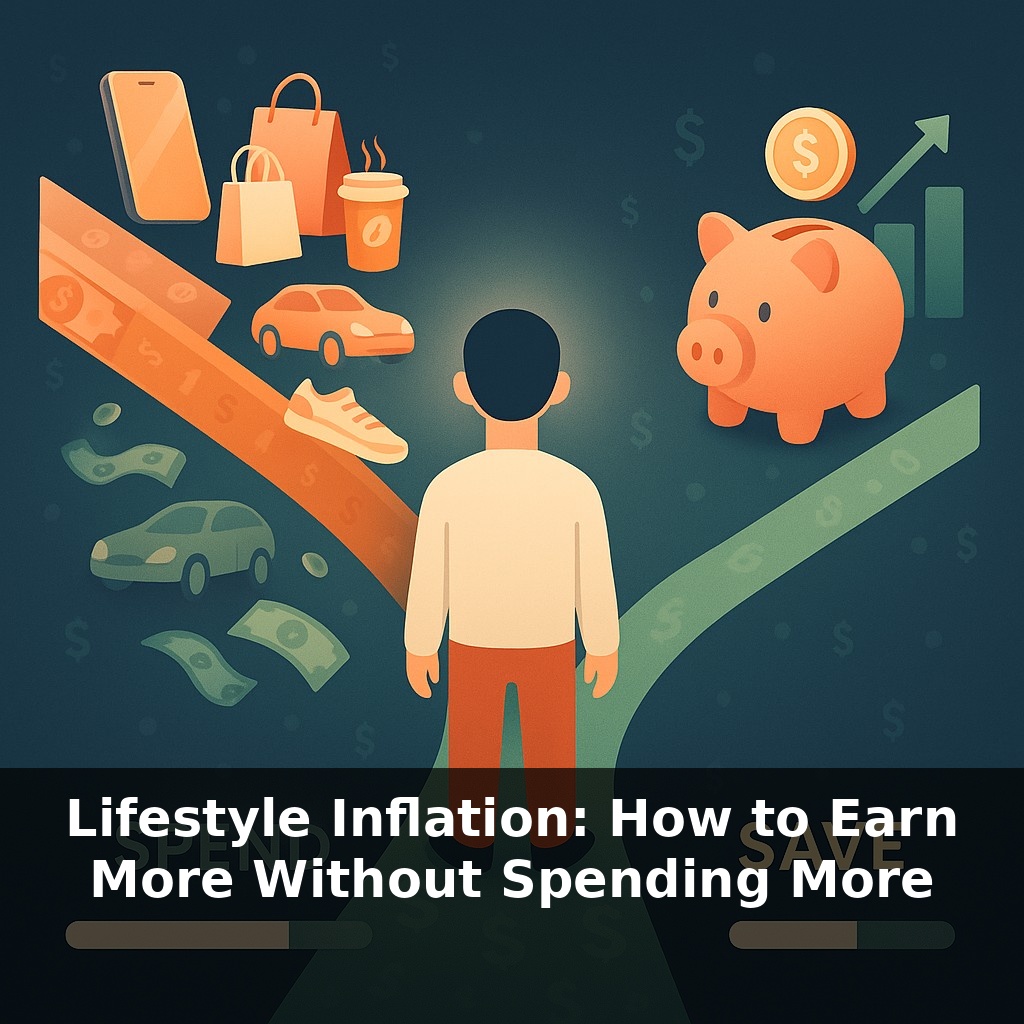
About half of every pay raise in America quietly disappears into nicer takeout, newer phones, and “I deserve this” upgrades. You get promoted, your paycheck jumps, yet your bank balance feels the same. In this episode, we’ll unpack why more income so often brings zero progress.
Here’s the uncomfortable twist: earning more can actually push you further from financial independence if every bump in income silently upgrades your lifestyle. The data is brutal. The median U.S. household saves just 3.4% of its income, and credit card debt has climbed past $1.13 trillion. That means many people are effectively giving every raise straight to restaurants, subscriptions, and “small” monthly payments. Yet the same raise, handled differently, can be a decade-altering lever. Households that boost their savings rate immediately after an income jump are 2–3 times more likely to hit their financial-independence goals within 10 years. In this episode, you’ll learn how to lock in progress the moment your income changes—using a simple rule for new money, automatic systems that protect you from impulse upgrades, and a few mindset shifts that keep “normal” from getting more and more expensive.
Most people don’t realize how fast “just a little nicer” adds up. An extra $300 a month for dining out, $120 for upgraded phone and streaming, $200 for a better car payment—that’s over $7,000 a year gone. Over 10 years at a 7% return, that could’ve been about $100,000 in investments. Now zoom in: if your take-home pay rises by $500 a month and you quietly lock $350 of it into savings or investing, you’re boosting your annual wealth growth by $4,200 without cutting a single current expense. This episode is about turning every future raise, bonus, or side-hustle payment into automatic, measurable progress.
Here’s the key move: treat every new dollar you earn differently from the dollars you already make.
Start with a simple rule for “new money.” Before the raise hits your account, decide a split like this: - 60% to saving/investing - 20% to long-term goals (debt payoff, future travel fund, home down payment) - 20% to lifestyle upgrades
Say your after-tax income climbs by $800 a month. Using that split: - $480 goes straight to savings/investing - $160 goes toward goals - $160 is guilt-free upgrade money
That’s $5,760 a year boosting your net worth, without touching your current lifestyle. At a 7% annual return, 10 years of that one change is roughly $80,000–$85,000 of additional wealth. And if you repeat this with each raise, the effect stacks.
To make this work in real life, lock in the numbers ahead of time:
1. Run your “raise math” Take your expected raise, bonus, or side income and calculate the after-tax monthly increase. If your salary jumps from $60,000 to $69,000, your take-home might rise by around $450–$550 a month, depending on taxes. Use that actual increase—not the gross raise—for your split.
2. Pre-commit with specific targets Assign dollar amounts, not just percentages: - Extra $500/month? - $300 to investments - $100 to a specific goal - $100 to lifestyle
Then tie each amount to a concrete account: brokerage, high-yield savings, loan payment.
3. Build in a 90-day delay on upgrades When the raise hits, keep your lifestyle exactly the same for three months. During that window: - Route the planned amounts to their accounts - Track how your cash flow feels - Only after 90 days, pick 1–2 intentional upgrades that fit within your “lifestyle” slice
4. Use hedonic adaptation to your advantage You adapt quickly to nicer things—but also to smarter habits. For the first month, manually move the “new money” into its destinations so you feel the change. Then automate it. Within a few paychecks, the higher saving rate feels normal, and any remaining room becomes truly discretionary.
5. Plan your “fun raise” in advance Write down exactly how you’ll enjoy the smaller lifestyle portion: - $60 more eating out - $40 more on hobbies - $? on travel sinking fund
This prevents that vague “I make more, so why not?” creep that quietly eats the entire raise.
A mid-career engineer earning $95,000 gets a new job at $120,000. After taxes, that’s roughly $1,600 more per month. Instead of letting it vanish into “nicer everything,” she sets a strict rule: the extra covers just three specific moves. First, she increases her 401(k) by $600/month. Second, she sends $500/month to a brokerage earmarked for a “work-optional at 55” fund. Third, she adds $300/month to a high-yield account for a 12‑month sabbatical in five years—and keeps $200 as pure fun money. In one year, that’s $7,200 in retirement contributions, $6,000 in flexible investments, and $3,600 toward a career break, without touching her prior routine. Over five years, she’s redirected $80,000+, plus growth, from default upgrades into choices her future self can actually use.
You can treat each raise like a software update: don’t just add flashy features—improve the core system stability first, then selectively turn on one or two visible upgrades.
As incomes get bumpier, expect software to act like a real‑time “raise filter.” Apps will soon suggest exact splits for every $100 of new cash—say $55 to a taxable account, $25 to a joint goal, $20 to flexible fun—based on your progress toward targets. Employers may auto‑escalate contributions by 1–2% whenever pay rises, unless you opt out. To stay in control, audit these defaults yearly and adjust them to match your timeline for big goals within 5–15 years.
Use this: for every extra $100 you earn this year, pre‑assign $50 to investing, $30 to specific goals, $20 to guilt‑free fun. If that adds up to $600/month in “new money,” you’ll redirect $7,200 in year one. Keep the rule through three raises and you’ll have over $20,000 re-routed—before any growth—simply by refusing to let “normal” quietly get more expensive.
To go deeper, here are 3 next steps: 1) Open a free tracking app like Copilot, YNAB, or Monarch Money and tag the last 90 days of transactions into “needs,” “wants,” and “lifestyle creep” so you can see exactly where new income has quietly turned into recurring spending. 2) Set up two automatic transfers in your bank today: one to a high‑yield savings account (Ally, Capital One 360, or Marcus) labeled “Freedom Fund” and one to an investment account at Vanguard, Fidelity, or Schwab—use a simple total-market index fund like VTI or FSKAX so every future raise gets invested, not spent. 3) Grab one of the books mentioned—“I Will Teach You to Be Rich” by Ramit Sethi or “The Psychology of Money” by Morgan Housel—then schedule a 25‑minute “money meeting” on your calendar this week to read a single chapter and immediately apply one tactic (like automating bills or setting a “fun budget” cap) before you close the book.