Most people spend more time choosing a show to stream than checking their bank account—yet that tiny bit of attention each month can quietly add up to hundreds of dollars saved. Today, we’re stepping into that overlooked half hour that can completely reroute your money story.
Most of us know we “should” check in on our finances, but the idea often feels huge—like you’re supposed to overhaul your entire life every time you open a spreadsheet. So we avoid it until something forces us to look: a declined card, a scary bill, a creeping sense that things are off but we’re not sure where.
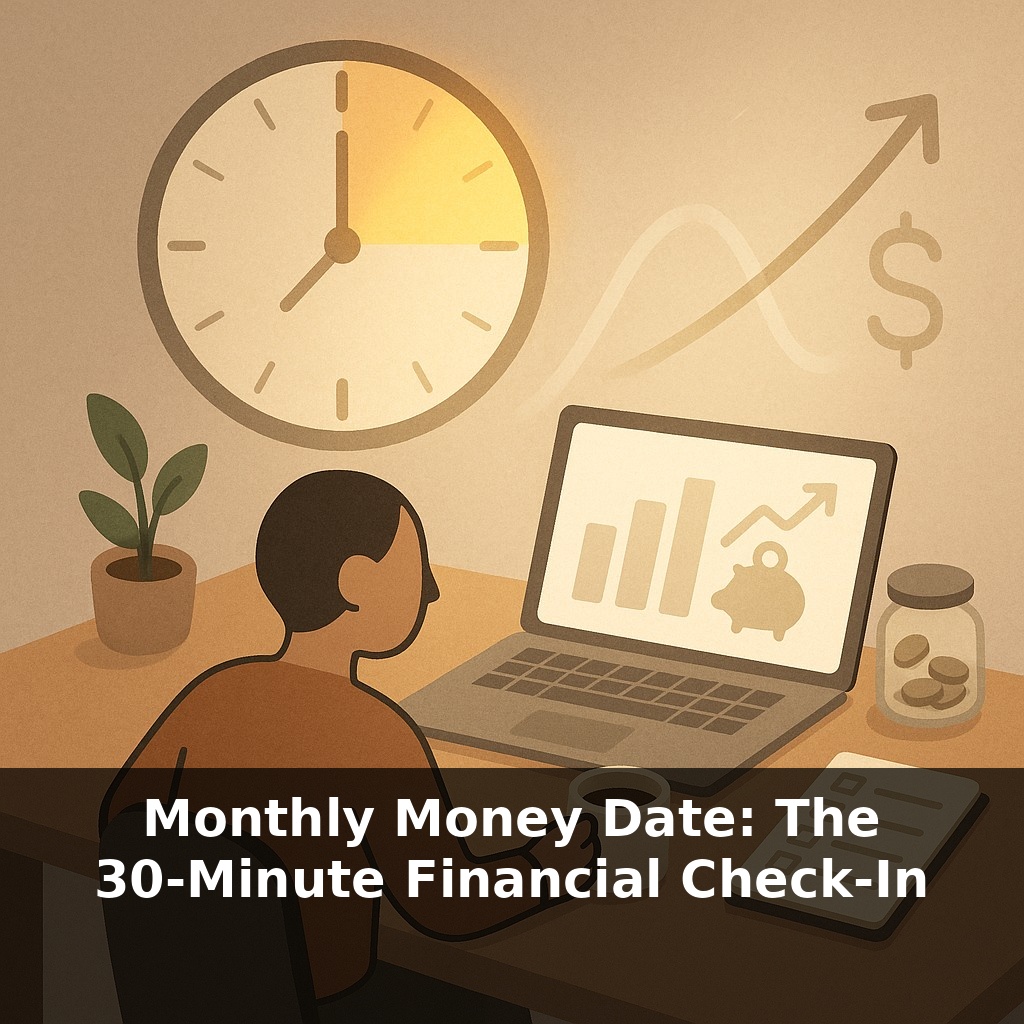
That’s where a monthly money date comes in. Not a weekend-long bootcamp, not a dramatic reset—just thirty focused minutes to see what actually happened with your money and make one or two small tweaks. Research shows that this kind of consistent, low-drama review does more for your savings, debt, and stress levels than the occasional burst of willpower.
In this episode, we’ll map out exactly what to do in that half hour, how to make it feel sustainable, and how to turn it into a rhythm you can actually keep.
A 30-minute money date works because it shrinks a vague intention into a concrete habit: one slot on your calendar, one simple ritual, once a month. Behavioural research backs this up—short, recurring check-ins dramatically cut “budget drift,” that slow slide where your spending quietly stops matching your plans. Think of this as stepping into a control room where you flick a few key switches: glance at your upcoming bills, skim recent card charges, compare what you meant to do with what actually happened, and adjust. No spreadsheets exploding, no perfection required—just regular, honest feedback.
Here’s the simple structure for that 30‑minute check‑in: three short segments, each with a different job. You’re not trying to solve everything at once—you’re running a repeatable script that keeps you oriented.
First 10 minutes: “What actually happened?” Pull up your main accounts and look only at the last month. You’re hunting for patterns, not perfection. Scan for: - Big or unusual charges you’d forgotten about - Recurring subscriptions (streaming, apps, boxes, memberships) - Categories where spending quietly crept up
This is where the data wakes you up: the average U.S. household is paying for 5–7 recurring subscriptions, and trimming unused ones can free up roughly $715 a year. One forgotten $12.99 charge doesn’t feel urgent—until you multiply it by 12.
Next 10 minutes: “Does this match what I want?” Now you’re shifting from history to alignment. Compare your actual spending with your current priorities: - Are your top 2–3 goals (like paying off a card, building an emergency buffer, or saving for a move) getting funded? - Did money leak into categories you don’t truly care about? - Is anything coming up in the next month—travel, renewals, annual bills—that needs a placeholder now?
Behavioural experiments show that simple monthly prompts like this improve budget adherence by more than 20%, not because people become stricter, but because they course‑correct earlier.
Final 10 minutes: “What tiny tweaks set Future You up better?” Sticking to the 1% rule, you’re choosing one or two moves—no more: - Cancel or pause one subscription - Bump an automatic savings transfer by $10–25 - Add an extra $20–50 to a specific debt payment - Set a reminder for a known expense instead of hoping you’ll remember
Think of it like updating the settings on your favorite app: a couple of small toggles now, smoother performance all month.
And if you’re doing this solo, it still counts as a “date.” You can even write a one‑sentence note each month—“March: cut two subs, added $25 to emergency fund”—so you can literally watch your decisions stack up. Over time, you’re not just tracking numbers; you’re building proof that you can nudge them, on purpose, in the direction you care about.
Think of each monthly session as rehearsing with a band: same set list, but every run‑through sounds a little tighter. One month you catch that a “trial” app quietly turned into a premium plan. Another month you notice your grocery bill spiked, not because you “failed,” but because you hosted twice—useful data for next time.
You can even give each date a theme, like tracks on an album: - “Prune & Polish”: only hunt for things to cancel or downgrade. - “Future Stack”: focus on upcoming trips, renewals, or gifts. - “Boost Mode”: look solely for places to increase tiny automations.
Couples can treat it like a shared dashboard review: one person drives the numbers, the other narrates what actually happened (“That restaurant week was our anniversary,” “That Lyft was when the car was in the shop”). The goal isn’t blame; it’s to sync stories with transactions.
Over a year, these quick passes create a kind of annotated history of your choices—less a judgment log, more a behind‑the‑scenes director’s cut of how your life and money evolved together.
As this ritual spreads, it quietly changes what “normal” looks like. Friends might swap screenshots of progress bars the way they trade workout stats. Families could add quick check‑ins to group chats before big plans, so costs are clear upfront. Think of it like updating a shared playlist: everyone sees what’s been added, what no longer fits, and which tracks should be bumped to the top. Over years, these tiny sync‑ups can shape career moves, housing choices, even when you feel ready to take bigger risks.
Over the next few months, notice how this small ritual shifts your default choices: you may start checking prices the way a careful traveler scans flight options, or say no faster to expenses that don’t fit. Your challenge this week: block that 30‑minute slot, protect it like any real plan, and jot down one insight you’d miss if you skipped it.