Cannae: The Art of Double Envelopment
📝 Transcript
In a single afternoon in 216 BCE, one army was so completely destroyed that survivors said the killing stopped only because no one was left to kill. That afternoon, Hannibal Barca's forces—initially outnumbered—achieved the unthinkable, overwhelming a larger Roman contingent. What unique strategy allowed such a remarkable victory?
Hannibal’s real genius at Cannae wasn’t just a clever battlefield trick; it was how he choreographed thousands of terrified, exhausted humans into a single, fluid decision. Think of an orchestra where the conductor doesn’t just follow the written score, but rewrites it mid‑performance as the audience storms the stage. Every contingent in his army—the wavering center, the steadfast African infantry, the aggressive cavalry—had a role that only made sense in relation to all the others. Hannibal wasn’t chasing a “perfect move”; he was designing a system that could bend without breaking as reality shifted. To understand Cannae, we have to zoom in on three things: how he shaped Roman expectations before the battle, how he controlled time and space during it, and how he empowered subordinates to exploit tiny openings before they vanished.
On the ground, none of this looked elegant. Dust, heat, and noise blurred every signal; orders vanished in the chaos like ink in water. Hannibal had to assume that once contact began, his plan would start to decay immediately. So he built a battle that could afford to be “wrong” in the details while still right in the overall direction. Think of a river that keeps flowing even as individual currents clash along the banks. The key was margin: extra time, depth, and room to adjust so that when parts of the line bent too far or too fast, the rest of the system could absorb the shock instead of collapsing.
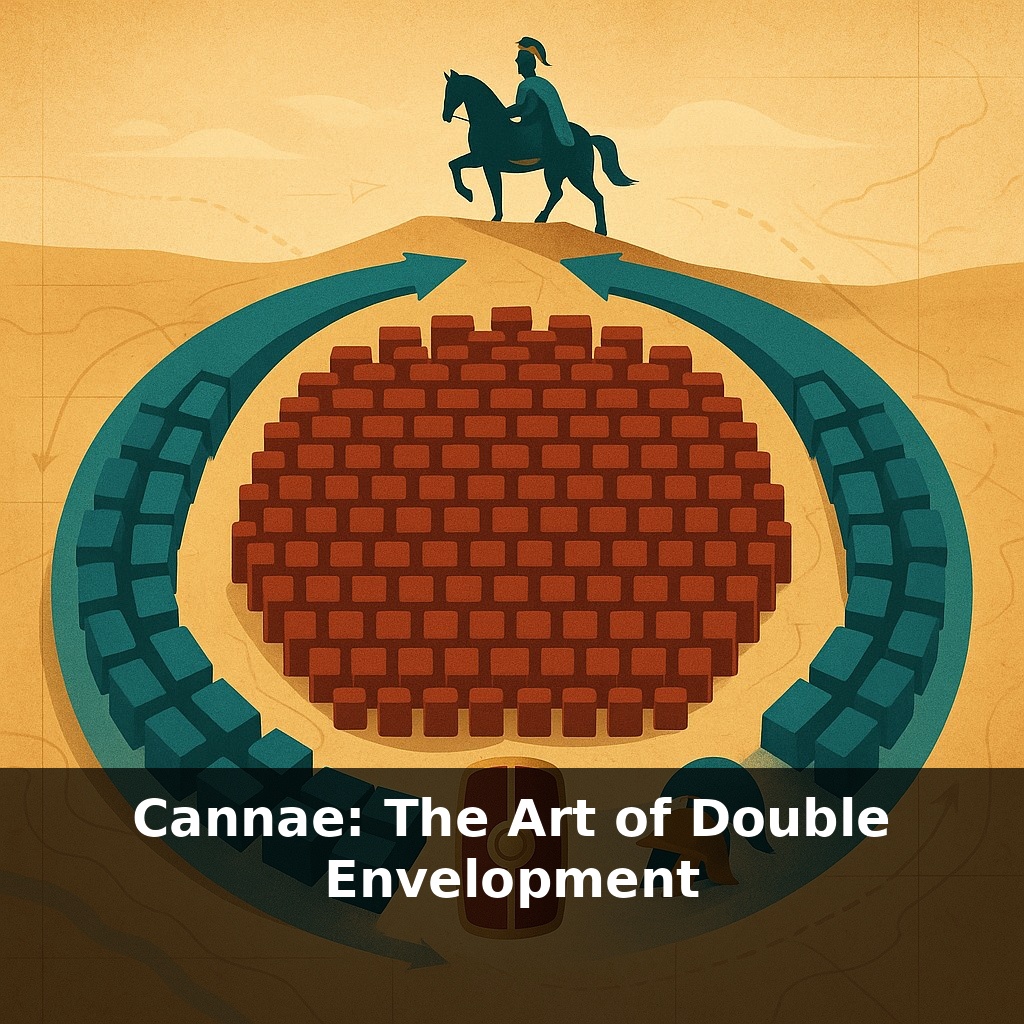
First, look at the physical design of Hannibal’s line. He didn’t simply mirror the Romans. He projected what they wanted to see: a slightly bulging, apparently weaker center made of Gauls and Spaniards, with his tougher African infantry stepped back on either side. To Roman commanders fixated on a frontal smash, this looked like confirmation that raw mass would do the job. Hannibal let their doctrine complete half his work before the first javelin flew.
The center wasn’t just “weak”; it was intentionally elastic. Those troops were briefed not to hold a straight line at all costs, but to give ground in a controlled, shallow arc. That demanded discipline of a different kind: the courage to step backward under pressure without believing you were losing. Meanwhile, the African infantry on the flanks had the opposite brief—stay relatively fixed, conserve strength, and wait. Their moment would come only when the Roman formation had pushed itself deep into the pocket.
Now zoom out to the cavalry, where the real timing problem lived. On one wing, Hannibal massed his best horse under Hasdrubal, facing Rome’s softer allied cavalry. On the other, his weaker riders had to buy minutes against Rome’s better horsemen without collapsing. The plan depended on asymmetry: win fast where you’re strong, delay where you’re not, then recombine your freed‑up strength where the enemy least expects it. Think of a storm front where one edge slams into the coast while the rest moves more slowly inland; the violence isn’t uniform, but the shape of the system still advances.
When Hasdrubal broke the Roman allies, he didn’t chase fugitives. He pivoted. His cavalry crossed the rear of the battlefield, hit the Roman horse on the opposite flank from behind, and then—only then—curved in against the Roman infantry’s back. That final turn is what converts “hard fight” into “no escape.”
The so‑called double envelopment wasn’t a single gesture; it was three interlocking shifts: the center bowing inward, the African infantry angling in on compressed Roman flanks, and cavalry sealing the rear. Each move created the conditions for the next, like stepping stones that only appear once you’ve committed to the previous one.
Consider how often “double envelopment” shows up far from battlefields. A modern version appeared in 1991’s Operation Desert Storm: coalition forces fixed Iraqi troops in Kuwait with frontal pressure while armored units hooked wide through the desert, closing from flank and rear so quickly that many Iraqi units collapsed more from shock than from direct destruction. The maneuver rhymes with Cannae, but the tools—satellites, air power, logistics—are utterly different. In business, Netflix used something similar against Blockbuster. It didn’t just compete on rentals; it pressed from two sides: subscription mail disrupting the store model, and early investment in streaming undermining the future of physical media. Blockbuster found itself locked into a narrowing corridor of viable responses. The pattern isn’t mystical. Wherever one side can draw an opponent into over‑committing in one direction while quietly developing pressure from two converging sides, a Cannae‑like opportunity is forming.
The deeper lesson from Cannae is less about encirclement and more about patiently engineering a moment when options vanish all at once. In modern terms, think about how a slow‑moving regulatory change on one side and shifting customer habits on the other can quietly fold in on a rigid business. Like watching a tide rise around an isolated rock, nothing seems urgent until every escape path is already water. Hannibal’s real genius was timing the flood, not just drawing the map.
So Cannae becomes less a frozen diagram and more a mindset: instead of lunging at problems head‑on, you ask where pressure will naturally funnel them, then prepare converging answers. Like guiding rain down a roof into two gutters that meet at one drain, you’re not forcing outcomes—you’re arranging the slope so they arrive there.
Try this experiment: Pick a recurring “battle” in your life this week—a tough client, a stubborn project, or a personal habit—and design a mini-Cannae around it by attacking from two sides at once. For one week, deliberately “fix” the center (do just enough to hold the line), while you launch two flanking moves: one that reduces the opponent’s strength (e.g., limit their options, simplify the scope, cut distractions) and one that boosts your own (e.g., add a strong ally, better tool, or extra preparation time). Each day, jot down in a single sentence whether your “enemy” felt more constrained and you felt more free, and at the end of the week decide if the double envelopment made the problem easier to contain or even “collapse” on its own.
From this course
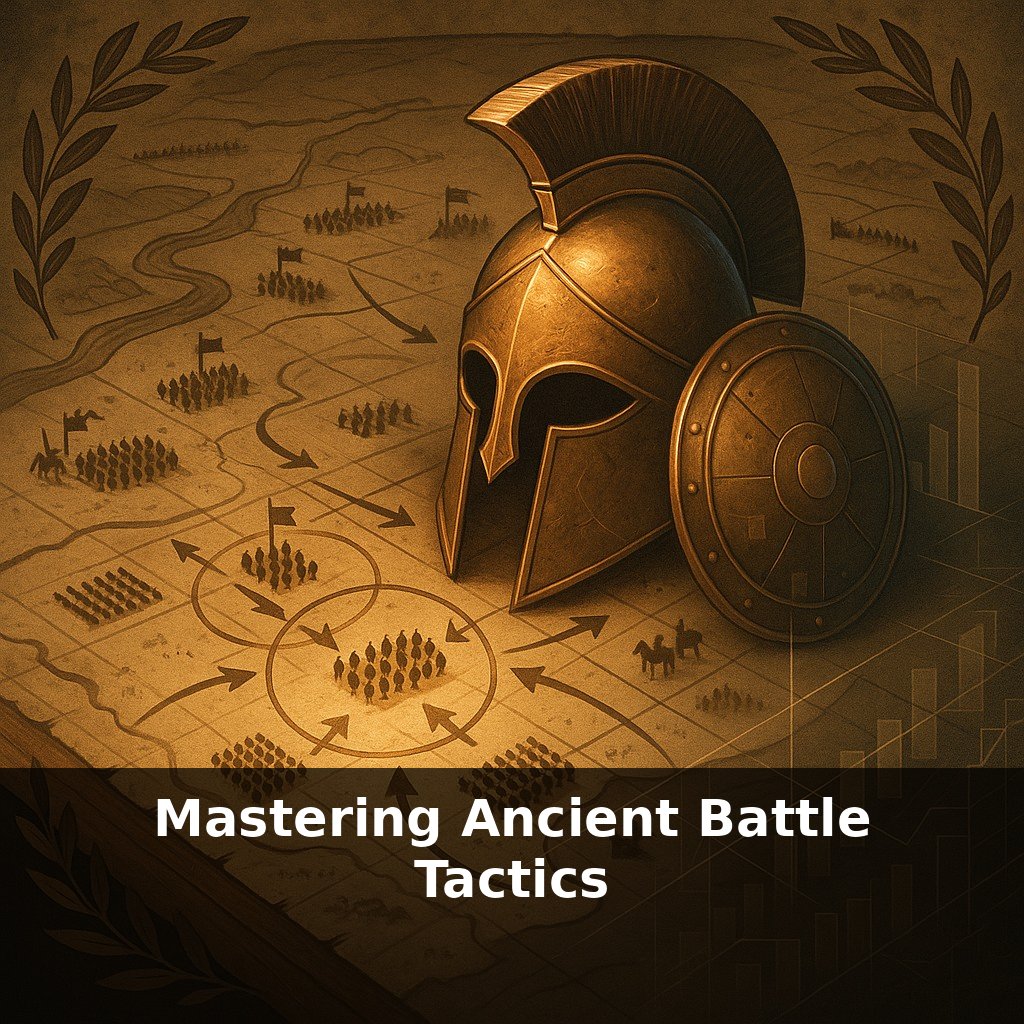
Mastering Ancient Battle Tactics
5 episodesUnlock all episodes
Full access to 5 episodes and everything on OwlUp.
Subscribe — $1.99/monthLess than a coffee ☕ · Cancel anytime