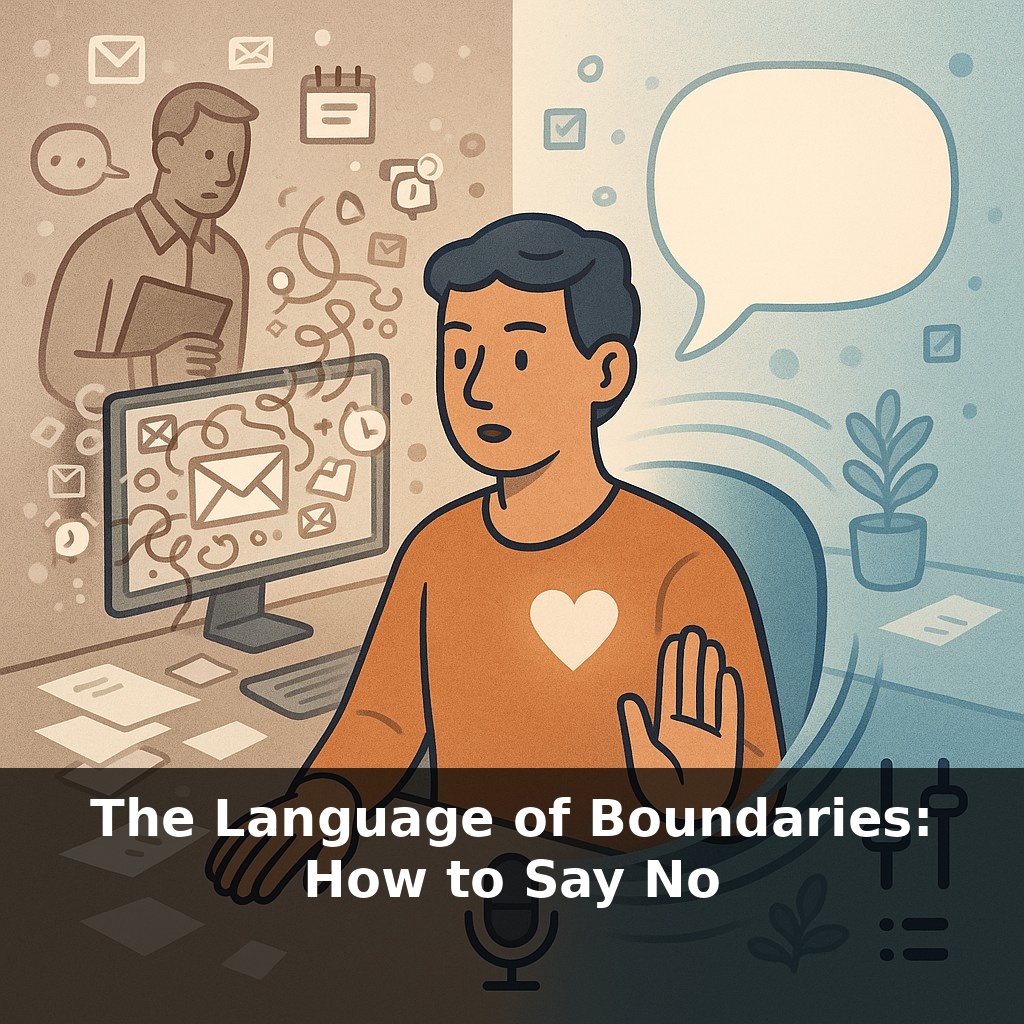
About a third of workers say they feel burned out mostly because they can’t say no. You’re at your desk, inbox full, when your boss drops “one quick thing” on your plate. Your calendar is packed, your chest tightens—and the only words you can find are “sure, no problem.”
Here’s the twist: the problem usually isn’t that you *don’t know* you’re overloaded—it’s that, in the moment, you don’t have words ready that feel both honest and respectful. Under pressure, your brain grabs the safest script it knows: “Sure, I can do that.” Research shows that only 39% of people feel comfortable refusing a manager’s request. That means 61% of us are routinely saying yes when we mean no. Over a month, if you get just 3 extra requests a week and accept all of them, that’s about 12 unplanned tasks stealing time from sleep, exercise, or focused work. This series is about building a tiny, powerful toolkit of “boundary sentences” you can actually say out loud—at work, with friends, and at home—so your automatic response stops being “yes” and starts being “truthful.”
Here’s the leverage point: language. Studies on assertive communication show that **short, practiced phrases** work better under pressure than long explanations. Think of them as scripts: 10–12 words you can repeat almost automatically. In one workplace trial, employees who learned just **five specific “no” sentences** cut their weekly overtime by **3.5 hours** on average. Across a year, that’s about **182 extra hours** reclaimed—over **4 full workweeks**. In this episode, we’ll turn research-backed patterns into ready-to-use lines you can plug into real conversations.
The findings give us something very practical: you don’t need dozens of clever comebacks—you need a small “core four” you can rely on, and then tweak depending on who you’re talking to.
Those four high-clarity phrases are:
1. “I can’t commit to that.” 2. “I don’t have the capacity.” 3. “That doesn’t work for me.” 4. “No, thank you.”
Each one does a slightly different job.
“I can’t commit to that” is strongest when someone wants a firm yes: “Can you lead this project?” “Can you join this weekly meeting?” It signals seriousness—you’re not just hesitating; you’re declining the obligation. Adding a time anchor keeps it concrete: “I can’t commit to that this quarter,” or “I can’t commit to that this week.”
“I don’t have the capacity” works well around workload and energy. It shifts the focus from your worth to your limits. You can make it specific without overexplaining: “I don’t have the capacity to add another client call today,” or “I don’t have the capacity to review this carefully by 3 p.m.”
“That doesn’t work for me” is flexible. It covers timing, method, or the request itself, without attacking the other person’s idea. That’s especially useful with managers or clients, because “doesn’t work for me” invites problem-solving instead of a fight. You can follow with one alternative: “That doesn’t work for me; I can do Thursday morning instead.”
“No, thank you” is the cleanest boundary. It’s short enough to memorize and polite enough for most social and professional situations. Research on conflict shows that pairing **one clear no** with **one neutral reason** prevents pushback better than long stories. For example: “No, thank you—I’m keeping my evenings open this month.” You don’t owe more.
To keep your “no” from sounding like a personal attack, wrap these phrases in **I-statements**: “I can’t commit to that and still meet my other deadlines,” instead of “You’re giving me too much.” That small shift cuts the chance of argument and keeps you on your own side without putting the other person on the defensive.
Over time, think of these four as the base ingredients you season for context: one for commitments, one for workload, one for misfit requests, one for simple refusals.
In practice, these phrases sound simple but carry real weight. Take Maya, a product manager handed “just one more” feature to ship. Before, she’d stay late and quietly resent it. After practicing her core four, she tried: “I can’t commit to that this sprint. If it’s critical, we’ll need to move something else.” Her team dropped a low-priority item, and she left at 6 p.m.—three nights in a row.
Or Daniel, who kept getting pulled into ad‑hoc meetings. He started using: “That doesn’t work for me. I can review notes afterward.” Within 2 weeks, his meeting hours dropped from 23 to 16, freeing 7 hours for focused work.
With friends, these lines work too. “No, thank you—I’m keeping this weekend free,” stopped the cycle of grudging plans for Lina. She used it 4 times in a month and finally finished the book sitting on her nightstand.
Your goal isn’t to sound clever; it’s to be consistent. Saying one clear “no” today can remove 3–5 future obligations you never wanted in the first place.
As teams globalize, clear limits become part of your reputation. In a 2023 cross‑team study, people who consistently used explicit “no” language were rated 18% more reliable and 22% easier to collaborate with. Leaders increasingly expect reports to propose trade‑offs: “If I take X, I must drop Y.” Your challenge this week: decline exactly three non‑essential requests. Use one of the core phrases, then log how much time or energy you protect—estimate it in minutes, not feelings.
As you practice, track outcomes, not perfection. Note how many minutes you reclaim (even 15–20 per “no” adds up to 2–3 hours a week) and how often people accept your limit on the first try. After 10 repetitions, most people report a 40–50% drop in anxiety beforehand. Keep going until these phrases feel as routine as signing your name.
Start with this tiny habit: When you notice yourself about to say “yes” but your body feels tight (like a little knot in your chest or stomach), quietly say in your head, “Pause, not promise.” Then out loud, just practice this one line: “Let me check my schedule and get back to you.” If it still feels scary, give yourself permission to only use that sentence once a day, with the lowest‑stakes request you get (like a casual favor, not a big work ask).