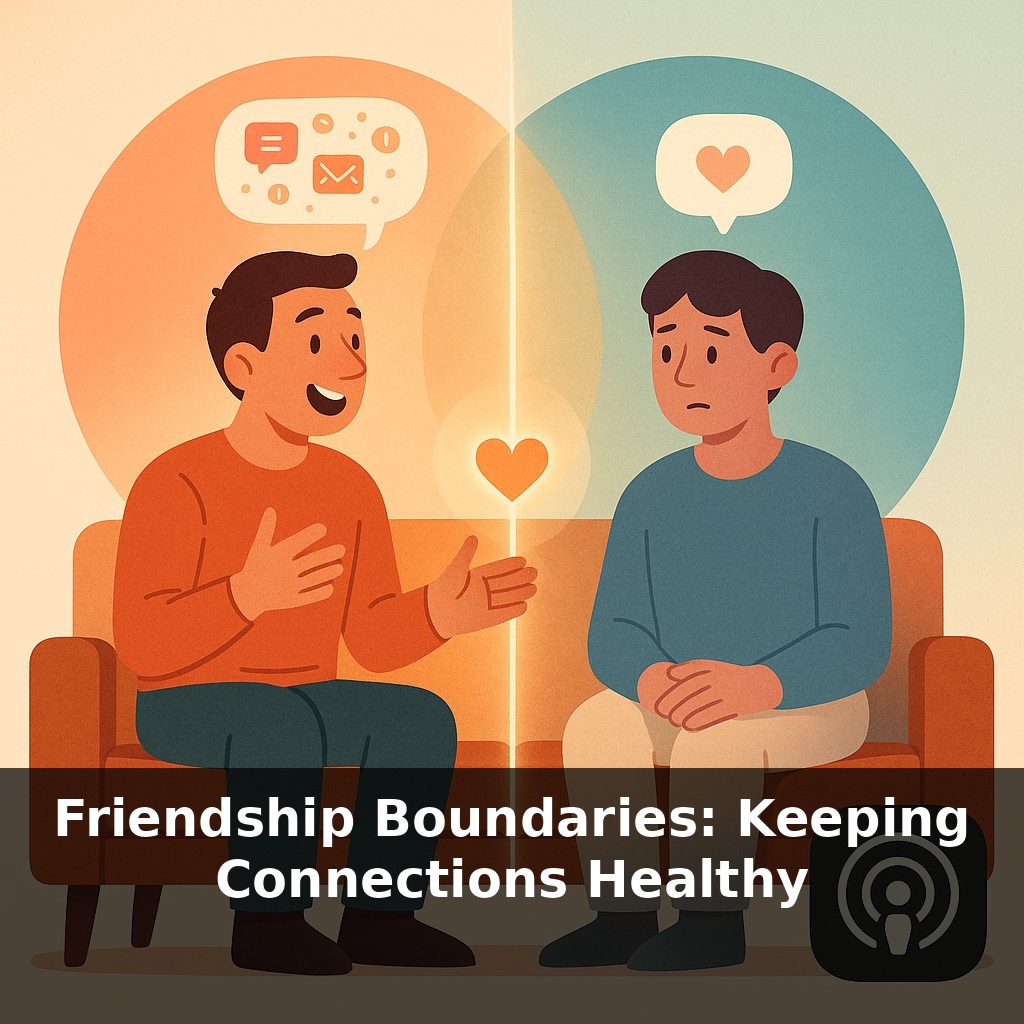
About half of adults say they’ve quietly backed away from a friendship—not because of a huge fight, but because “something just felt off.” You’re laughing together, sharing secrets… and still going home drained. How can a “good” friendship leave you exhausted instead of supported?
46% of adults say they’ve ended a friendship over repeated boundary violations. Not one big betrayal—just the same small lines crossed, over and over, until something quietly snaps. That’s the tricky thing about boundaries: they often become visible only when they’re broken.
In the moment, it can feel harmless to say yes when you mean no, to answer calls at midnight, to listen for hours when you’re already overwhelmed. But research shows that people who clearly articulate what is and isn’t okay report up to 20% higher friendship satisfaction—and fewer recurring conflicts. Friends don’t have to guess; they know where they stand.
Consider how different it feels when someone says, “Can we talk about what I’m comfortable with?” instead of silently pulling away. Today, we’ll explore how those small, honest conversations can transform a relationship before it reaches the breaking point.
This is where things get interesting: many people think “good friends shouldn’t need boundaries”—yet neuroscience suggests the opposite. When you routinely override your own limits to keep the peace, your brain’s stress systems stay activated longer, nudging you toward irritability, numbness, or quiet resentment. Over time, that stress bleeds into how you interpret your friend’s texts, jokes, and requests. A neutral message suddenly feels like pressure; a harmless cancelation feels like rejection. We’ll look at how to notice those early internal signals and use them as data, not drama, to guide healthier choices.
“People-pleasers report higher loneliness than assertive people, even though they say ‘yes’ more often,” notes psychologist Ellen Hendriksen. That’s the paradox of unclear limits: you get more interactions, but feel less seen.
So how do you tell when a line *needs* to be drawn—before you hit the point of ghosting or exploding?
Start with patterns, not single moments. One 2-hour rant from a heartbroken friend? Probably fine. But if you notice a rhythm—every Friday night becomes crisis duty, every celebration turns into you reassuring them—it’s a sign the unspoken rules of the friendship tilt heavily in one direction. Boundaries don’t start with confrontation; they start with observation.
Next, notice *where* the strain shows up: - Time: Do plans always stretch longer than you agreed to? Are you regularly late for other commitments after hanging out? - Energy: Do you need hours to recover after seeing this person, even when nothing “bad” happened? - Values: Do you find yourself laughing at jokes you don’t believe in, or agreeing to things that don’t sit right?
Each of these is a different *type* of limit: time, emotional, and values-based. Most people only think of the first (“I can’t talk right now”), but the last two are where resentment quietly grows.
Here’s a helpful twist: instead of asking, “What should I let my friend do?” ask, “What do I want to be able to offer *willingly*?” Boundaries are less about controlling someone else and more about protecting your capacity to give freely. When you protect that capacity, warmth returns; when you don’t, warmth turns into obligation.
You can also adjust by *context*. You might be totally fine with drop-in calls from a childhood friend, but need more structure with a newer coworker-turned-buddy. Healthy limits flex with risk level, history, and how resourced you are that week.
Think of it like adjusting seasoning in cooking: the same dish might need more salt on a cold day and less after a salty appetizer. You’re not being inconsistent; you’re responding to what’s already in the mix.
Your challenge this week: for one specific friendship that feels “off,” pick just *one* area—time, energy, or values—and experiment with a slightly firmer line there. Don’t overhaul everything; change one dial and watch what happens.
Think of two friends, Maya and Jo. Maya notices she feels tense before group hangs with Jo. Instead of labeling the whole friendship “bad,” she zooms in on *situations*: it’s only when Jo teases her in front of others. That’s a *context-specific* limit. So she decides, “I’m okay with sarcasm 1:1, not in groups,” and tells Jo, “I’m fine joking around in private, but in front of people I need you not to make me the punchline.” She’s not rewriting the whole relationship, just updating one setting.
Now flip it: Andre loves deep talks, but his friend Sam prefers quick check-ins. When Andre notices Sam going quiet after long emotional dumps, he experiments: “I’ve got a lot going on—do you have 10 minutes, or should we save it for later?” That tiny pre-check lets Sam opt in honestly.
A useful test: after you try a small shift, does the friendship feel more spacious or more cramped? Genuine connections may wobble, then rebalance; brittle ones tend to crack when limits appear.
As social norms shift, the friends who name their limits early may quietly become hubs of their networks—the “steady” ones people trust with both good news and crises. In group chats and online communities, clear limits can work like traffic lights, preventing pile‑ons and burnout. Over time, kids who grow up hearing, “Thanks for telling me what works for you,” instead of, “Don’t be so sensitive,” may treat other people’s preferences the way we treat food allergies: something you automatically ask about and accommodate.
Healthy limits don’t freeze relationships; they give them room to evolve. As seasons of life shift—new jobs, partners, grief—your needs will shift too. Let your “settings” be reviewable, like updating an app: check what’s lagging, what’s crashing, and what still works beautifully. Curiosity keeps the door open while your rules get clearer.
Before next week, ask yourself: “Where in my friendships do I keep saying ‘yes’ when I actually feel resentful or drained, and what honest sentence could I use instead (for example, ‘I care about you, but I can’t talk about this every night’)? In my closest friendship, what’s one recurring pattern (like always being the listener, always hosting, or always rearranging my schedule) that I’m willing to gently renegotiate, and how could I bring it up in a calm, non-blaming way? The next time I feel that tight, uncomfortable feeling after hanging out with a friend, can I pause and ask: ‘What boundary just got crossed for me, and what would protecting that boundary look like in our next interaction?’”