One global study found long work weeks are now linked to hundreds of thousands of deaths each year. Yet in many offices, the people praised most… are the ones who never log off. In this episode, we’re stepping straight into that tension: when “good worker” quietly becomes “always available.”
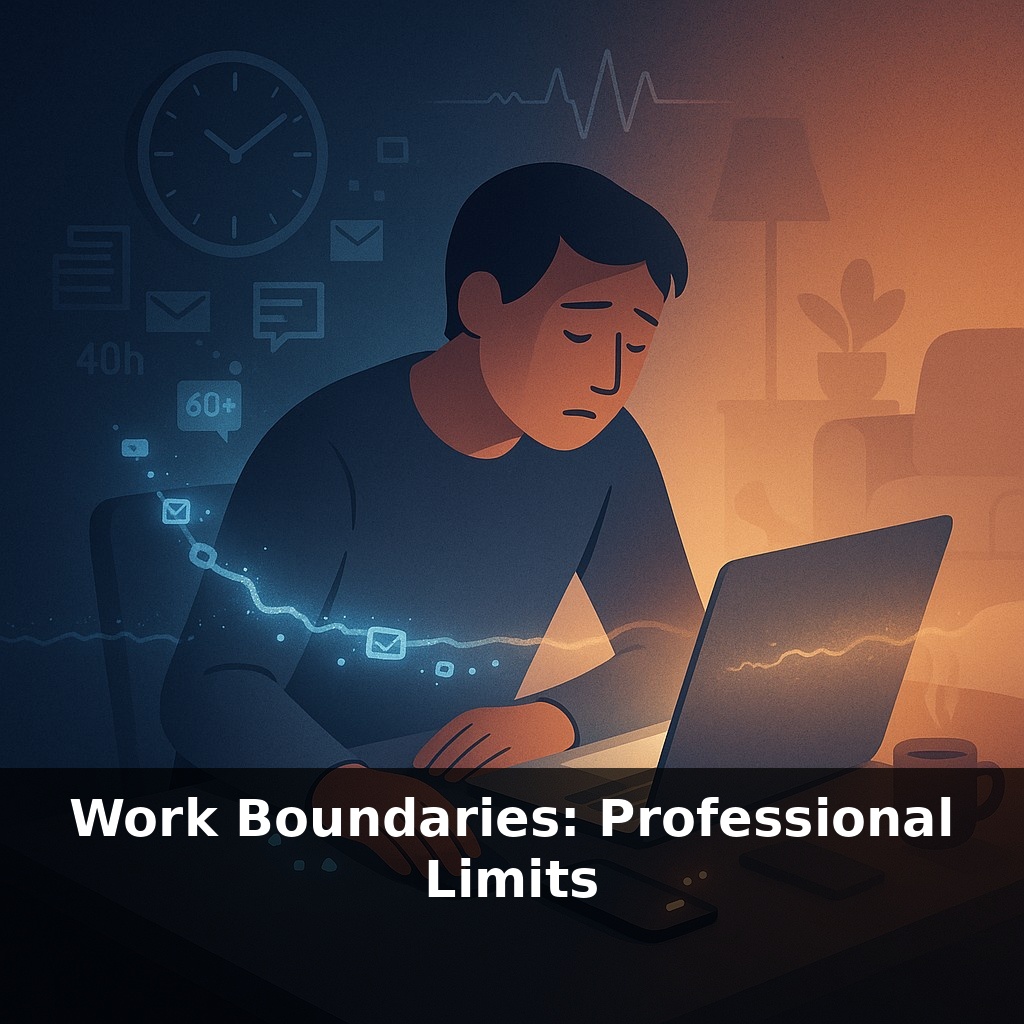
Forty hours on paper, sixty in your inbox, and your brain still replaying tomorrow’s meeting at 11:47 p.m.—that’s not a schedule, that’s a leak. This episode is about finding where, exactly, your work is spilling into the rest of your life and learning how to close the valves without blowing up your reputation or your career.
We’ll zoom in on three kinds of boundaries that quietly shape everything: when you work, what you actually own, and how reachable you are. These aren’t abstract HR concepts; they’re levers that change how exhausted or effective you feel.
Instead of treating every request as a fire drill, we’ll look at how some teams turn down the “urgency thermostat” and still hit ambitious goals. Think of it as adjusting the ingredients in a recipe: a little less “yes” and a bit more “not now” can completely change the result.
Some workplaces quietly reward the person who answers at midnight more than the one who fixes a problem at noon. That unwritten system shapes how much you sleep, how you plan your evenings, even whether you dare ignore a “quick ping.” In this episode, we’ll map those invisible rules against three concrete limits: when your day actually starts and ends, which tasks are truly yours, and how fast you’re expected to react. Think of it like tuning a radio: we’ll test which signals deserve full volume, which get turned down, and which you can finally switch off without missing anything that matters.
When researchers look at burnout, one pattern keeps flashing red: high demands plus low control. Most of us can’t instantly lower our workload, but we can quietly increase our control. That’s what well-designed limits actually do—they tilt the equation back in your favor.
Start with how much of your time is truly negotiable. Many people treat their calendar like a public park: anyone can drop something in, anytime. The companies that see sustained performance treat it more like a managed clinic schedule: there are appointment blocks, there are “no-book” periods, and there’s a clear cap on daily volume. Microsoft Japan’s 4‑day experiment didn’t magically make work disappear; it forced sharper choices about what was worth a meeting at all—and productivity rose.
Next, zoom in on what you say yes to by default. When your role is fuzzy, every loose ball rolls toward you. High performers often become the unofficial “catch-all,” then wonder why they’re drowning. The research on job design is blunt: unclear scope predicts exhaustion. Narrowing your lane—“I own X, I support Y, I don’t take point on Z”—sounds limiting, but it actually preserves capacity for the work that matches your skills and your goals.
Then there’s the constant drip of contact. Notifications train your nervous system to stay on alert, even when nothing is wrong. Organizations that address this don’t just send a memo; they change structure. Basecamp doesn’t rely on “use your judgment” after hours; they remove the channel entirely. France’s right-to-disconnect rules work the same way: they make the default humane, so individual workers don’t have to fight every battle alone.
The paradox is that these limits can make you more valuable, not less. When you aren’t stretched across ten half-finished tasks at all hours, you can deliver deeper work during the hours you’re actually on. Teams learn that when you commit, you follow through—and that your “no” or “not now” signals real constraints, not attitude.
None of this requires a personality transplant. It’s a series of small, testable adjustments: one fewer meeting, one clarified responsibility, one less channel where you’re “on call.” Over time, those micro-decisions redraw the edge between your job and the rest of your life—and shift you from being managed by demands to actively managing them.
Think about three tiny experiments, each in a different corner of your workday. First, your clock: one product manager set a “shutdown alarm” at 5:45 p.m. When it rang, she had 15 minutes to pick the single task she’d finish, park everything else in tomorrow’s plan, and then close her laptop. She didn’t work fewer hours at first—but her evenings stopped dissolving into “just one more email.”
Second, your scope: a senior engineer wrote a one-paragraph “I’m the right person when…” blurb on her profile and chat status. It listed the systems she owned and the kind of problems she should only advise on. Within a month, she’d shed two recurring projects that never really fit her role.
Third, your channels: a customer-success lead turned off push notifications on her phone and created a simple rule with her team: green dot means “actively replying,” grey dot means “responses within a few hours.” The work didn’t slow—but the twitchy checking eased, and her replies became sharper.
The next wave of “healthy work” may feel less like wellness programs and more like safety standards. Just as ergonomic desks reshaped offices, norms about reply speed, meeting-free time, and calendar access will quietly redraw how power flows at work. Your future teammates might be onboarded into a shared “availability map,” the way pilots share flight plans—less guesswork, fewer collisions. The open question: who gets to design these maps—leaders, laws, or the people doing the work?
Treat this less like self-defense and more like design. As roles, seasons, and goals shift, your limits should, too—closer to how chefs tweak heat and seasoning mid-service than a one-time rulebook. Your challenge this week: adjust one tiny “always” to a “usually,” then watch what actually breaks versus what quietly falls into place.