You say “no” once, and suddenly someone’s joking, pouting, or guilt-tripping you. Here’s the twist: research shows people who rehearse their boundaries out loud are far more likely to hold them when pushed. So why does a simple sentence feel like starting a fight?
“Come on, it’s just this once.” “This is really important.” “You’re the only one I can ask.”
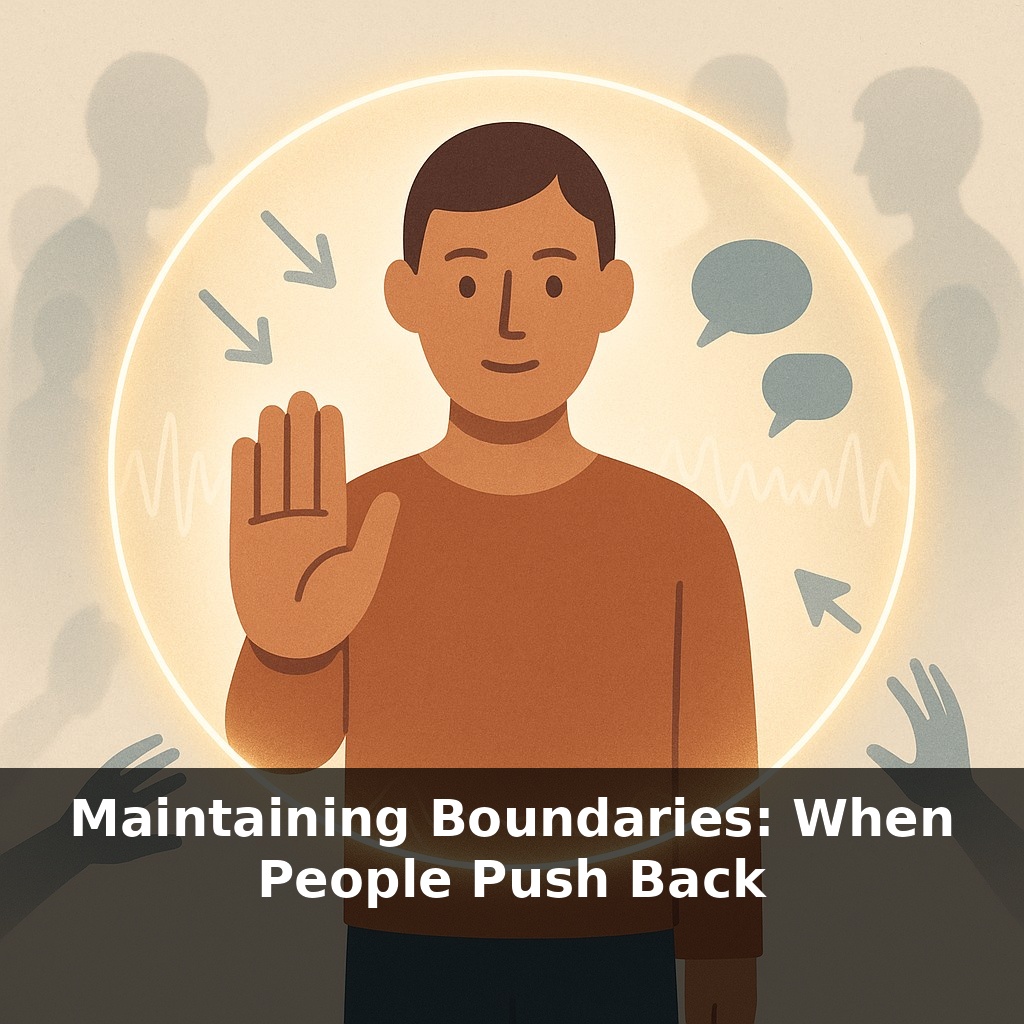
The moment you try to hold a line, the pressure starts. Not always loud or aggressive—often it’s a sigh, a long silence, a “wow, okay.” That micro‑pushback is exactly where most boundaries quietly collapse.
This is the messy part people don’t talk about: maintaining a boundary is less about finding the perfect sentence and more about what you do *after* the other person doesn’t like it. Their discomfort can trigger yours—tight chest, racing thoughts, urge to explain yourself into exhaustion.
Here’s where things get interesting: you can train for that moment. Not to be tougher or colder, but to stay steady enough that you don’t abandon yourself just to make the tension go away. In this episode, we’ll focus on how to hold your ground when the real-time pushback hits.
When people push back, they’re often running their own “scripts”—habits, fears, or expectations you didn’t write but still get cast in. A manager assumes you’ll always “step up,” a friend leans on you as the default problem-solver, a partner treats your time as shared property by default. Each script comes with built‑in reactions: guilt, irritation, distancing, charm. Your job isn’t to rewrite their entire personality; it’s to keep returning to your own script. That means knowing *in advance* which lines you’ll repeat, which topics you’ll step away from, and how you’ll calm your body so your mouth doesn’t betray your values.
Pushback usually shows up in three flavors: confusion, persuasion, and escalation.
Confusion sounds like: “Wait, I don’t get it—why can’t you?” or “Since when is this a problem?” Here, the temptation is to over‑explain. The more detail you pour in, the more entry points you create for debate. Instead, think in short loops: clarify once, then gently repeat. “I’m protecting my evenings for family now, so I’m not taking extra work. I know that’s different from before, but it’s important to me.” If they circle back: “I get that it’s inconvenient. My answer’s still no.”
Persuasion sounds warmer: “We really need you.” “It would mean a lot to me.” This kind of pushback leans on your desire to be helpful or liked. Research on compliance shows that even a tiny delay—five seconds of pause and a slow exhale—dramatically reduces automatic yeses. Use that space to quietly ask yourself: “If I say yes, what am I teaching them about my limits?” Then respond with a “yes to something else”: “I can’t stay late, but I can help you prioritize what to tackle first.”
Escalation is the hardest: sarcasm, raised voice, sulking, or subtle punishment—messages left on “read,” invitations drying up. Here, the goal shifts from convincing them to protecting yourself. You’re not arguing for your right to have a boundary; you’re deciding how you’ll respond to violations. That might mean naming the pattern: “When I say no and you shut down, it makes it hard to talk honestly. I’m willing to discuss this, but not if it turns into a punishment.”
Think of this like adjusting medication dosage: you don’t start with the strongest response, but you *do* increase it if mild interventions fail. First you restate. If that’s ignored, you change your behavior: leave the conversation, log off on time, decline future requests. Consequences are not about revenge; they’re feedback about reality. Over time, people learn which version of you they get: the one who folds under pressure, or the one who’s kind, clear, and consistent even when it’s uncomfortable.
Jade’s boss drops a “quick favor” on Friday at 4:45 p.m. She feels that familiar jolt—tight shoulders, mind racing to justify a refusal. Instead of launching into a long story, she uses a simple loop: “I’m not available tonight. I can work on this first thing Monday.” When he presses—“It really has to be today”—she doesn’t add new reasons; she repeats, calmly, almost like reading from a script she already chose: “I hear it’s urgent. I’m still not available tonight.” The content barely changes; her *nervous system* response does. Each steady repetition signals to her own body, “We’re safe, we’re consistent.”
Your version might happen over text. A friend double‑texts after you decline last‑minute plans: “You’ve changed” followed by “Guess you’re too busy now.” Instead of defending your entire personality, you keep it narrow: “I care about you *and* I’m keeping tonight free. Happy to plan another day.” Their reaction is data. If they keep poking, your next move isn’t a better speech—it’s a behavioral shift: slower replies, fewer “emergency” rescues, more intentional yeses.
Thirty-nine percent of employees say they’re comfortable saying no at work. That means most teams run on silent resentment and quiet overwork. As tech, AI, and remote tools blur every line, the real skill won’t just be naming limits—it’ll be weathering the reaction when those limits cost someone convenience, money, or ego.
Your challenge this week: Notice one place where tech sneaks past your intentions—like checking email in bed—and run a simple experiment. For seven days, create a tiny “no‑tech window” around one pressure point: the first 15 minutes after you wake up, the last 20 minutes before sleep, or the first 10 minutes of lunch. Expect some internal protest: “You’ll miss something,” “They’ll be annoyed.” Instead of arguing with those thoughts, test them. At the end of the week, see what actually happened—to your stress, to your focus, and to how people responded when you didn’t instantly react.
You won’t always get applause when you hold a line; sometimes you get silence, distance, or a joke at your expense. Treat those moments like weather reports, not verdicts on your worth—signals that help you adjust your “forecast” for certain people. Over time, the pattern shifts: fewer storms, more clarity, and relationships that can handle an honest “no.”
To go deeper, here are 3 next steps:
1. Print or download Nedra Glover Tawwab’s “Set Boundaries, Find Peace” Boundary Scripts (on her website) and highlight 3 phrases you can borrow for the exact pushback you get most (e.g., guilt-tripping from a parent, pressure to say yes at work). 2. Install the guided journaling app “How We Feel” and, for the next week, log your emotions right after you hold a boundary, then screenshot one entry to bring into your next tough conversation so you can say, “Here’s what happens for me when this line gets crossed.” 3. Queue up Terri Cole’s “Boundary Boss” podcast episode on saying “no” without over-explaining, and while you listen, open your phone’s Notes app and create a “Default No Responses” list using her wording, so you have ready-made replies the next time someone pushes back.