In hospitals, a simple checklist has cut certain diagnostic mistakes by nearly half. Now, jump to your own life: hiring, feedback, even dating. You trust your gut, but it quietly tilts the scales. How would your choices change if you treated bias like a daily safety hazard?
Think of moments when you’re sure you’re being “objective”: skimming résumés, choosing who to mentor, deciding whose idea sounds “strategic.” Those are often the exact moments hidden shortcuts are steering you. The tricky part is that you can’t simply decide to “be less biased” any more than you can decide to “be fitter” and wake up with stronger muscles. Good intentions help, but they don’t rewire habits.
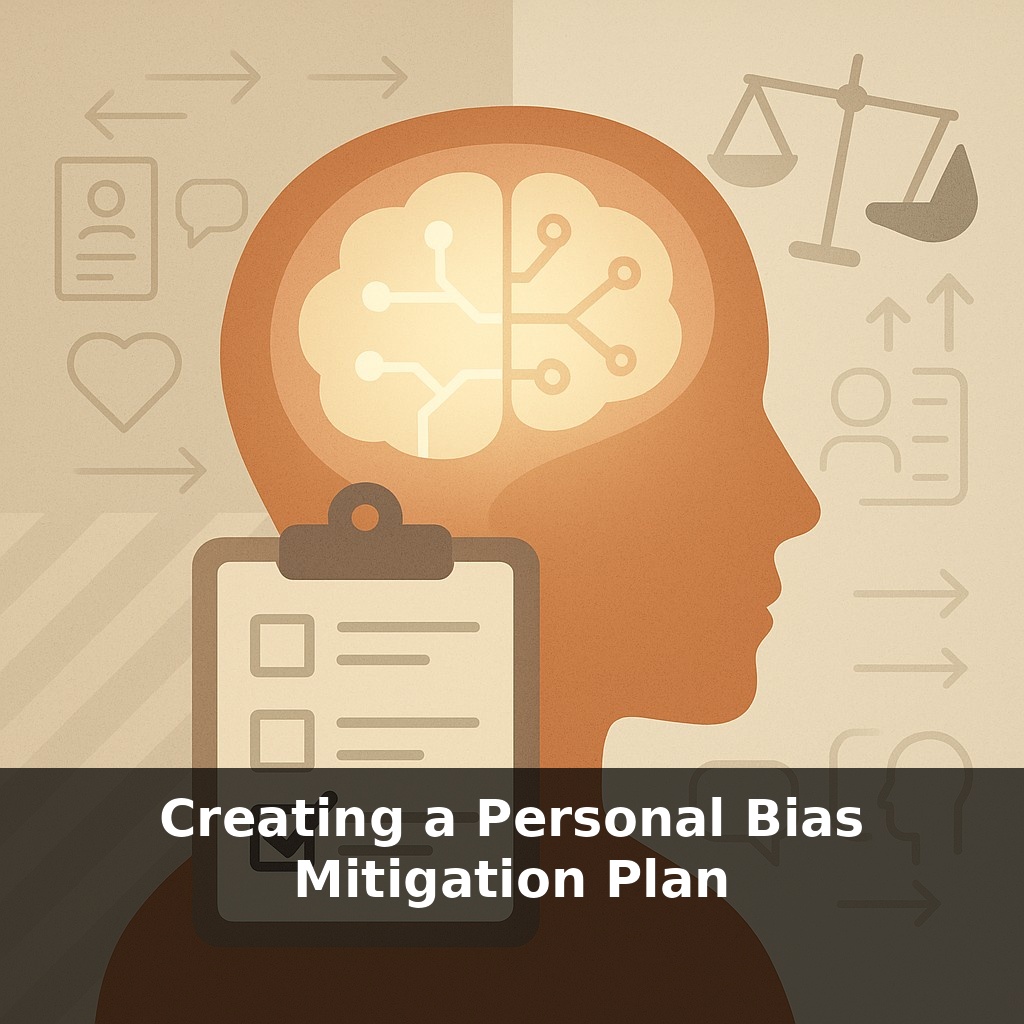
This is where a personal bias mitigation plan comes in—not as a moral report card, but as a practical blueprint. Instead of hoping you’ll notice bias in real time, you design a small set of routines that will catch you when you’re most likely to tilt: before you send that email, rank that candidate, or give that piece of feedback. Over time, these routines become less like rigid rules and more like the guardrails on a mountain road—quietly preventing the worst drops while still letting you drive.
So far, we’ve focused on seeing where your thinking tilts; now we’ll turn that insight into a concrete, personal system. The goal isn’t to overhaul your entire life at once, but to target the few situations where your snap decisions have outsized impact: who gets opportunities, whose ideas move forward, how you judge “potential” versus “polish.” Think about these as high‑leverage intersections, like busy roundabouts in a city where small design tweaks change the whole traffic flow. Your plan will start there, then expand as you collect evidence about what actually shifts your patterns.
Researchers have catalogued more than 180 cognitive biases, but your plan doesn’t need to tackle all of them. It needs to focus on the specific “pressure points” where your judgment reliably drifts. That starts with pattern‑spotting: when do you later realize, “I was too harsh,” “I gave them the benefit of the doubt,” or “I went with the most confident voice in the room”? The plan turns those vague regrets into concrete triggers.
Begin by mapping three kinds of moments:
1. **High‑stakes**: choices that meaningfully affect other people (promotions, grading, funding, referrals). 2. **High‑uncertainty**: situations with incomplete information (first impressions, quick evaluations, crisis decisions). 3. **High‑emotion**: episodes where you feel rushed, annoyed, impressed, or anxious.
Where these overlap, your plan needs the most structure. For each overlap, you design two things: an *if‑then* interruption and a *standard of proof*.
- *If‑then interruption*: “If I’m about to rate someone’s ‘leadership presence’ after a single meeting, then I will write three concrete behaviors before scoring.” - *Standard of proof*: “Before labeling an idea ‘unrealistic,’ I must list at least one condition under which it could work.”
These are small, mechanical moves, but meta‑analyses show such if‑then rules dramatically increase follow‑through because they pre‑decide your response while you’re still calm.
Next, you anchor your plan in observable data rather than feelings. Instead of asking, “Am I being fair?”, you ask, “What would someone see in my decisions over the past month?” That means tracking a few simple distributions: who you praise, whose ideas you assign ownership to, who gets stretch work, how often you change your mind when presented with disconfirming evidence.
Think of it like adjusting a camera lens on a hike: you don’t argue with the landscape; you tweak the focus until the picture matches reality more closely. Over time, your plan becomes a set of small, repeatable moves that make those tweaks predictable instead of accidental.
Consider a manager who keeps a simple log after each hiring round: three names, brief notes on why each was advanced or rejected, plus one column labeled “hunch vs. evidence.” After a few cycles, she notices a pattern: candidates who mirror her own background get “leadership potential” comments with thinner evidence. That single realization guides her next if‑then rule: when two candidates are close, she brings in a second reviewer who doesn’t know their résumés, only anonymized work samples.
Or take a professor grading projects. He randomizes the order of papers, hides student names, and scores one criterion at a time across the whole stack. His dashboard shows fewer extreme scores for women only after he changed his process, not his standards.
Analogy from travel: think of your plan like updating a navigation app after each trip—flagging where you hit traffic, then automatically suggesting alternate routes next time those same conditions appear.
As these plans spread, your calendar may feel less like a to‑do list and more like a dashboard for how your judgments shape others’ paths. Leaders might share bias‑reduction metrics the way teams now share uptime stats. Pair that with AI tools quietly flagging skewed patterns in drafts or decisions, and you get a kind of “ethical spell‑check.” The open question: who owns that data—and how do we balance self‑improvement with privacy, autonomy, and the right to change?
Your challenge this week: treat one recurring decision—like who you ask for input—as a live experiment. Draft a tiny safeguard, try it three times, then note what shifted. Over months, these tweaks can turn your calendar into a record of course‑corrections, more like a gardener’s journal than a scoreboard of right and wrong.