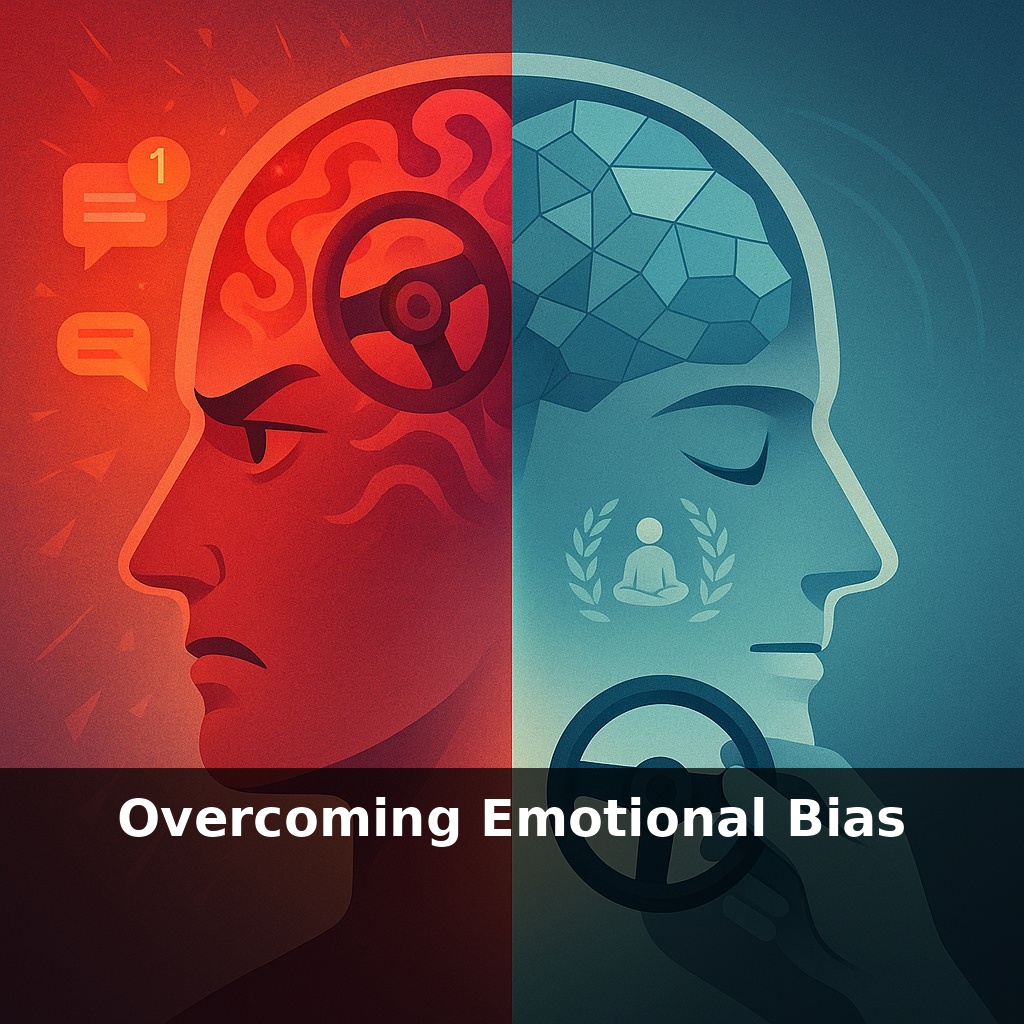
Your brain can predict elections better than chance—until emotion gets involved. One text from an ex, one scary news alert, and suddenly your “rational plan” melts. This episode asks: when your feelings grab the steering wheel, how can Stoic tools quietly take it back?
Ochsner’s lab found something wild: simply reframing a situation can cut emotional brain activity almost in half. That means the gap between an impulsive text, trade, or outburst and a calm, deliberate response is often just one structured thought away. Yet in real life, we rarely use that gap. We move from trigger to action like it’s a single step, not a hallway with doors we can choose.
In this episode, we’ll walk into that hallway. We’ll look at how a 5‑minute Stoic-style reflection can shift a tense salary negotiation, a market downswing, or a family argument. Instead of just “feeling less,” the goal is to feel clearly—and then choose. Think of it as composing a short piece of music: the notes (your reactions) are already there, but the order, the pauses, and the emphasis are up to you.
So now we zoom in on the exact moment things usually go wrong: not in a crisis, but in tiny, ordinary frictions. A terse email from your boss. A sudden dip in your portfolio. A partner who’s late—again. These aren’t life-or-death events, yet they quietly bend your choices all day. Neuroscience and Tetlock’s forecasters both hint at the same leverage point: people who pause to inspect their first story about an event make measurably better calls. In Stoic terms, that story is your “impression.” In this episode, we’ll practice catching that impression in flight, then testing it instead of swallowing it whole.
Most emotional bias begins in the half‑second after something happens, when your mind silently fills in missing details. The Stoics called that instant story an “impression,” but what matters for you is this: your brain treats that first draft as if it were a news report, not an opinion piece.
Modern research quietly agrees. In Tetlock’s forecasting trainings, the turning point wasn’t deeper data; it was teaching people to question the snap narrative: “This means X… therefore Y will happen.” Those who learned to add one simple step—“What else could this mean?”—started outpredicting professionals who never paused to do that.
To make this concrete, take three everyday scenes:
• A terse “We need to talk” from your manager. Default story: “I’m in trouble.” Alternative stories: “New project,” “Schedule change,” “They need my input.”
• Your investments drop 3 % in a day. Default story: “I’m about to lose everything.” Alternative stories: “Normal volatility,” “Sector rotation,” “Overreaction to headlines.”
• A friend goes quiet on your messages. Default story: “They’re mad at me.” Alternative stories: “They’re overloaded,” “Phone issues,” “They think the conversation is paused.”
In each case, emotional bias isn’t just “feeling strongly”; it’s over‑committing to one untested version of reality and then acting as if it’s confirmed. Fear, excitement, or anger narrow the field of possible explanations until only the most intense one survives. The Stoic move is not to censor the feeling, but to deliberately widen that field again.
Here is where structured reflection earns its keep. A 5‑minute written review of a charged event—especially the part where you list alternative explanations—forces the brain to treat your first story as a hypothesis, not a verdict. fMRI work on cognitive reappraisal hints at why this matters: when you consciously generate different interpretations, regions linked to deliberate evaluation light up, and emotional reactivity drops.
The key is specificity. Vague “stay rational” intentions do almost nothing in the heat of the moment. But a practiced micro‑routine—spot the story, name it, generate at least two rival stories—gives your mind a pattern to fall into when the email lands, the price moves, or the message stays unread.
A practical way to see this is to watch where your mind “autocompletes” reality. Think of three quick scenes from a single day:
You open your trading app and see a sudden spike in one stock you own. One person instantly feels a rush and thinks, “I knew it, I’m onto a winner,” and starts adding more without checking news or fundamentals. Another notes the same spike, but before acting, scribbles a one‑line note: “Three non‑hype explanations?” That tiny detour often cools the urge to chase.
Later, you get a short reply from a close friend: “Can’t. Busy.” One version of you reads rejection and pulls back for weeks. Another pauses to ask, “If a stranger sent this, what would I assume?” Often the sting softens enough to just ask how they’re doing.
Finally, in a late‑night argument, your partner sighs and looks away. One narrative: disrespect. Another: exhaustion. That single fork—insult or overload—can flip whether you escalate or end the night problem‑solving side by side.
As AI systems handle more of the “heavy math,” your edge may come from something subtler: noticing when your own judgment is drifting. Teams might soon treat bias‑checks like safety drills—routine, logged, and reviewed. Schools could grade not just answers, but the reflection that led there. Think of boardrooms where a “Stoic minute” is standard before high‑stakes votes, and wearables nudge you to run that drill whenever your pulse or voice starts to spike.
Treat this as a craft you’re learning, not a switch you flip. Some days your review will feel sharp, other days muddy—both are data. Over time, patterns in your notes become like contour lines on a hiking map: routes where you usually slip, ledges where you can rest. Follow them long enough, and “overreacting” turns into “noticing sooner.”
Start with this tiny habit: When you notice yourself feeling strong emotion about a decision (like excitement about a risky investment or dread about giving feedback), quietly say in your head, “Feeling isn’t fact—what else could be true?” Then, look for exactly ONE concrete piece of disconfirming evidence (for example, one reason the investment might fail, or one reason the feedback might actually help). If you’re near your phone, quickly label the emotion in a note using just three words: “I feel [emotion] about [decision].” This tiny pause builds the muscle of checking your emotional bias without needing a big journaling session or long reflection.