About half of salespeople never follow up after sending a proposal—yet most deals only close after several follow-ups. In one story, two reps pitch the same client; one casually waits, the other guides each step. Same offer, totally different outcome. Why?
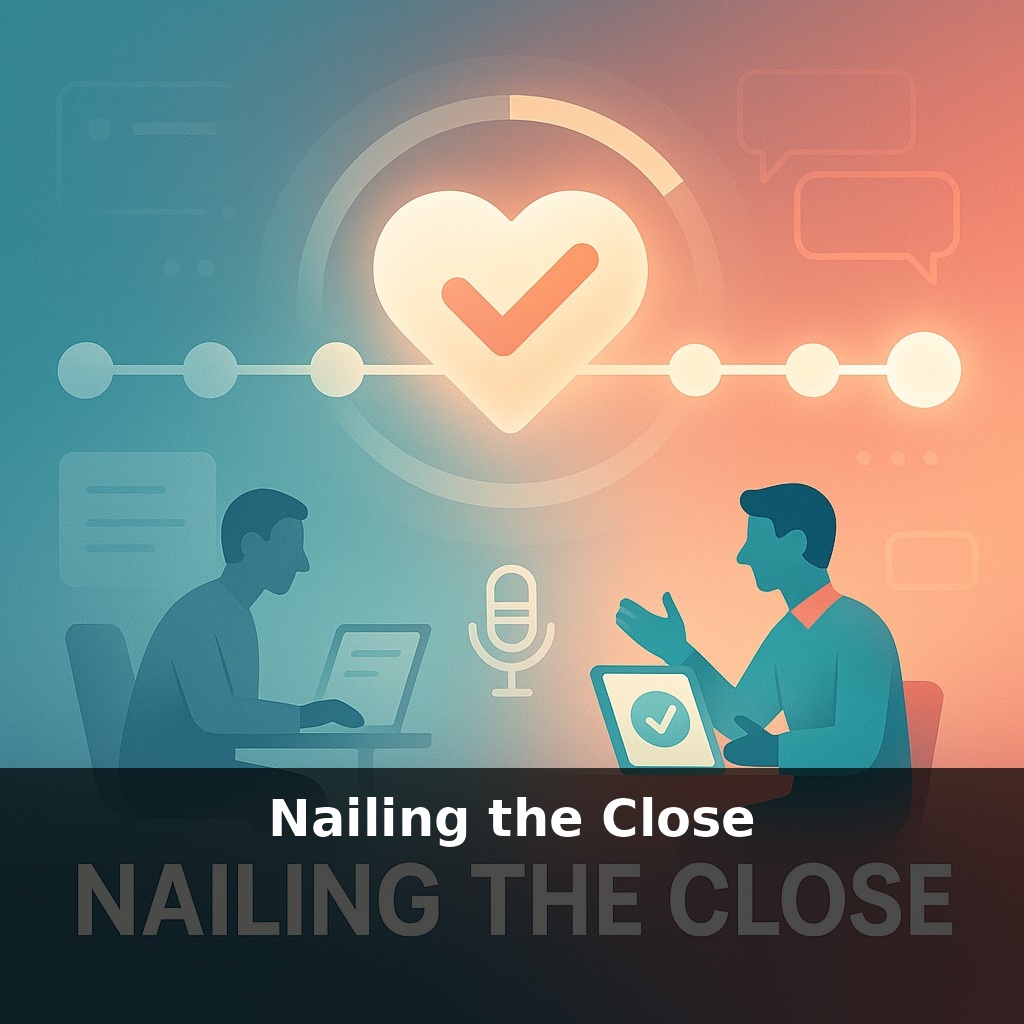
Most people treat “closing” like a dramatic final line—either you nail it or you choke. But in real high-stakes deals, there’s rarely a single cinematic moment. The close is more like loading a software update: dozens of small background processes quietly complete before you ever click “Install now.” By the time the client hears a closing question, their mind has already been updating—shifting from “Is this relevant?” to “Is this worth changing for?” to “Is this the right partner?”
That’s why top performers don’t wait for the end; they seed the close from the first real conversation. They watch for subtle readiness signals: how precisely the buyer talks about outcomes, who suddenly gets invited to meetings, how quickly they respond to clarifications. Closing becomes less about pressure and more about helping the buyer cross a line they’re already standing next to.
So what actually separates the rep who “guides each step” from the one who just waits? It’s not charm or a magic script; it’s how deliberately they design the path to a decision. Think of it like drafting architectural plans: every beam, doorway, and staircase is placed so people naturally move through the building without getting lost. In the same way, effective closers map the buyer’s path in advance—who needs to weigh in, what risks must be de-risked, which questions must be answered—and then use each interaction to quietly remove one structural obstacle to saying yes.
Most people lose the close long before they ask for it—by skipping the unglamorous work of building *clarity* and *commitment* step by step.
The research you rarely hear in “killer closing line” videos is this: deals jump 2–3× in likelihood when you (1) uncover decision criteria early, (2) earn micro-commitments, and (3) align your ask with explicit readiness signals. That means the “yes” is usually decided in the messy middle, not the polished finale.
Start with decision criteria. Instead of “Do you like it?” ask, “When you’ve chosen vendors in the past, what separated the winner from the runner‑up?” or “If this stalls internally, what will usually be the reason?” You’re not just gathering preferences; you’re learning the rules of the game before you play it. Now you can frame your value in their language: “You said integration risk and rollout speed matter most. Here’s how we de‑risk both.”
Next, think in micro‑commitments. Each small “yes” should move the deal forward in a visible way: “If this pilot hits X result, are you comfortable championing it to your VP?” or “Are you open to looping in procurement next week so we don’t get surprised later?” These aren’t tricks; they’re gentle tests of intent. When someone agrees repeatedly to meaningful next steps and follows through, their own behavior nudges them toward consistency at the final decision.
Options matter too. Instead of a binary “Are you moving ahead?”, use calibrated choices: “Based on what you’ve shared, the two best fits are A and B. Which feels closer to what you want to roll out first?” That small shift reduces the psychological weight of deciding; they’re choosing *how* to move forward, not *whether*.
Finally, match your close to their communication style. For an analytical buyer, anchor on proof and risk: “Given the numbers we’ve reviewed, is there any remaining risk you’d want covered before we formalize this?” For a visionary, anchor on outcome: “If we can lock this in this quarter, are you ready to start seeing those gains by Q3?”
You’re not pushing them over a line; you’re making it obvious, safe, and natural to cross it.
Think about the moment a buyer *shows* you they’re close, but doesn’t say it outright. They start asking, “How soon could this be live?” or “Who else is using this in our industry?” Those are inflection points where your next move either normalizes progress or lets the energy leak out.
Instead of, “So… what do you think?”, try layering in their own words: “Earlier you said cutting onboarding time by 30 % would change your team’s quarter. Between the standard rollout and the fast‑track option, which gets you there in a way that feels realistic?” You’re not introducing pressure; you’re narrowing their focus to concrete paths that match their stated stakes.
One useful pattern: treat each late‑stage interaction as a “decision rehearsal.” You preview the conversations they’ll have without you in the room: “When your CFO asks why now, what’s going to resonate most with them?” Their answer becomes raw material for your close. When they can articulate that logic clearly, they’re usually ready—your closing question just lets them say it out loud.
Soon your “last mile” won’t be just a meeting; it’ll be a live, adaptive system around you. AI will watch call transcripts like a chess engine, surfacing which questions tend to unlock stalled champions in your exact segment. Biometrics may flag micro‑hesitations the way a heart‑rate monitor flags overtraining, nudging you to pause and probe. As rules tighten around manipulative tactics, the real edge shifts to those who can document their closes like clean, auditable code: clear intent, explicit consent, no hidden loops.
Treat each “yes” you earn as a joint design decision, not a victory. You’re co‑authoring a future state they’ll have to live in long after you’re gone. The real mastery isn’t getting agreement; it’s making sure that agreement still feels right for them three quarters later—when budgets shift, priorities change, and your promises meet their reality.
Try this experiment: For your next three sales calls this week, ask the prospect upfront, “What needs to be true for you to feel completely comfortable moving forward today?” and write down their exact words as they answer. Then, near the end of each call, use their own language to close, e.g., “You said you’d be ready to move forward if X, Y, and Z were in place—have we checked those boxes together?” Track what happens to your close rate and how long the close part of the call takes compared to your usual approach. After the three calls, decide which phrasing felt most natural and landed best, and lock that in as your new default closing script for the next week.