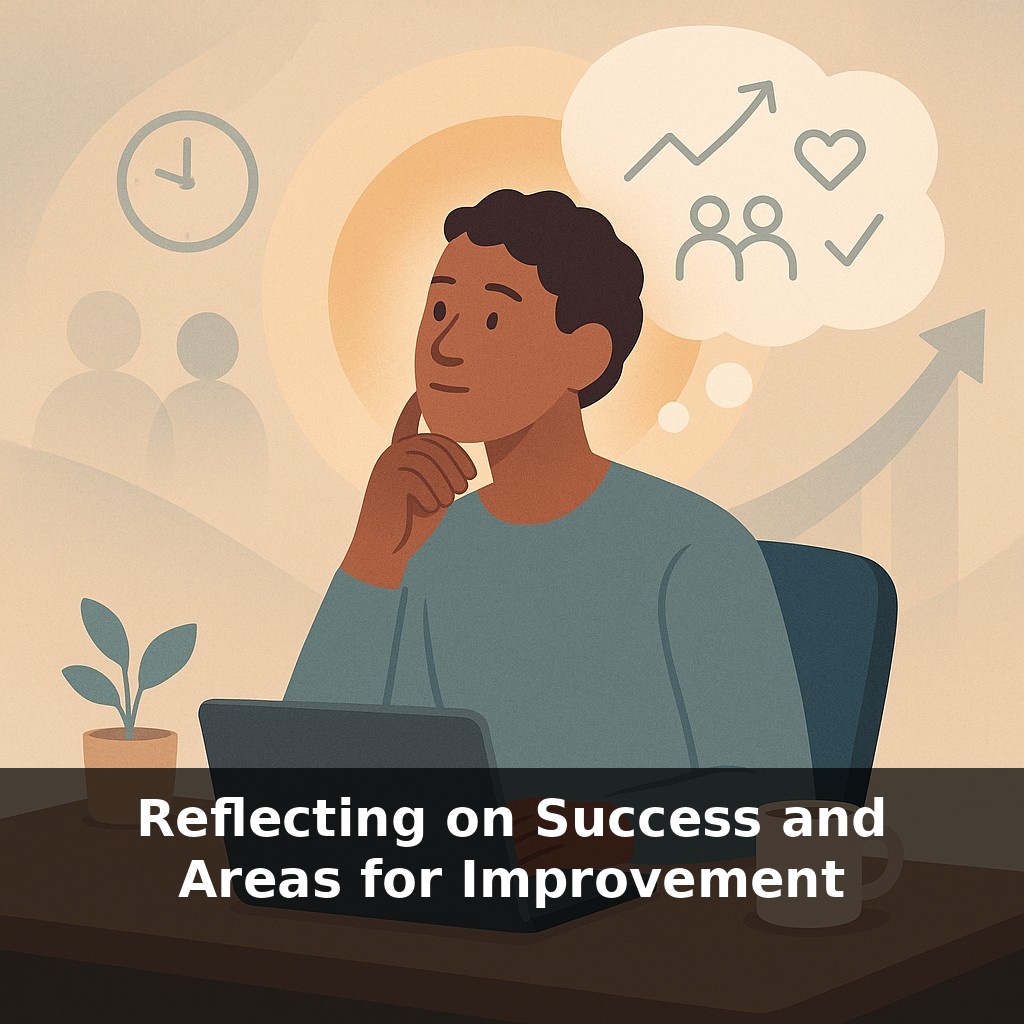
“Reflect for fifteen minutes, perform more than twenty percent better.” That’s the finding from one Harvard experiment. Now, jump to a sales rep closing their laptop—no fireworks, just a quiet pause to replay the day. That tiny habit might be the hidden engine behind their biggest wins.
“Top performers spend more time reviewing their work than doing more work.” On paper, that sounds backwards—surely more calls, more meetings, more activity should win. Yet when researchers looked closer, the real differentiator wasn’t hustle; it was how deliberately people learned from what they’d already done.
Here’s the twist: most people only “reflect” when something goes wrong—a lost deal, a tense conversation, a bad quarter. But the real leverage is in calmly dissecting your *wins* too: what, exactly, made that client open up? Why did that skeptical stakeholder suddenly lean in?
Think of it like tuning a radio. The signal (what actually works for you) is already there, but buried in static. Structured reflection is how you slowly dial past the noise—until your own patterns, strengths, and blind spots come through in clear stereo.
Most people say they’ll “think about what happened later,” then never do. The day blurs, one interaction melts into the next, and useful details vanish: the exact moment a prospect’s tone softened, the question that shut the conversation down, the side comment that revealed a hidden need.
That’s where *structure* matters. A simple scaffold—three numbers, three questions, three next steps—forces your brain to slow down and label what actually happened. Over time, those labeled moments turn into patterns you can trust: which openings consistently lower defenses, which signals predict a stalled deal, which behaviors precede your best conversations.
Start with what you *can’t* argue with: numbers. Your CRM already knows how many calls you made, how many moved to next steps, how many went dark. But numbers alone are like a scoreboard without the game film—you see the outcome, not the *why*. The power move is to pair hard metrics with a short, focused look at how you actually *showed up* in those conversations.
One simple way to do this is to split your reflection into three “views”: **Dashboard view, Replay view, Zoom-in view.**
**1. Dashboard view: the quick scan** Look at just three metrics at the end of a day or week: - Conversations started - Next steps agreed - Deals meaningfully advanced
No judgment—just notice what’s up, down, or flat. You’re not solving yet; you’re spotting where to look closer.
**2. Replay view: the storyline behind the numbers** Pick *one* interaction that clearly went well and *one* that clearly didn’t. For each, answer: - “Where did the energy shift?” - “What did the other person do right before that shift?” - “What did *I* do right before that shift?”
This keeps you anchored in observable behavior, not vague moods. It’s less “the call felt bad” and more “when I jumped to pricing, their answers got shorter.”
**3. Zoom-in view: the tiny lever** Now, choose a single behavior to test next time. Not a personality transplant—*one* small, repeatable tweak. For example: - “Pause two seconds longer after asking a question.” - “Paraphrase their problem before suggesting anything.” - “Ask, ‘What would make this a win for you?’ before sharing features.”
Treat this like adjusting a single setting in an app and watching how the interface changes. You’re isolating variables so you can actually tell what made the difference.
Over a few cycles, you’ll notice certain levers pay off more often. Those become your personal “plays.” And when you tie each play back to both the metric trend and the felt shift in the conversation, you’re no longer guessing; you’re running controlled experiments in real relationships, guided by both data and lived moments.
Think of a rep named Maya. Her dashboard says she’s booking plenty of first meetings, but few turn into serious opportunities. Instead of guessing, she tags three calls where things stalled and three where prospects eagerly booked next steps. Listening back, she spots something concrete: in the better calls, she stays with the problem longer; in the weaker ones, she switches to slides within minutes.
She turns that into one tiny test: “Hold off on sharing a deck until I’ve heard three consequences of their problem.” Next week, she compares *only* meetings where she followed that rule. Her conversion rate nudges up. That small win becomes her new default, and she moves on to the next lever.
Teams can do this together. One company I worked with ran a “deal autopsy” every Friday: they’d bring one won and one lost deal, map the turning points on a whiteboard, and each person left with a single behavior to test. Over a quarter, their average deal cycle shrank by four days—and no one added more hours, just more precision.
Soon, your “future self” may feel less like a goal and more like a collaborator. As AI stitches together your calls, emails, and outcomes, it can flag blind spots you’d never notice alone—like a quiet co-founder who only speaks up when the data is clear. The edge won’t just come from who reflects, but from who *implements* fast: testing micro-adjustments in live conversations, then feeding those results back into shared playbooks that update as quickly as software releases.
Your future edge won’t be knowing *that* you should reflect—it’ll be how creatively you turn those moments into experiments. Treat each insight like a software patch: small, specific, and shipped fast. Over time, your conversations become less like cold calls and more like well-mapped hiking trails you’ve personally tested, marked, and refined.
Before next week, ask yourself: 1) “Looking at this past week, which specific moment actually felt like success for me (not what others would applaud), and what exactly was I doing, thinking, and saying in that moment?” 2) “Where did I feel the most resistance or frustration, and if I replay that situation in my mind, what’s one concrete thing I could have done differently right then (a question I could have asked, a boundary I could have set, or a pause I could have taken)?” 3) “If next week went ‘10/10 successful’ by my own definition, what would I be proud to tell a close friend about, and what’s one decision I can make today that nudges me in that direction?”