Introduction to Mediation
📝 Transcript
Right now, somewhere, two people are locked in a fight that will drain tens of thousands of dollars and months of their lives—over a dispute that could be solved in one afternoon. In this episode, we step into that room and quietly change how the conversation ends.
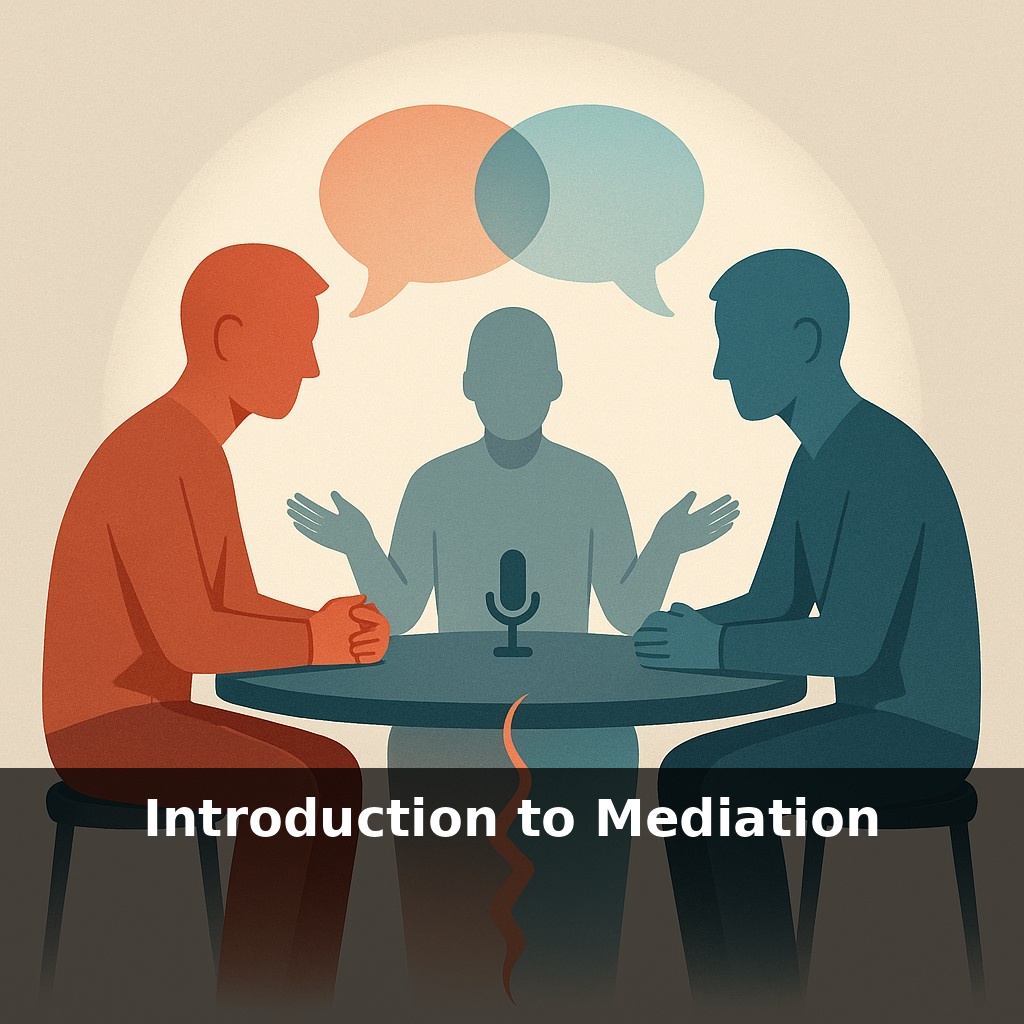
Most conflicts don’t explode because the issue is huge; they explode because no one feels safe enough to say what actually matters. That’s where mediation enters—not as a softer version of fighting, but as a different game entirely. Instead of arguing about who’s right, people are invited to explore what they need next.
In this episode, we’re stepping behind the scenes of that process. We’ll look at what happens before anyone speaks, how the room is set up, and why the mediator’s first few sentences can determine whether people shut down or start to open up. Think of it like tuning instruments before a performance: nothing beautiful happens until the basics are aligned.
You’ll see how small shifts—where you sit, how you frame the problem, what you agree not to do—can transform a tense standoff into a workable path forward, even when trust is almost gone.
Before any ground rules are spoken, something quieter is already shaping the outcome: what each person believes is *even possible* today. Some arrive convinced “nothing will change,” others secretly hope for a miracle, most are braced for disappointment. Those expectations act like software running in the background—limiting what people risk saying, the offers they consider, and how they interpret every pause or raised eyebrow. In this phase, the mediator is listening for those hidden assumptions and gently testing them, so the “program” can update enough for real options to appear. Only then can any agreement feel real, not forced.
Numbers help break through skepticism, so let’s ground this in what actually happens once everyone is in the room. When you move past opening statements, the work shifts from “telling your story” to carefully re‑wiring how the problem is framed. Not redefining reality, but choosing which slice of it you’re all going to work on first.
A good mediator starts narrowing the focus from “everything that’s ever gone wrong” to one concrete decision: an overdue invoice, a parenting schedule, a delivery timeline. That first slice matters. If it’s too big (“our whole relationship”), people freeze. Too small (“who speaks next meeting”), it feels trivial and disrespectful. Finding that middle ground is often the first quiet win of the session.
Then comes translation. Parties speak in conclusions: “He lied,” “She doesn’t care,” “They’re sabotaging us.” The mediator listens for what’s underneath—risks, needs, fears—and feeds those back in more workable language: “So predictability in payments is critical for your cash flow,” or “It sounds like reliability of future deliveries matters more to you than rehashing the last one.” This isn’t word‑polishing; it’s shifting from blame to criteria you can actually negotiate.
At this stage, the conversation starts to branch. Instead of a linear tug‑of‑war over one number or one outcome, the mediator opens multiple tracks: timing, money, apologies, future safeguards, how to communicate when things wobble again. Often, the surprising progress comes not from the headline demand, but from these side tracks—like a supplier agreeing to earlier status updates in exchange for slightly looser deadlines.
You’ll also notice a change in tempo. Early on, every sentence lands hard. Gradually, the mediator experiments with micro‑pauses: “Let’s take 30 seconds. No talking. Just check whether what you *actually* want to say next will move us forward.” Those tiny breaks allow people’s better judgment to catch up with their emotions.
Behind it all is a quiet invitation: instead of trying to win the past, design a future you can both live with. That shift—from replaying to redesigning—turns the session from a post‑mortem into a planning meeting with tension, but also possibility.
Think about two co‑founders who barely speak except through lawyers. One is obsessing over equity percentages; the other, over a board seat. On the surface, it’s “who owns what.” Underneath, it’s security versus recognition. When the mediator surfaces those different priorities, the deal space widens: maybe one gets a slightly larger stake but fewer veto rights, while the other trades some equity for stronger governance protections and a clear title. Neither “wins” the old argument; both get more of what quietly mattered.
In another case, a divorcing couple stuck on who keeps the house may discover they care about different timelines: one needs immediate stability for the kids’ school year; the other needs time to refinance. Suddenly options appear—temporary nesting, short‑term co‑ownership, or a staged buyout—that would never show up if the only question was, “Who walks away today?”
The same pattern appears in workplace disputes: a team lead wants autonomy, their manager wants predictability. Once those are named, they can design check‑ins, not character judgments.
As conflicts get more digital, cross‑border, and high‑stakes, that quiet skill of “re‑framing the problem” becomes strategic infrastructure. Leaders who can do this won’t just handle blow‑ups; they’ll shape mergers, climate talks, even AI policy. Think of it as learning to read the “source code” of tension: once you can spot the buried fears and mismatched timelines, you can update the system without crashing it. The future advantage belongs to people who can do that live, in the room, under pressure.
Treat this first glimpse of mediation as a toolkit you can quietly test in everyday friction—family logistics, project deadlines, neighbor noise. Notice where people argue about “what happened” but never design “what happens next.” That’s your opening to ask one new question: “What would ‘good enough’ look like six months from now—for both of you?”
Before next week, ask yourself: “Where in my life right now (work, family, or friendships) is there a tension or misunderstanding that might benefit from a mediation-style conversation rather than another argument or silent avoidance?” Then ask: “If I stepped into a neutral ‘mediator’ role for that situation, how would I describe each person’s interests (not positions), and what might each side actually be needing or afraid of?” Finally, ask: “What is one specific, low-stakes opportunity this week to practice a mediation skill from the episode—like summarizing both sides without blame, or asking an open-ended question that invites the other person to share more—and when, exactly, will I do it?”
From this course
Mediation Mastery: The Art of Conflict Resolution
8 episodesUnlock all episodes
Full access to 8 episodes and everything on OwlUp.
Subscribe — $1.99/monthLess than a coffee ☕ · Cancel anytime