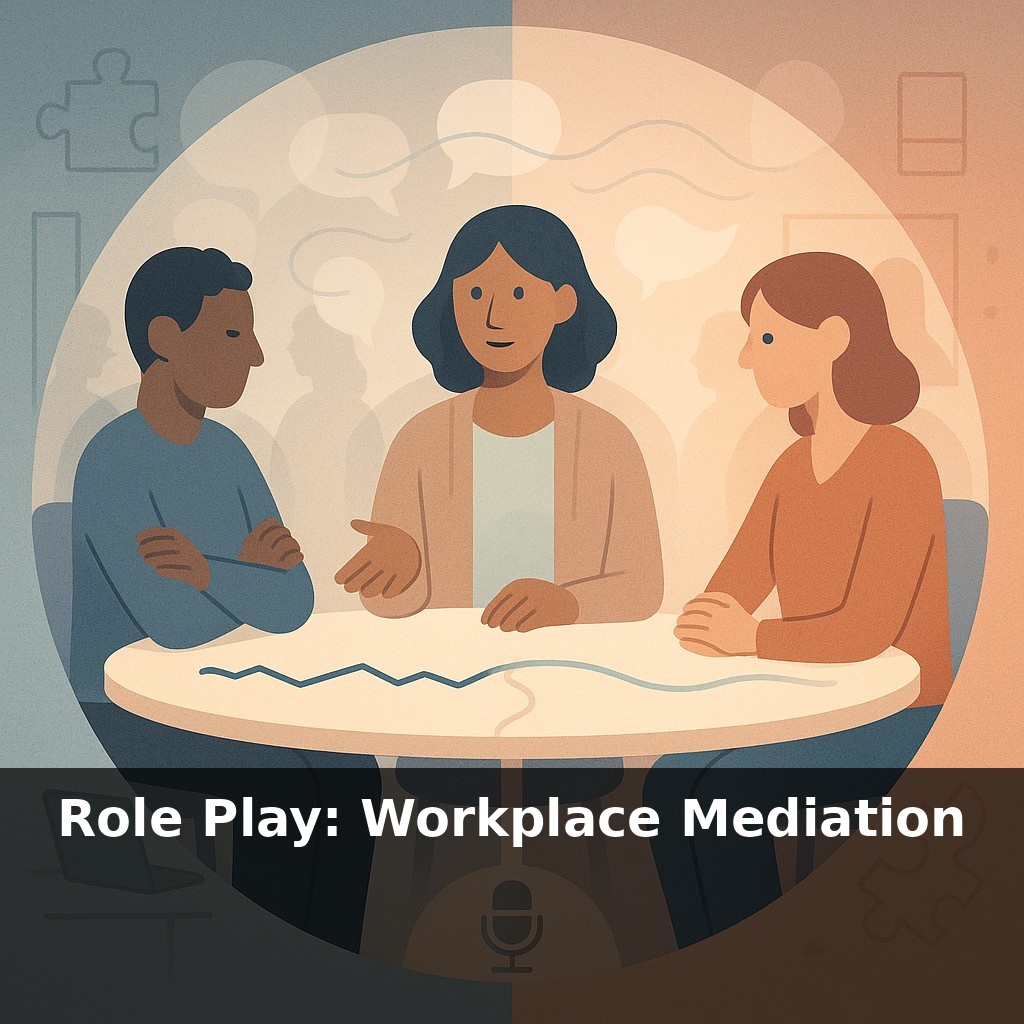
About eight out of ten people at work are tangled in conflict right now—yet most “mediators” they meet have never practiced out loud. In this episode, we drop you into the middle of a tense workplace showdown and explore how guided role-play can quietly change its ending.
That tension-filled showdown you just heard? In many organizations, it would leap straight from awkward meeting to formal complaint—skipping the one step that actually builds skill: structured practice. Inside effective training rooms, people don’t just “talk about” hard conversations; they put them on their feet. Scripts are dropped, emotions turn up, and suddenly the safe classroom starts to feel uncomfortably real. That’s by design.
In this episode, we zoom in on what happens *between* the role-plays: the micro-coaching, debrief questions, and quiet pattern-spotting that turn clumsy first attempts into reliable habits. You’ll see how high-performing programs design sequences of scenarios—like a playlist that slowly raises the difficulty—so that by the time mediators face real cases, they’ve already “lived through” dozens of messy endings and better alternatives.
Outside the training room, the stakes look very different. A delayed product launch, a grievance filed, two senior engineers who now refuse to be in the same meeting—these are the downstream costs organizations quietly absorb. That’s why serious programs don’t just chase “good conversations”; they track outcomes. Settlement rates, time-to-resolution, and post-mediation satisfaction become their scoreboard. When trainers review these numbers, they start tweaking who plays which role, how emotional a scenario can get, and when to pause the action—turning the curriculum into a living system that keeps learning.
The secret lever inside these programs isn’t how *dramatic* the scenarios are; it’s how precisely the roles are designed. You’re not just “Person A” arguing with “Person B.” You might be a high performer who feels invisible, a overextended manager under executive pressure, or an HR partner torn between policy and empathy. Each role sheet quietly encodes specific skills the trainee has to practice: spotting unspoken fears, naming power differences without shaming, or translating accusations into concrete requests.
Well-crafted training doesn’t start with “hardest case wins.” It starts by isolating one or two skills at a time. One round may focus almost entirely on neutral listening; the next adds value- and identity-based tensions; only later do you layer in legal landmines, cultural misunderstandings, or hierarchy. Think of it less as “one big simulation” and more as a series of targeted drills that eventually add up to game readiness.
Casting matters too. Many programs rotate people through three chairs: mediator, party, observer. Being “the difficult person” for fifteen minutes teaches you how clumsy interventions can feel from the inside. Sitting as an observer, you start noticing patterns the mediator can’t see in the moment—who talks more, what triggers escalation, where questions open things up or shut them down. Trainers then recycle those real observations into the next round’s instructions: “This time, exaggerate that eye roll,” or “Cut your answers short and see how they respond.”
The best designs also borrow from sports film review. Sessions are recorded; trainees watch specific moments in slow motion: the first interruption, the sigh before someone checks out, the missed chance to summarize. Instead of generic feedback—“You should stay neutral”—they replay the exact sentence where neutrality blurred and experiment with alternatives. Over time, this builds a mental library of moves that mediators can call on under pressure, long after the training room is packed up.
At one tech firm, trainers built a “product launch lab” series. In the first scene, two leads argued over priorities; by the final scene, a VP quietly threatened to pull funding. Each participant rotated through very specific briefs: the people-pleaser who never says no, the brilliant but defensive architect, the sponsor with a hidden deadline from the board. Afterwards, they compared notes on which interventions actually shifted momentum. Patterns from those labs later shaped how real cross‑functional meetings were run.
Government agencies sometimes push this further. One program stacked three cases from the same fictional department across a year of training. Tiny details—an offhand joke, a performance review comment—reappeared later as “history” that colored new tensions. Trainees had to recognize how unresolved slights echoed forward, not as a lesson on theory, but because the past was literally written into their next role sheet.
Your own version could be modest: a three‑scene arc following a promotion decision, a budget cut, and a reorg, all touching the same fragile working relationship.
As tools mature, the line between “training room” and “real work” will blur. AI could surface live prompts during tense 1:1s—like track changes for conversations—flagging when voices vanish or language hardens. VR might let global teams rehearse tough conversations across time zones, like a scrimmage before a championship game. Over time, promotion paths may quietly favor people who can document practice hours, not just performance numbers, reshaping who is seen as “leadership material.”
Treat these rehearsals less like acting class and more like prototyping. Each round is a rough draft of how you’ll respond when stakes are higher and time is shorter. Over weeks, you’re not just gathering tools; you’re mapping your own pressure points—who you freeze around, when your voice tightens—and quietly redesigning your default settings before they’re tested.
Here’s your challenge this week: Before Friday, initiate a 20-minute “reset” conversation with a colleague you’ve had even mild tension with and explicitly take on the *mediator mindset* from the episode—your only goal is to understand, not to defend. Start by asking them, “From your perspective, what hasn’t been working between us lately?” and then reflect back their key points in neutral language at least twice (“What I’m hearing is…”), exactly like the role-play mediator did. Before you finish, propose *one* specific experiment for the next week (e.g., clearer handoff times, no surprise Slack messages after 5 pm, a shared checklist) and agree on how you’ll both know if it’s working.