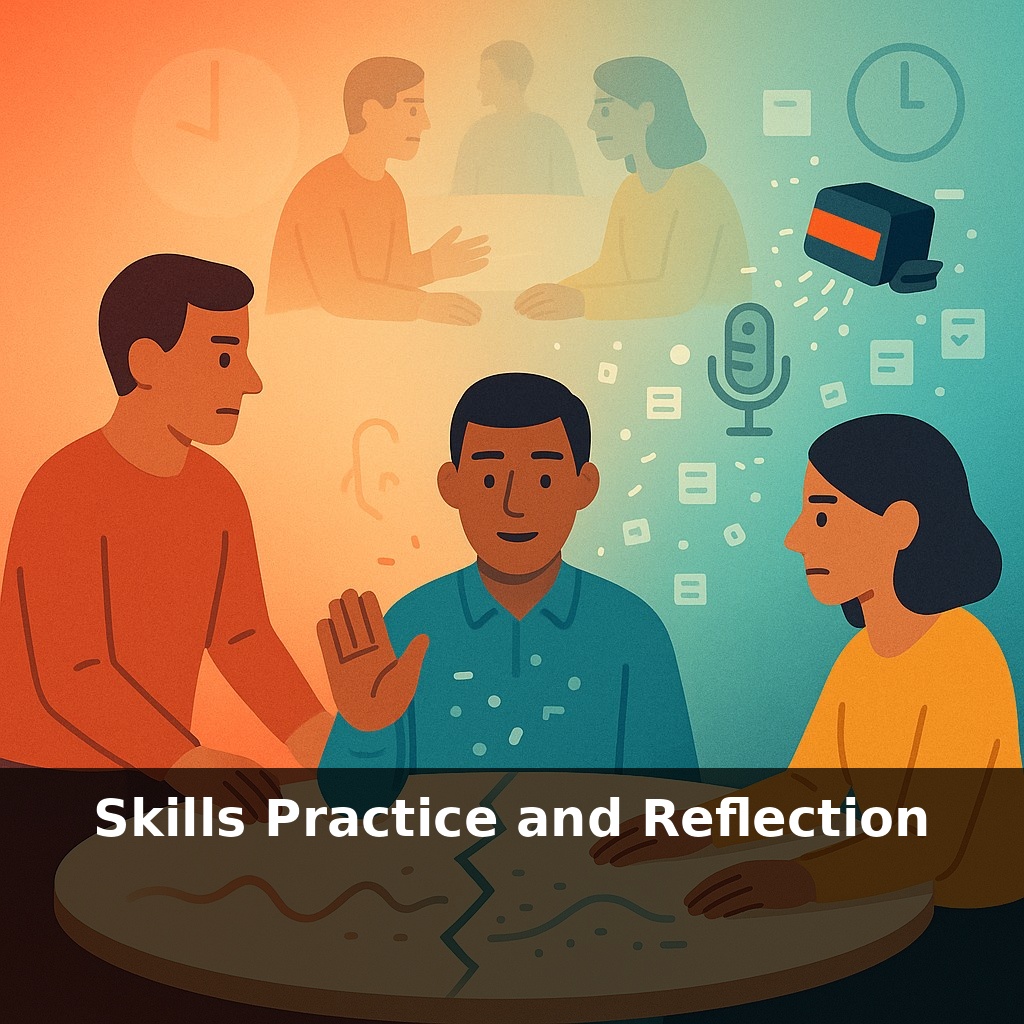
Most mediators don’t fail because they lack talent; they fail because they don’t train on their mistakes. A tense meeting runs long, voices rise, the session ends… and everyone just moves on. The real skill jump starts in the quiet hour after the conflict is over.
High‑performing mediators treat every session like a flight recorder: the real value is in the data you pull afterward, not just the landing you managed. Yet most people’s “review” is a vague feeling—*that went fine* or *that was rough*—which is about as useful as a calendar with no dates. What accelerates your growth is structured practice paired with structured reflection: deliberate drills that stress-test specific skills, followed by precise questioning of what actually happened. Elite programs do this on purpose. The USPS’s REDRESS didn’t just throw mediators into rooms; they built repeatable routines that steadily shrank formal complaints. You don’t need an institutional program to copy this. You can build a lightweight system for yourself that turns every conversation, from hallway tension to high‑stakes deals, into usable training data.
Most people treat “practicing conflict” as something that only happens in real disputes, under pressure, with reputations on the line. That’s like only ever stepping onto the playing field during a championship match. The result: you improvise, survive, and learn almost nothing you can reliably repeat. The research points elsewhere. Programs that outperform that 65–80% settlement band quietly stack hundreds of low‑stakes reps: role‑plays, micro‑drills, and debriefs on everyday friction—status updates, feedback talks, even family logistics. The twist: the more mundane the setting, the easier it is to notice patterns and fine‑tune your responses.
Seventy percent of mediators in one international survey said they “regularly reflect” on cases—yet when researchers checked, fewer than 15% could point to a written note or a specific change they’d made as a result. That gap between *impression* and *evidence* is where your growth leaks away.
To close it, think in terms of *skills labs*, not “thinking harder” after the fact. Skills labs have three parts:
1. **Tight focus.** Pick one capability per cycle: for example, “opening questions,” “reframing blame,” or “handling interruptions.” For a week, every practice rep and reflection revolves around that single move. Breadth comes later; precision comes first.
2. **Scenario design.** You don’t need elaborate role‑plays. Design short, realistic moments you’ll actually face: - A teammate says, “This whole timeline is ridiculous.” - A manager dismisses an idea with, “We’ve tried that; it never works.” - Two peers talk *about* each other in a meeting, not *to* each other. Treat each as a mini‑case. Your job isn’t to “win” the scene; it’s to execute the chosen skill under a bit of social pressure.
3. **Structured capture.** Reflection stops being vague the second it hits the page. Borrow from high‑reliability teams and keep it simple: - **What did I try?** (exact words or move) - **What happened next?** (behaviour, not story) - **What surprised me?** - **What will I test differently *next time*?** Four questions, three minutes, right after the interaction. The power comes from the repetition, not the poetry.
Over time, these lab cycles add up to a personal playbook. Patterns emerge: maybe your questions open doors with defensive engineers but stall with senior executives; maybe you interrupt more when someone talks slowly; maybe your reframe works until money enters the conversation. Now you’re not chasing generic “confidence”; you’re tuning specific responses for specific contexts.
One helpful way to see it: you’re debugging a complex piece of software—your own conflict habits. Each conversation throws an error log. Practice generates more logs; reflection is your debugger, stepping through line by line until the bug is clear enough to fix on purpose.
Think of a *skills lab week* where your single focus is “better questions when people are blaming.” You tell two trusted colleagues, “I’m practicing how I respond when someone complains—can I try something with you this week?” Now every time a teammate vents about another team, you treat it as a rep: one clean attempt, one quick note.
You might notice that with peers, your questions stay genuinely curious, but with senior leaders you slip into defending or fixing. Or that you ask good first questions, then rush to summarize and accidentally shut the person down. Those micro‑discoveries rarely show up in a generic debrief; they appear when you line up several similar moments and compare them.
You can also invite a partner into the process. After a tough meeting, ask, “When X pushed back, what did you see me do? What options did I miss?” Their perspective is often like a second camera angle on the same play—revealing blind spots you’d never catch from your own vantage point.
Within a few years, your “skills lab” won’t live only in your notebook. AI tools will quietly score your questioning patterns, highlight emotional pivots you glossed over, and surface side‑by‑side clips of moments when you stayed curious versus when you slid into fixing. VR platforms will let you rehearse the same tense moment with different personalities, like running the same play against multiple defenses. The mediators who embrace this feedback will adapt faster than those relying on memory alone.
The deeper you go with this, the more your notes become like a quiet co‑mediator beside you—nudging, “Try the other door this time.” Over months, patterns harden into instincts: your tone shifts sooner, your timing sharpens, you notice the room’s temperature change like a referee sensing momentum. Skill stops feeling forced, and starts feeling like choice.
Here's your challenge this week: Pick one real, upcoming situation where you can deliberately practice a specific skill from the episode (for example, structuring feedback using the SBI method, running a 10‑minute focused listening block in a 1:1, or using a “pause–paraphrase–probe” sequence in your next meeting). Before the moment happens, set a 3‑point micro-plan: what exact words you’ll use to start, where you’ll deliberately slow down, and how you’ll close. Afterward, replay that moment by mentally “watching the tape” and score yourself 1–5 on effectiveness, clarity, and emotional tone—then decide one precise tweak you’ll test in the next similar interaction this week.