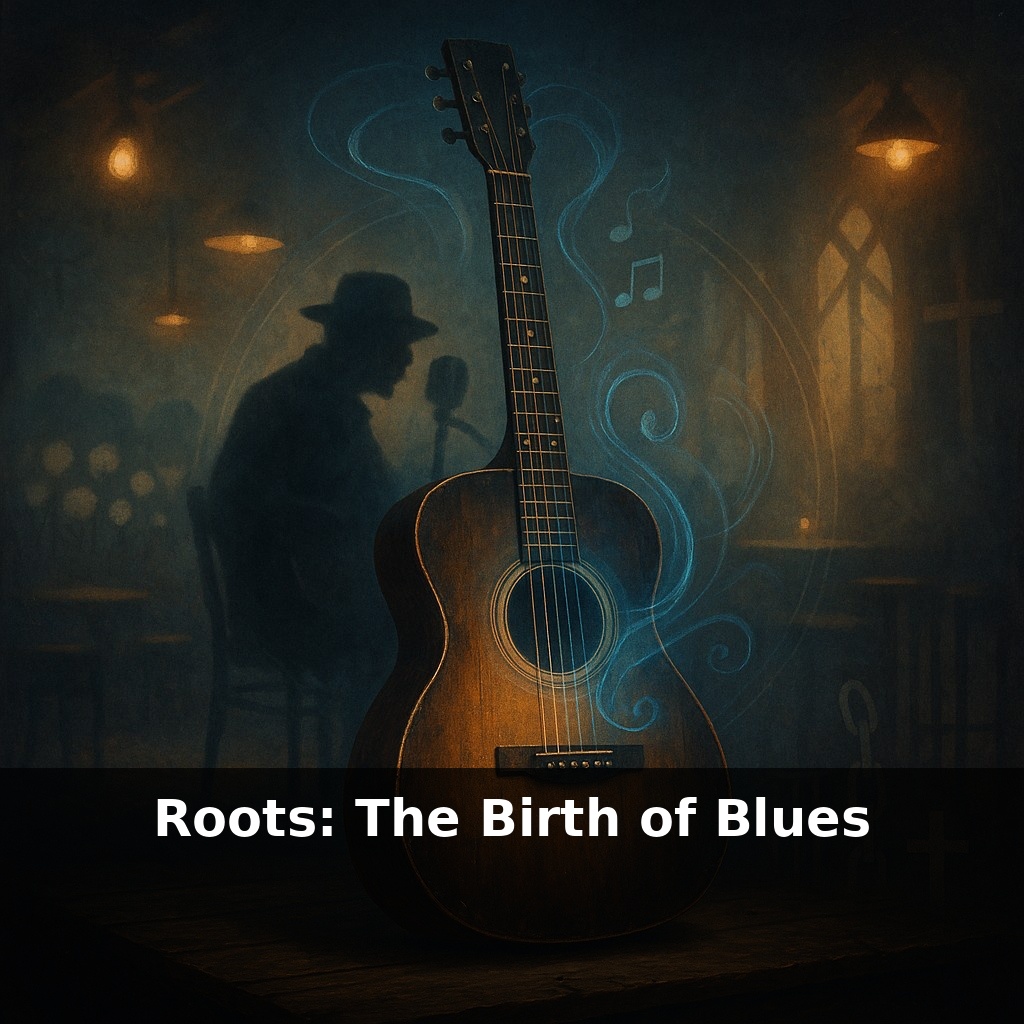
Roots: The Birth of Blues
📝 Transcript
A song born in cotton fields and prison yards ended up shaping almost every major American genre. Tonight, we drop into a smoky juke joint, a lone guitar bending “blue” notes, and trace how those haunted sounds became the hidden blueprint of modern music.
Before anyone called it “the blues,” the ingredients were already simmering across the Deep South: work songs floating over cotton rows, spirituals rising in wooden churches, hollers cutting through humid air like sonic flares. These weren’t “songs” in the commercial sense; they were tools—ways to pace labor, signal danger, share jokes the overseer couldn’t decode. Over time, those fragments started to link up: a turn of phrase from a field holler, a melodic contour from a spiritual, a rhythmic snap from a dance tune. Like footpaths that slowly carve into a visible trail, these repeated choices created a recognizable route—a sound people could follow, bend, and eventually sell. By the time a lone guitarist carried that sound into a roadside shack, the blues already held decades of memory inside every bent note and shouted reply.
Out in rail camps, turpentine forests, and levee camps, players started stitching those raw fragments into small, portable dramas: three or four chords, a handful of verses, and a voice that cut through cheap whiskey and clattering dice. No one had a syllabus; conventions formed the way slang does in a schoolyard—someone twists a phrase or timing, others copy, then mutate it again. As guitars, harmonicas, and homemade rigs like the diddley bow joined in, patterns quietly solidified. Long before publishers inked the word “blues” on paper, a loose, living grammar was already pulsing across the South.
Listen closely to an early country blues recording and you’ll hear a kind of organized looseness. The singer might drag a phrase over the bar line, the guitar may answer a lyric half a beat “late,” yet everything locks into a slow-rolling shuffle between 60 and 120 beats per minute. That feel wasn’t accidental; it reflected the stop-start rhythms of days structured by other people’s whistles and bells. Musicians learned to make time feel elastic inside a steady pulse, so dancers could sway reliably while the vocalist stretched emotion across each measure.
By the early 1900s, something else was hardening into place: a recurring 12-bar harmonic loop. Three basic chords—often framed as “home,” “away,” and “tension”—cycled in a predictable pattern. Singers could stack verses like playing cards on top of that loop, swapping stories in and out without rebuilding the frame each time. This made the music portable between players who’d never met; if you knew the pattern, you could walk into a store-front party in Clarksdale or a tent show in Texas and join in instantly.
Tools evolved alongside these structures. The diddley bow, nailed to a wall or porch post, taught kids how to slide into notes, chase buzzing overtones, and tease melody out of a single string. When those kids graduated to guitars, that sliding touch turned into bottleneck technique—knife blades, polished bones, and later glass bottlenecks gliding over steel strings. Meanwhile, echoes of West and Central African instruments like the ngoni lingered not just in technique but in tuning; the intervals favored on those lutes quietly resurfaced in what came to be called “blues scales.”
Contrary to the stereotype of a lone, sorrowful man on a crossroads, the first blues celebrities were often Black women fronting orchestras in theaters. Ma Rainey, Bessie Smith, and others turned local idioms into big-city entertainment, pressing their repertoires onto shellac discs that rode new rail lines and phonographs into parlors far from the Delta. Collectors like Alan Lomax, hauling bulky recorders into farms and prison yards, preserved hundreds of hours of performances that otherwise would’ve vanished with the evening air. Their crackling archives reveal a genre already diverse: bawdy jokes, sharp political asides, flirtation, bragging, coded complaint—an unwritten chronicle of a people thinking aloud in three chords and a shifting groove.
Think of an old, hand-drawn map: not every path is marked, but the routes people walk most become darker, more reliable. Early players did that with harmony and timing, tracing and retracing certain turns until others could follow them in the dark. When W.C. Handy heard a guitarist on a Mississippi platform “torturing” a melody with a knife, he wasn’t witnessing a random quirk; he was hearing one of those heavily traced paths—techniques carried from porches and barrelhouses into theaters and, eventually, printed bars of sheet music.
On the page, though, the music looked tamer than it felt. Publishers froze flexible rhythms into neat grids, the way a long-exposure photo turns flickering fireflies into a smooth band of light. Meanwhile, phonograph records did the opposite: they shipped every slide, grunt, and shouted aside to places where no one had met a Southern farmworker. A teenager in Chicago, lowering a needle onto a disc, could pick up those inflections the way you might steal brushstrokes from a favorite painter—copying first, then twisting them into something of your own.
Library basements, hard drives, and roadside plaques now act like parallel jam sessions, each extending early blues experiments into new contexts. Digitized discs invite producers to twist old licks with synths, while heritage trails turn backroads into open-air archives that can feed local economies as reliably as crops once did. As AI starts “learning” from these recordings, a live question emerges: who gets paid when ancestral riffs become part of commercial code?
Like a river that keeps branching, those early riffs now irrigate film scores, game worlds, and bedroom beat tapes. Each sample or borrowed turn of phrase is a little time machine, smuggling 1910s porches into 2020s playlists. Your challenge this week: trace one favorite track backward until you hit a blues ancestor—and notice what survived the journey.
From this course
Melodic Quests: The Evolution of Music Genres
8 episodesUnlock all episodes
Full access to 8 episodes and everything on OwlUp.
Subscribe — $1.99/monthLess than a coffee ☕ · Cancel anytime