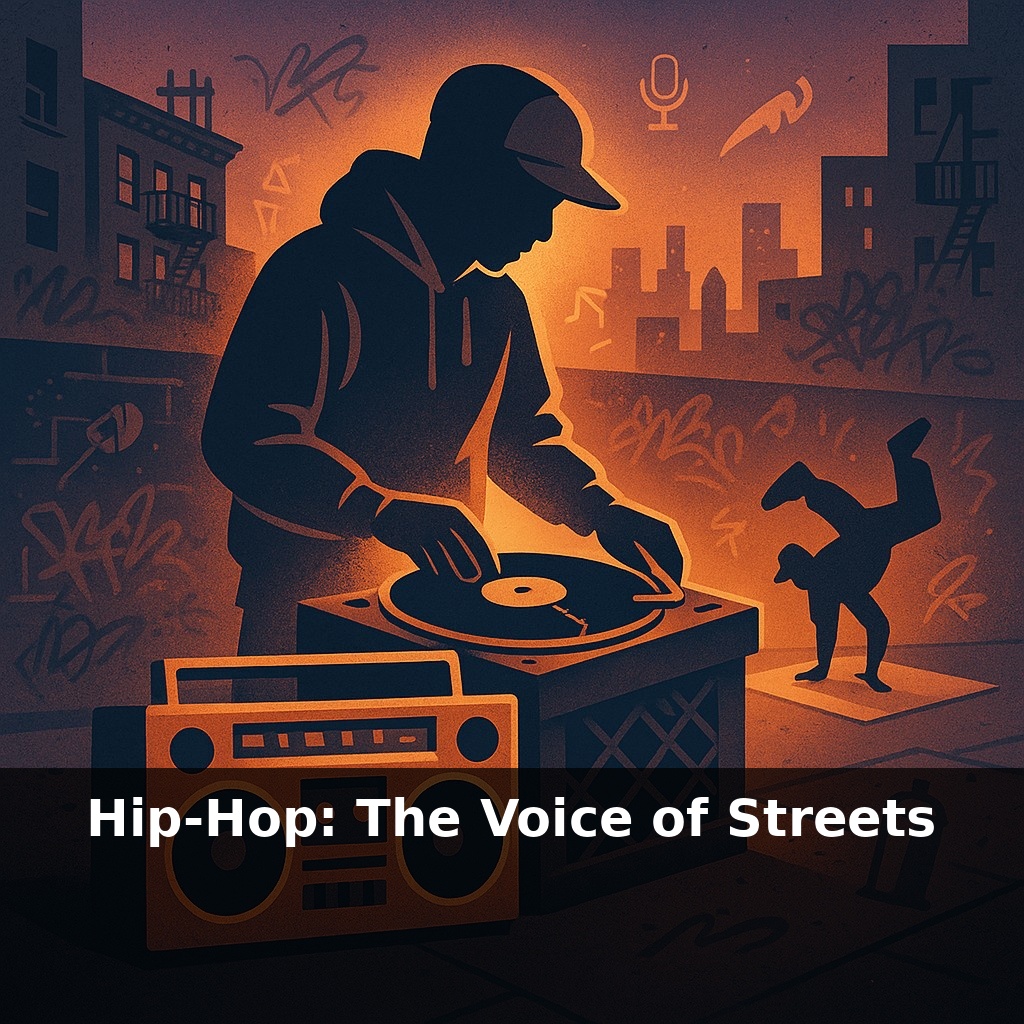
A music genre born at a Bronx block party now shapes nearly a third of what Americans stream. A kid on a busted turntable, a dancer spinning on cardboard, a poet with no stage—each claiming space the city denied them. How did street survival become the world’s loudest voice?
By the time hip-hop hit national TV in the 1980s, many viewers saw only cardboard, chains, and boom boxes—missing the quiet revolution underneath. Four elements were busy rewriting the rules of who gets to speak and be seen. DJs stretched drum breaks into endless runways for dancers. MCs turned cramped apartments and police sirens into verses sharper than headlines. Writers turned subway cars into moving canvases, sending their names across the city long before social media. And breakers flipped concrete into a stage, inventing new ways to move the body when formal studios were out of reach. Together, they built an ecosystem where skill, not status, decided who mattered. As the music industry took notice, this local code of creativity and competition faced its own crossroads: stay rooted in the block, or step onto the global stage and risk being misunderstood—or remixed beyond recognition.
By the early 1990s, that local code had leaked far beyond New York—through mixtapes dubbed a dozen times over, scratched vinyl shipped overseas, and grainy VHS tapes traded like secret maps. Kids in Paris, Tokyo, and Johannesburg copied moves off TV the way others copied homework, then twisted them to match their own slang, struggles, and city blocks. As labels circled and money swelled, a tension sharpened: hip-hop was now both neighborhood bulletin board and international billboard, forced to speak to two audiences that didn’t always hear the same thing—or want the same stories told.
By the time hip-hop reached this crossroads, the stakes weren’t just artistic—they were economic, political, and deeply personal. The same culture that once needed extension cords snaking out of tenement windows now fueled a global industry worth billions. Record labels, fashion houses, and streaming platforms all wanted a piece, but each came with strings: radio edits, market research, brand alignment. The tension sharpened between telling the raw truth of a neighborhood and smoothing the edges for playlists and advertisers.
Streaming supercharged that split. On-demand platforms turned plays into precise data points: where listeners skipped, what tempos held attention, which moods went viral. As trap’s slower, 70-BPM sway began to dominate charts, some artists leaned in, treating the new sound as a fresh canvas for storytelling. Others felt boxed in, pressured to dilute regional slang, political edges, or experimental flows to match algorithm-friendly formulas. A track might trend globally while the block that birthed its slang still dealt with underfunded schools and overpoliced streets.
Yet the streets kept talking back. Independent scenes—from drill in Chicago and London to gqom-infused rap in Durban—sprang up using cheap software and shared studio time, then exploded online without traditional gatekeepers. Social media turned comment sections into instant feedback loops: fans called out inauthenticity, amplified protest songs, and demanded accountability when brands tried to cash in without giving back. Corporate co-signs could boost a career, but a misplaced endorsement or tone-deaf lyric could sink reputation overnight.
At the same time, hip-hop’s voice grew more formally recognized in places that once ignored it. University syllabi dissected verses like literature. Museums curated exhibitions on style, photography, and design. A Pulitzer for an album crystallized something fans had long argued: these were not just party anthems, but complex narratives about power, survival, faith, and failure. The paradox deepened: a form built for those excluded from official platforms was now being archived, awarded, and theorized—sometimes more eagerly in elite spaces than in the communities that sparked it.
In one city, a rapper records in a bedroom closet, uploads a track at midnight, and wakes up to find it stitched into thousands of TikToks by teenagers oceans away. They don’t know his block, but they know the hook—and brands suddenly want that hook for sneaker drops and energy drinks. In another city, a dance crew turns the same song into a routine that wins a global competition; prize money pays rent, but the contest owns the footage and monetizes every replay. A visual artist flips a viral lyric into a gallery piece, selling limited prints for more than the rapper got for his first contract advance. Meanwhile, local organizers loop that same track under footage of protests, turning a club banger into a rallying cry. The song moves through these worlds like a traveling mural: repainted, recontextualized, sometimes respected, sometimes stripped for parts. Each stop adds value—but who gets paid, who gets quoted, and who quietly disappears from the story reshapes what “voice of the streets” really means.
Algorithms now act like unseen A&Rs, nudging certain flows, topics, even song lengths into the spotlight. As AI starts drafting verses and beats, the question shifts from “Can this sound real?” to “Whose truth is this carrying?” Livestream cyphers, VR battles, and global collabs let a kid with cracked headphones trade bars with someone continents away. Like roots pushing through concrete, new voices keep finding paths around walls—legal, digital, and cultural—that try to contain them.
Hip-hop keeps shifting like a city skyline at dusk—same streets, new shadows, fresh lights. Tourists may chase trends, but locals still redraw the map: language bending like train tracks, fashion hacked like school uniforms, beats stitched from kitchen-table studios. As borders blur, the real question isn’t “What is real?” but “Who gets to keep the pen?”
Here’s your challenge this week: Pick one social issue you heard discussed in the episode (like police brutality, housing injustice, or school underfunding) and write 16 bars about it from your own neighborhood’s perspective, using at least three concrete details from real life (a specific street corner, local legend, or community spot). Record the verse on your phone—no fancy gear, just one clean take—and keep every word you’d actually say on your block (no “radio-safe” edits). Before the week ends, play it for at least one other person from your community and ask them one question: “What did I get right—and what did I miss?”