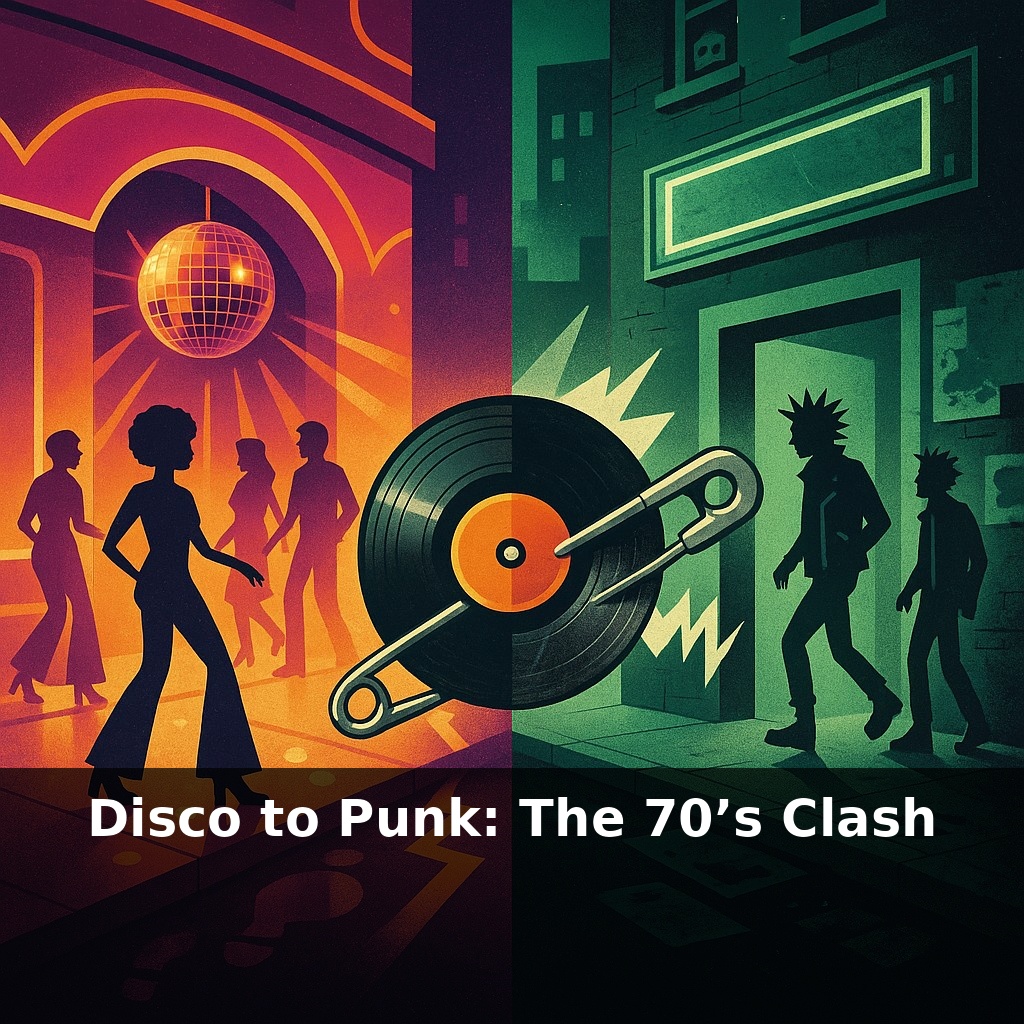
The year disco ruled almost half of U.S. record sales… punk bands were recording full albums for the cost of a used car. In one city block, you’d find sequined dancers under mirror balls; a few doors down, safety pins, ripped tees, and three-chord anthems shaking the walls.
In this episode, we’re not just lining up two genres and asking who “won.” We’re stepping into the messy corridor between them—the radio booths, label offices, and crowded dance floors where taste, money, and identity collided. While rock loyalists argued about “real music,” studio engineers were quietly rewriting the rulebook: extended 12-inch singles for DJs, ultra-cheap recording sessions for bands who could barely afford strings for their guitars. Fashion followed: not just glitter or torn fabric, but whole dress codes that signaled where you belonged the instant you walked into a room. Think of the era’s clubs and dive bars like neighboring art studios in the same building—sharing walls, occasionally borrowing paint, even while insisting they were painting completely different worlds. Under the surface, both scenes were asking the same question: who gets to control the sound of the future?
Step outside the dance floors and grimy stages for a second and look at who was actually in the room. On one side: Black, Latino, and gay communities carving out safer spaces in cities hollowed by white flight, economic crisis, and moral panic. On the other: bored suburban kids and working‑class teens staring down layoffs, inflation, and futures that felt pre‑cancelled. Radio programmers, sensing the tension, sliced playlists into strict lanes, like train tracks that rarely intersect. Yet record bins, mixtapes, and late‑night TV kept leaking signals across those lines, hinting that the story was more tangled than the headlines.
Walk into a 1970s studio session, and the contrast hits immediately. In one building, engineers are obsessing over drum sounds for a track like “I Feel Love,” close‑miking every hit, syncing sequencers, and bouncing takes through expensive consoles to get a hypnotic, machine‑tight pulse. Across town, a band like the Ramones is blasting through an entire album in days, not months, tracking mostly live, leaving in rough edges because studio time is a luxury and polish feels like a lie.
Those choices weren’t just aesthetic; they mapped directly onto who had access to power and money. Disco relied on gatekeepers—club owners, DJs, arrangers, label executives who could afford full horn sections and orchestrated strings. But it also opened doors: 12‑inch singles gave DJs room to stretch, remix, and beat‑match, turning the booth into a creative command center where Black, Latino, and queer tastemakers quietly steered mainstream pop. Punk, meanwhile, shrank the required infrastructure. If you could scrape together a few hundred dollars, borrow mics, and press a tiny run of vinyl, you could start your own label and get records into local shops. Fanzines, photocopied overnight, acted like analog algorithms, routing curious ears toward new bands.
The clash became public theater. On the radio, programmers leaned into binaries: “disco” hours vs. “rock” blocks, as if listeners lived in separate universes. Stunts like Disco Demolition Night turned that split into spectacle, framing records as trash rather than culture. Yet even as crowds chanted, some of their favorite rock acts were quietly borrowing four‑on‑the‑floor beats and glossy production tricks for their next singles.
Meanwhile, the lines on the ground were blurrier. Kids who pogoed at punk shows might still sneak into dance clubs when they wanted to meet people or actually move. Some musicians floated between both worlds, playing in minimalist bands while taking session work on more polished projects to pay rent. The supposed enemies were often sharing rehearsal spaces, rehearsal gear, and even producers.
Over time, both scenes hacked the same system from opposite angles. Disco proved that marginalized communities could push sonic innovation straight into the center of pop. Punk proved that you could bypass traditional pathways almost entirely. Together, they redrew the map of who was allowed to create, how records could sound, and what a “scene” could accomplish when it refused to stay in its assigned lane.
Think of how this tension shows up today. A pop star drops a meticulously polished dance track with a hundred songwriters in the credits; the same week, a teenager uploads a distorted, two‑minute burst made on a phone—and both end up on the same playlist. That split isn’t new; it’s the 70s argument re‑coded into streaming algorithms and “For You” pages. You can see it in software, too: expensive studio suites with subscription plans, sitting right beside free apps that let anyone drag loops and upload within an hour. Or in fashion, where runway brands sell crystal‑covered pieces while streetwear labels push repurposed workwear, patches, and DIY graphics. Even social movements echo the pattern: one branch designs choreographed campaigns with big sponsors; another favors scrappy zines, hacked posters, and surprise actions. Your own creative habits probably lean one way—layered, detailed builds—or the other—fast, rough, and public. Both instincts can coexist in the same project.
Streaming-era tools now fold those old extremes into a single interface: you can automate a kick pattern with the precision of a sequenced floor-filler, then distort it into something as jagged as a basement demo. Playlists mix both in one scroll, training ears to expect contrast instead of purity. Like a coastal path where the tide keeps redrawing the shoreline, the boundary between glossy and raw is now a moving line you can cross, erase, or redraw with each project, collaborator, or upload.
Your challenge this week: pick one project and give it both treatments. First, a “luxury” version—layers, revisions, fine‑tuning like you’re scoring a big stage. Then a “basement” version—one take, minimal tools, no undo button. Compare them like two photos of the same skyline at noon and midnight; ask what each one reveals that the other hides.