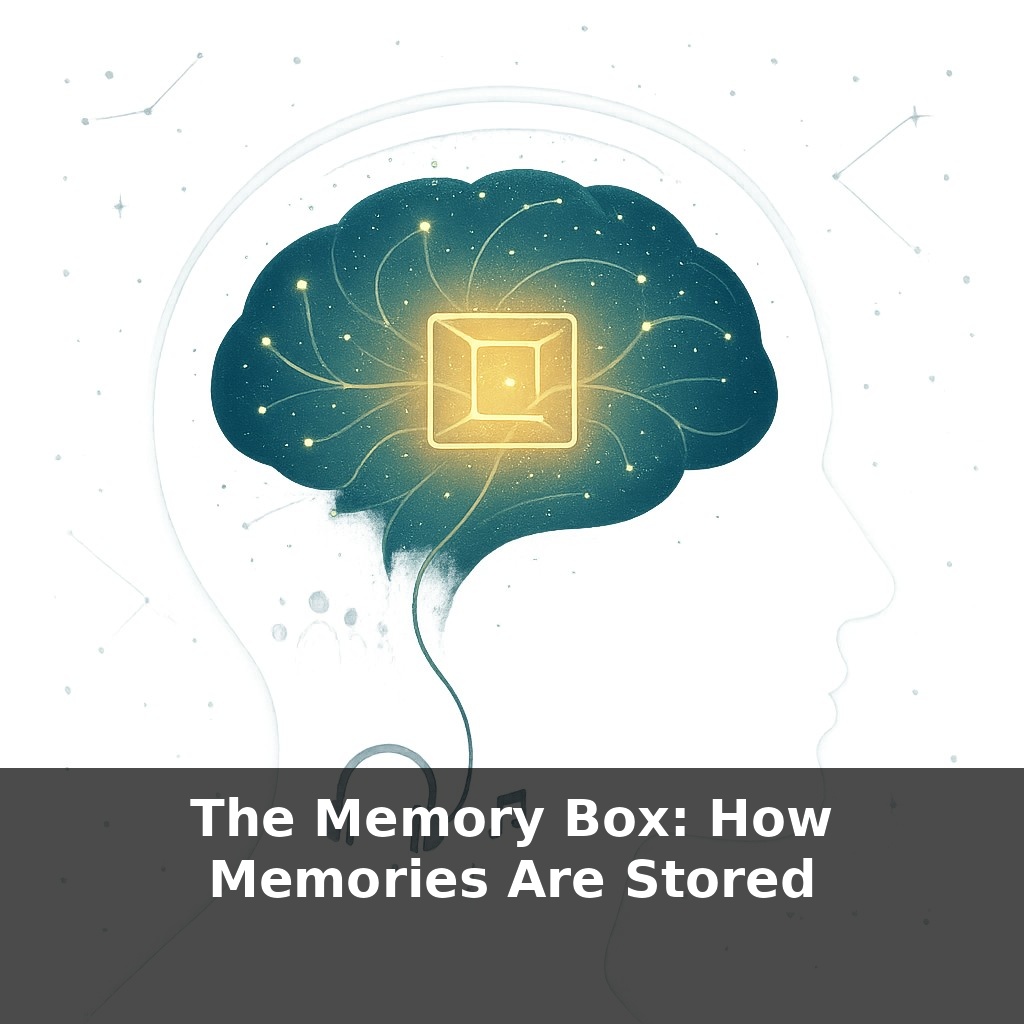
The Memory Box: How Memories Are Stored
📝 Transcript
Right now, your brain is firing off patterns more complex than all the stars you can see on a clear night. A stranger bumps your shoulder, a song leaks from someone’s headphones—and without effort, your brain decides which split-second will become a memory, and which will vanish forever.
Most of those moments your brain just processed will never be stored—but not because they weren’t “important enough.” Your memory system is ruthlessly economic. It has to be, because every new trace slightly reshapes an already crowded network. Instead of keeping a perfect log, it runs a kind of bidding war: novelty, emotional charge, and relevance to your goals all drive up the “price” of admission.
Walk into a new office, and your attention might snag on the odd green carpet, the smell of burnt coffee, the name on a badge. Hours later, you might keep only the coworker’s name and where the bathrooms are, while everything else dissolves. In the background, your brain is constantly asking: “Will this help me predict what happens next? Will this matter tomorrow, or next year?”
In this episode, we’ll follow that selection process—how stray moments become lasting traces, and why some details win while others quietly disappear.
That internal bidding doesn’t happen in one place, or all at once. Different brain systems quietly “pitch” their case. The hippocampus flags links between people, places, and events. Emotional circuits highlight moments that feel risky or rewarding. Meanwhile, areas that manage habits and skills lobby for repeated actions to be stored more efficiently, so you don’t have to think through tying your shoes every morning.
It’s less like saving one photo and more like syncing a shared folder: movement, sounds, meanings, and feelings each upload their piece, sometimes seconds, sometimes hours after the moment ends.
When one of those pitched moments “wins,” the brain has to do three hard things in quick succession: encode it, stabilize it, and make it findable later.
Encoding is where chaos gets compressed. A crowded street scene might start as millions of tiny signals from your eyes, ears, skin. Within a heartbeat, higher areas strip away redundancy and lock onto a few key patterns: the curve of a face, the tilt of a voice, the outline of a doorway. That stripped-down pattern is cheaper to store, but still rich enough to be useful.
Stabilizing the pattern is slower and more fragile. Right after an experience, the relevant circuits are in a kind of “wet cement” state. Interference—stress, multitasking, a barrage of new inputs—can smear the fresh traces. This is one reason short breaks or quiet moments after learning can matter as much as the learning itself.
Sleep pushes this further. During deep stages, the brain doesn’t go offline; it runs a massive background reorganization. Activity bursts in memory hubs are tightly timed with ripples in the cortex, nudging some connections stronger, letting others fade. Details that were only loosely sketched while you were awake can become crisper, or get blended into older knowledge so they’re easier to use.
Making memories findable turns out to be as important as storing them. The brain tags traces with cues: where you were, what you felt, what you were trying to do. Later, even a fragment of a cue—a smell from a subway platform, the click of a turnstile—can light up part of the original pattern and help reconstruct the rest.
Different kinds of memories get different treatment. Facts you can recite, steps of a motor skill, and a flash of embarrassment from a meeting all rely on overlapping but distinct routes. Over time, repeated use can shift a memory’s “budget line”: what began as effortful and fragile can become automatic and resilient, while unused traces quietly lose their priority in the network.
At street level, memory feels personal: your first day at a new job, the layout of your favorite café, the PIN you type without looking. Underneath, different systems are sharing the load in surprisingly specialized ways.
Learning a new password leans on circuits that handle facts and symbols. Practicing a piano scale recruits loops that tune tiny timing differences in your fingers. A tense performance that goes really well may get a separate “emotional priority tag,” making the whole episode stand out years later, even if you forget the exact pieces you played.
There’s also a tight capacity limit on what you can hold in mind right now. Juggle a phone number, a parking level, and an item someone just asked you to grab, and you’re essentially running a live demo of those front-of-brain networks that track a few items and update them on the fly.
One helpful way to think about this division of labor is like a software stack: low-level routines handle practiced sequences, mid-level code manages current tasks, and higher layers keep track of flexible, explicit knowledge you can explain to someone else.
Memories don’t just preserve the past; they quietly edit your future. Each time you recall something, you’re not opening a vault, you’re tweaking a recipe—you can strengthen, distort, or reframe it. That plasticity is why therapy can reshape painful narratives and why repeated “war stories” at work drift from precise report to guiding myth. As tools emerge to track and even steer these updates in real time, memory starts to look less like an archive and more like a live, collaborative draft of who you are.
So memory isn’t a static ledger; it’s more like a city skyline under constant renovation—old structures reinforced, others demolished, new bridges laid between distant blocks. As technology starts reading these “urban plans” in finer detail, we may soon face choices about which neighborhoods of experience to preserve, and which we’re willing to let be rebuilt.
Before next week, ask yourself: When I replay a strong memory (like a big win, an argument, or a childhood moment), what specific details—smells, sounds, colors, exact phrases—do I actually notice, and how do those details change the emotion I feel right now? When I tell a familiar story from my past, what parts do I tend to leave out or exaggerate, and what does that reveal about the “version” of myself my brain is trying to protect or promote? If my brain is constantly updating memories like files in a “memory box,” which one recurring memory would I like to gently re-tag today—by adding one new, truer detail to it—and how might that shift the way I react in similar situations this week?
From this course
Memory Mysteries: How We Remember and Forget
5 episodesUnlock all episodes
Full access to 5 episodes and everything on OwlUp.
Subscribe — $1.99/monthLess than a coffee ☕ · Cancel anytime