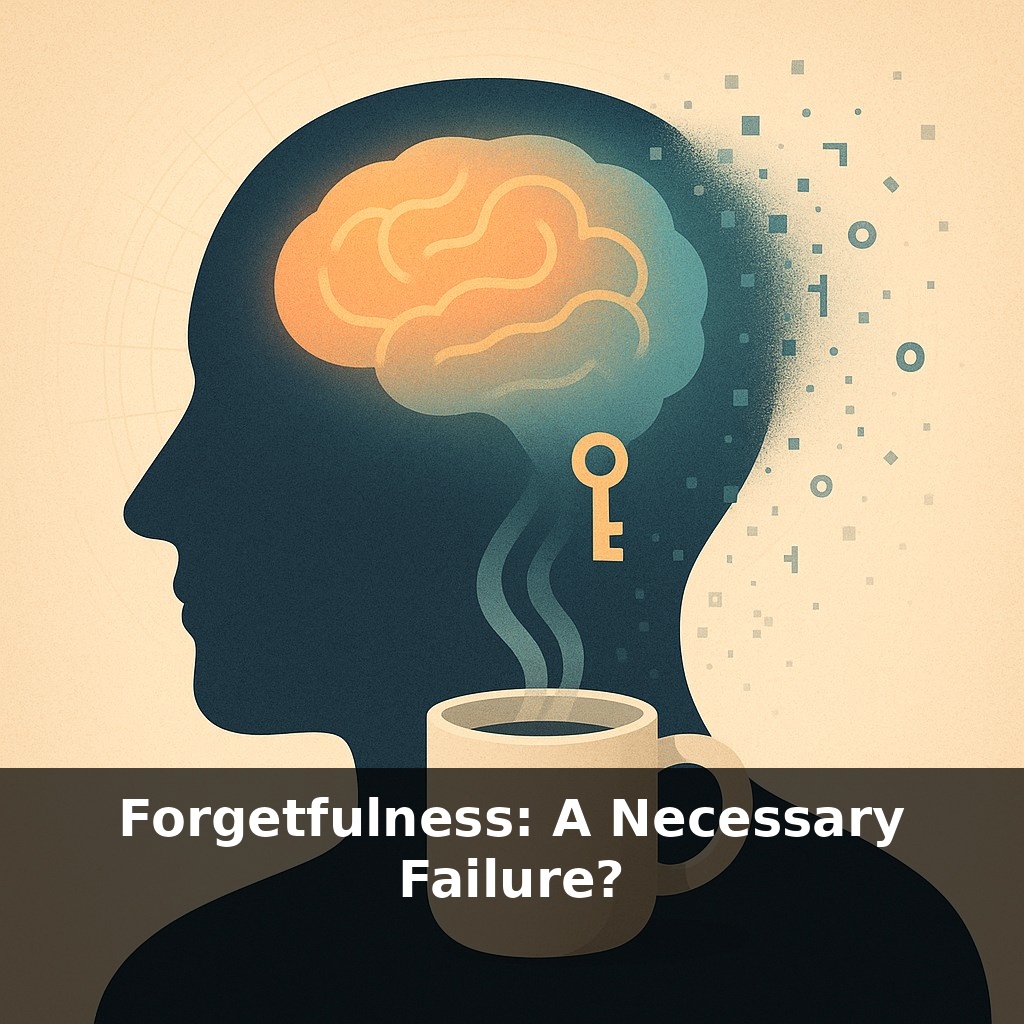
In the time it takes to brew coffee, your brain may have already erased almost half of what you learned this morning. Yet here’s the twist: that “lost” information might be the reason you can find your keys, recognize your friend’s voice, and stay sane in a loud, chaotic world.
So if your brain is quietly “ditching” so much, why doesn’t life feel like a constant tech glitch? One answer lies in what it chooses to keep. We tend to remember patterns, not raw data: the rule behind a math problem, the rhythm of a language, the feel of a friend’s sense of humor. The details blur first, while structures and habits often stick. This selectivity shapes how we learn, what we value, and even who we think we are. Forgetfulness also helps separate yesterday’s version of a situation from today’s: you might drop the exact words of a tense conversation, yet retain the lesson about where a boundary lies. In social life, this matters. Relationships survive partly because we don’t preserve every slight in high definition. And in a world of endless notifications, active forgetting may be one of the last defenses your mind has against becoming permanently overloaded.
But this quiet filtering isn’t just about comfort or efficiency; it shapes power, opportunity, and even history. What a student “lets go of” after a year of school helps determine which subjects feel “natural” later. What a community repeatedly rehearses—holiday stories, news headlines, family lore—gradually pushes other events out of reach. Over time, these lopsided rehearsals decide whose achievements are textbook material and whose disappear. At a cultural scale, forgetting is less a glitch in the record and more a vote about what a society finds worth repeating, funding, and protecting.
When scientists zoom in on this “necessary failure,” they don’t just look at what slips away; they watch how the brain makes room. One striking clue comes from energy use. Neurons are costly to run, and maintaining every connection at full strength would be like leaving all the lights in a skyscraper blazing 24/7. Instead, circuits that haven’t been used recently are dialed down. That frees resources for skills and knowledge you actually deploy—your second language, your job’s core tools, the routes you navigate every day.
This isn’t simply a matter of efficiency; it quietly steers who advances and who stalls. A child drilled on test formats but rarely invited to discuss ideas will strengthen very different networks than a child encouraged to debate, tinker, and question. Both are “learning,” but one is being wired for pattern-finding and transfer, the other for narrow recall on demand. Years later, those invisible wiring differences show up as “talent,” “aptitude,” or “leadership potential.”
Active biological pathways for letting memories fade add another twist: they can be tuned by stress, sleep, and even social status. People living with chronic insecurity or discrimination often show different memory profiles—not because they care less about school or work, but because their brains are repeatedly pushed to prioritize threat detection over fine-grained detail in a lecture or meeting. In that context, forgetting a formula faster than a face in a crowd is a rational adaptation, even if institutions read it as a deficit.
At the level of groups, what is rehearsed loudly can overwrite quieter experiences. School systems that cycle through the same narrow canon every year help crystallize one storyline about a nation while countless others dissolve from collective reach. The result is a feedback loop: certain histories feel “natural” to recall, receive more airtime and funding, and become even harder to forget, while other contributions require constant, deliberate effort to keep from vanishing.
In all these cases, the biology of forgetting is doing what it evolved to do—prioritize. The trouble starts when our schools, workplaces, and media pretend that everyone’s priorities are identical, and that anything not immediately retrievable must never have mattered.
A coder who hops between projects knows this well: learn just enough of a framework to ship, then let the trivia fade so there’s room for the next sprint. Months later, only the “moves that mattered”—how to debug, how to structure a feature—remain. Something similar happens when a city decides which archives to digitize first. Budget and time are limited, so officials prioritize documents tied to property, law, and commerce. Parish newsletters, protest flyers, or community cookbooks wait—and sometimes vanish before they’re scanned. At the personal scale, someone caring for a newborn may find that names of distant colleagues slip away while feeding schedules and clinic routes stay crisp. Under pressure, the mind silently renegotiates what counts as “worth keeping.” Even scientific communities do this: entire research programs can fade from citations once funding and fashion move on, leaving only a few core techniques embedded in how the next generation works.
A future that takes this “necessary failure” seriously might redesign schools and tools around it. Instead of hoarding every slide or email, we’d time key ideas to resurface—like scheduled deposits that keep an account active. Civic platforms could nudge forgotten local voices back into view, not as nostalgia but as options for new policies. Therapies might one day let people soften the sting of a memory without deleting its lesson, raising hard questions about who decides which pasts may fade.
Treat this less as a glitch to fix and more as a lever to design around. We can ask: which traces do we want to fade fast, and which should be revisited until they anchor policy, culture, or personal change? Like updating a budget, we could audit what gets mental “funding,” shifting resources toward futures we haven’t rehearsed yet.
Try this experiment: For the next three days, deliberately *don’t* set a reminder for one specific, low-stakes task you often forget—like taking your vitamins after breakfast or bringing your reusable bag to the car—and instead create a “memory trigger” tied to something you already do (e.g., putting the vitamins on top of the coffee maker or the bag on your shoes). Each time you forget or remember, quickly rate (in your head or a notes app) how annoying the consequence actually was on a scale of 1–5. At the end of day three, compare: Did the physical cue help more than your usual digital reminders, and were the “failures” as bad as your brain predicted? Use what you notice to decide which tasks truly deserve tech reminders and which you can safely let your “forgetfulness experiments” handle.