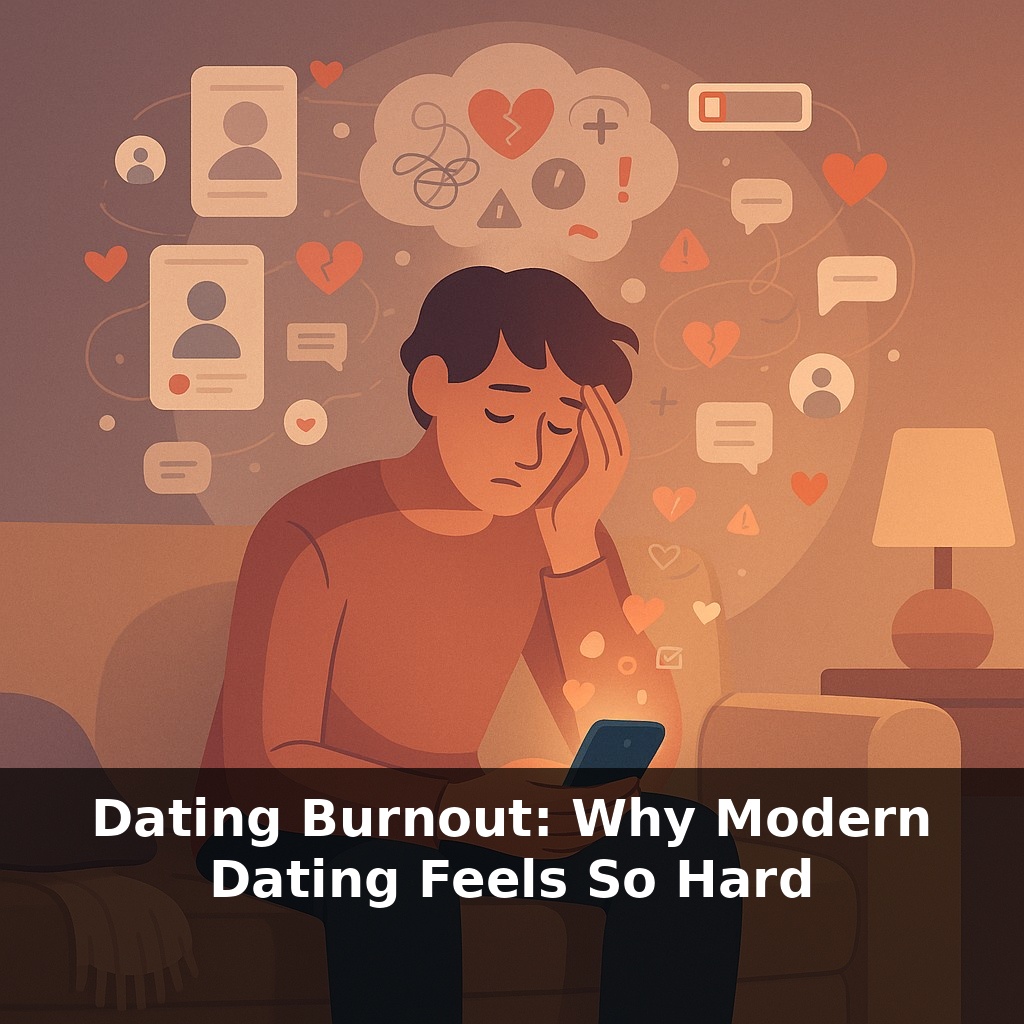
Dating Burnout: Why Modern Dating Feels So Hard
📝 Transcript
About half of Americans say dating feels harder now than it did a decade ago—yet we’ve never had more “options” at our fingertips. You’re swiping on the couch, chatting with three matches, and somehow feeling more alone. How did abundance start feeling so much like exhaustion?
You’re not just meeting people; you’re running a nonstop mental marathon. Your brain is scanning profiles, decoding messages, evaluating red flags, guessing intentions—all in tiny, rapid bursts. Each left swipe is a micro “no,” each right swipe a lottery ticket. Most don’t go anywhere, but your brain still pays the cost of hope, assessment, and disappointment. Add in the constant interruptions—notifications mid‑workday, late‑night messages, half‑hearted chats while you’re watching a show—and your nervous system never fully powers down. It’s like trying to read a novel while someone keeps shuffling the pages: you can’t settle into any one story long enough to feel grounded, so everything starts to blur together and feel strangely meaningless, even when you technically have a lot going on.
Modern apps layer on something our brains aren’t built for: constant social uncertainty. You rarely get clear endings—matches fade, chats stall, people “ghost” instead of saying, “Hey, I’m not feeling it.” Your nervous system keeps these loose threads open like too many browser tabs, draining quiet energy in the background. On top of that, you’re juggling invisible metrics: reply time, message length, emoji use, “Are they losing interest?” It turns dating into performance management. Over time, you stop asking, “Do I like them?” and start obsessing, “How do I keep them interested?” That shift alone is deeply exhausting.
Here’s the part almost no one tells you: nothing is “wrong” with you for feeling fried. You’re colliding with how your nervous system actually operates.
The human brain is optimized for a small, slow stream of social input—think village, not megacity. With apps, that stream turns into a firehose. Profiles, prompts, photos, pings: each one asks your brain to make a tiny judgment call. Multiply that by hundreds a week and you hit decision fatigue. When that kicks in, your choices get fuzzier. You lower your standards in some places (“Fine, I’ll just swipe right”) and become oddly rigid in others (“If they don’t check every box, forget it”). It’s not shallow; it’s a tired brain trying to conserve energy.
Layered onto that is a casino-style reward system. Most of your effort—scrolling, liking, crafting messages—goes nowhere. Then, unpredictably, you get a match, a flirty reply, a good conversation at 11:47 p.m. Your brain releases a spike of dopamine, then yanks it away when the chat stalls. Variable rewards like this are powerful: they keep you coming back long after the experience has stopped feeling good.
Meanwhile, micro‑rejections accumulate. Someone unmatches. Another stops responding mid‑conversation. A third never shows up to the date you rearranged your evening for. Taken one by one, you might shrug them off. But your threat‑detection system logs each as social risk. Over time, you start bracing for disappointment before you even open the app. That anticipatory tension is what makes it feel heavy just to tap the icon.
All of this slowly shifts your identity story. At first, apps are just a tool you use. After enough stalled chats and fizzled connections, it’s easy for your brain to turn outcomes into evidence: “Maybe I’m not attractive enough,” “Maybe there’s something wrong with me.” Burnout isn’t only emotional; it’s narrative. The more depleted you feel, the more you interpret neutral data—slow replies, short messages—as personal rejection, which deepens the burnout loop.
Think of it like a nervous system that’s been running a low‑grade fever for months: not sick enough to collapse, but never restored enough to feel fully alive in the process.
Think about how you feel after scrolling versus how you feel after a real‑life hangout with a friend. One leaves you buzzy and oddly empty; the other might be quieter, but it settles in your body like a full meal. That contrast is your nervous system telling you what kind of connection actually restores you.
For some people, burnout shows up as getting irrationally annoyed at tiny things—an overused prompt, a slightly awkward opener—and using them as instant dealbreakers. For others, it’s the opposite: saying yes to people you’re lukewarm about because the thought of searching again feels unbearable. Neither reaction is a moral failing; it’s your brain trying to reduce load any way it can.
Viewed this way, “taking a break from dating” isn’t laziness or giving up. It’s more like a doctor ordering rest after a concussion: the point isn’t to avoid life, it’s to let your system recalibrate so it can tell signal from noise again.
Forty‑five percent of Americans say dating is harder now than a decade ago, yet most of us are still trying to “push through” using the same habits. The next phase will likely reward people who treat their dating life more like training than gambling: setting limits, choosing formats that suit their nervous system, and noticing which interactions actually leave them calmer. Your challenge this week: run a “stress audit” after each date‑related activity. Label it green (restorative), yellow (neutral), or red (draining). Then adjust where you invest your energy.
So instead of chasing every ping, you can start asking: which interactions feel like sunlight, and which feel like fluorescent office lights at midnight? Let that answer guide how, when, and how often you engage. Modern tools aren’t going away, but you get to decide the pace, the settings, and the moments you reserve for real, grounded connection.
Here’s your challenge this week: Pick one dating app and delete or pause all the others, then cap yourself at 10 minutes of swiping per day for the next 7 days. Before each swipe session, say out loud one non‑negotiable you heard mentioned in the episode (like “I want someone emotionally available” or “I’m not dating people who are ambivalent about me”). Send no more than 3 messages total per day, and only to people who already show at least one of those non‑negotiables in their profile or first message. At the end of each day, rate your dating stress from 1–10 and notice whether this narrower, more intentional approach actually leaves you feeling less burned out.
From this course
Modern Dating: Find Connection Without Losing Yourself
7 episodesUnlock all episodes
Full access to 7 episodes and everything on OwlUp.
Subscribe — $1.99/monthLess than a coffee ☕ · Cancel anytime