“Contempt—those tiny eye rolls and mocking comments—is the strongest predictor a relationship will fall apart. Yet most people feel something is ‘off’ long before that shows up. In this episode, we’ll slow down those first dates and DMs to decode what your gut’s been trying to say.”
Some people walk away after the third date and can’t explain why—no big blow-up, no obvious dealbreaker—just a quiet “something doesn’t feel right.” That “something” is often your brain quietly flagging patterns before you can put them into words. Modern research shows we’re better at this than we think: early cues like how someone speaks to a server, responds to a boundary, or owns a mistake often forecast how they’ll handle stress, intimacy, and conflict months later. The catch? If you’ve been taught to “be chill” or “give it more time,” you might gaslight your own instincts. In this episode, we’ll name concrete red and green flags, connect them to what’s happening in your nervous system, and explore how to double-check your gut without silencing it—so your feelings become data, not drama.
Think of this part of the process less like judging people and more like adjusting a microscope. We’re zooming in, not to obsess over every flaw, but to see what’s actually there. Here’s where research helps: studies show that contempt usually doesn’t arrive out of nowhere; it grows out of dozens of tiny, repeated moments where respect is either reinforced or eroded. Same with trust—those “I’ll text you when I get home” follow-throughs quietly stack up. As you date, you’re not just asking “Do I like them?” You’re also asking, “What tends to happen around this person—inside me and between us—over time?”
Think of this episode as upgrading your internal “translation app” for behavior. You’re already noticing things; now we’re giving you words and meaning so those hunches can turn into choices.
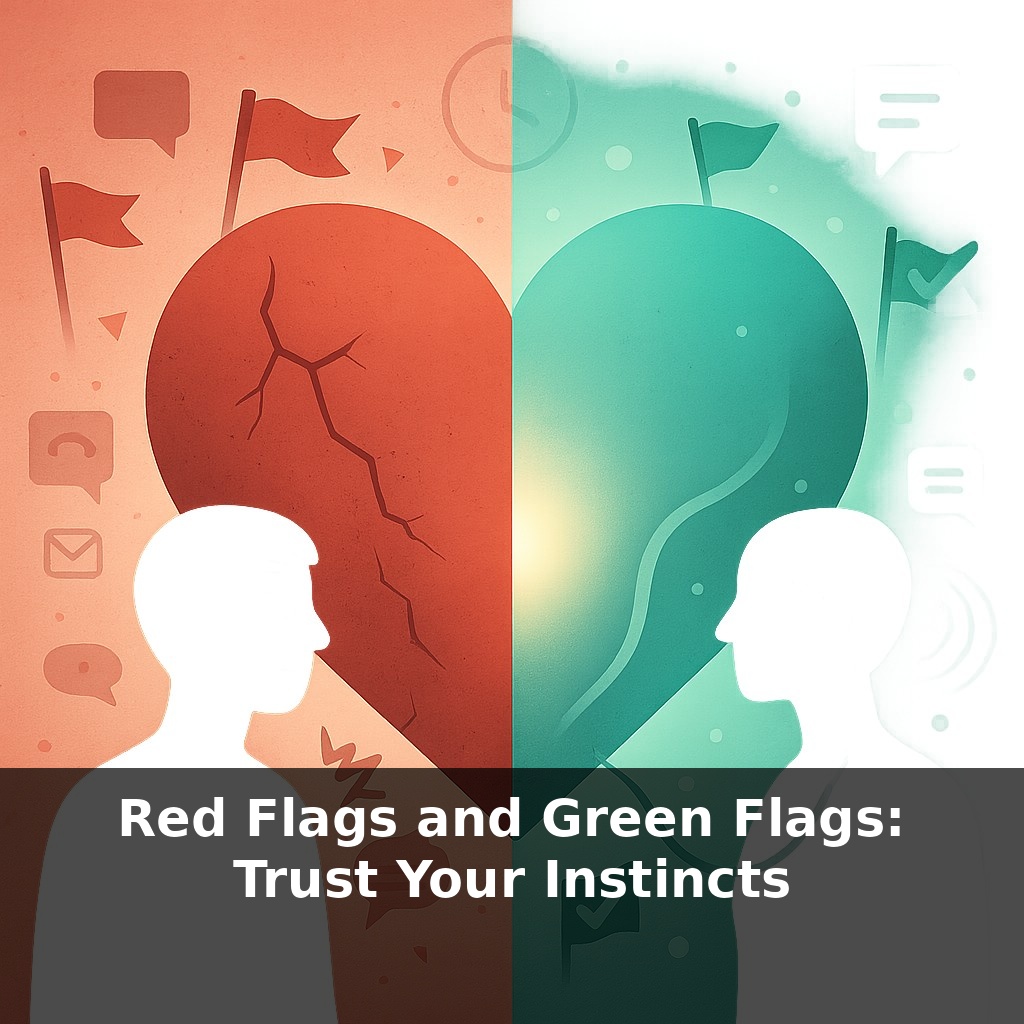
Let’s start with some quiet green flags that often get overlooked because they’re not flashy:
- They repair, not just apologize. When there’s a misunderstanding, they don’t just say “sorry” and move on. They ask, “What would help this feel better?” and adjust next time. - They tolerate your “no.” You decline a drink, a late-night visit, or a topic, and they don’t sulk, push, or keep re-negotiating. The conversation just… moves on. - They show kindness to people who can’t “do” anything for them—drivers, staff, strangers online. That consistency predicts how they’ll treat you when the honeymoon phase settles.
Now some subtle red flags that often get rationalized away:
- Micro–boundary pushes: “Come on, just stay over, don’t be so uptight,” said with a smile but repeated after you’ve been clear. It’s less about the request and more about their response to your limit. - Early scorekeeping: They “joke” about how much they’ve done for you already, or how you “owe” them time, attention, or intimacy. Attraction doesn’t need a spreadsheet. - Low empathy under stress: They’re charming when everything is smooth, but dismissive or cruel when they’re tired, rushed, or inconvenienced. Stress doesn’t invent new traits; it reveals existing ones.
A useful question on dates and in chats: “What happens *in me* around this person?” Notice if you become smaller, unusually anxious, apologizing for normal needs—or if you feel more grounded, curious, and honest. Your internal shift is often more accurate than their curated self-description.
Here’s where instinct meets skill: instead of arguing with your reactions, you *collaborate* with them. When something feels off, you don’t have to diagnose their personality; you just take a small step: slow the pace, ask a more direct question, or observe them in a new context—around friends, under mild stress, with a changed plan.
Over time, you’re less focused on “Are they amazing?” and more on “Do I like who I am when I’m with them, repeatedly?”
Your body often notices shifts before your brain makes sense of them. Say you’re on a third date: the conversation is light, you’re laughing, but every time you share something vulnerable, they quickly turn it back to themselves. You walk away oddly drained. Nothing “bad” happened—yet the ratio of you-listening to them-listening was wildly off. That mismatch is information.
Or you’re messaging someone who remembers your big presentation, wishes you luck, and checks in afterward—not in a clingy way, just once, like they mentally bookmarked what mattered to you. That small, accurate recall is also information.
Use mixed signals as mini-experiments. If they’re sweet over text but snappy in person with their sibling, don’t panic—slow down and watch which version shows up more often. If you feel tense before every meetup but calm after plans with friends, put those nights side by side. You’re not hunting for perfection; you’re tracking consistency. Over a month, it becomes clearer whose presence adds weather, and whose adds climate.
As relationship education spreads and apps quietly adopt safety tools, your private “inner radar” starts mattering in public ways. Your split-second reads today may train tomorrow’s AI filters, nudging platforms to flag subtle disrespect like a storm warning instead of waiting for damage. On a personal level, the more you name what feels off or solid, the more your future choices stack—like consistent deposits—into calmer partnerships and less emotional debt.
Your challenge this week: Run a real‑time “body check‑in” experiment on every new interaction—dates, chats, DMs. Three times per conversation, silently ask: “Do I feel tighter or looser right now? Smaller or more myself?” Don’t analyze, just tag it: tighten or loosen. After seven days, review which people and contexts consistently left you more relaxed—and which ones reliably spiked tension, no matter how charming the surface was.
Let your curiosity stay in the driver’s seat: you’re not issuing verdicts, you’re running gentle experiments. Notice who feels like a sigh of relief versus a subtle brace, the way you’d sense a change in weather before checking the forecast. Over time, those tiny internal shifts sketch a map, and your choices start to follow the routes that actually feel like home.
Here's your challenge this week: Have one real-life “green flag vs. red flag” check-in with someone in your life (a partner, friend, coworker, or client). During your next interaction, notice at least three **green flags** mentioned in the episode—like consistency between their words and actions, emotional accountability (“I was wrong, here’s how I’ll fix it”), and respect for your boundaries—and also watch for at least two **red flags**—like defensiveness, love-bombing, or blame-shifting. After that interaction, give yourself a clear yes/no answer: “Do I feel safer, clearer, and more respected with this person than I did an hour ago?” and let that answer guide one concrete decision about how close you’ll let them be in your life this week.