About half of adults say thinking about money makes them anxious. Now, here’s the twist: many of those people earn “enough.” So why the knot in the stomach? Today we step into that gap between the numbers in your bank account and the stories running in your head.
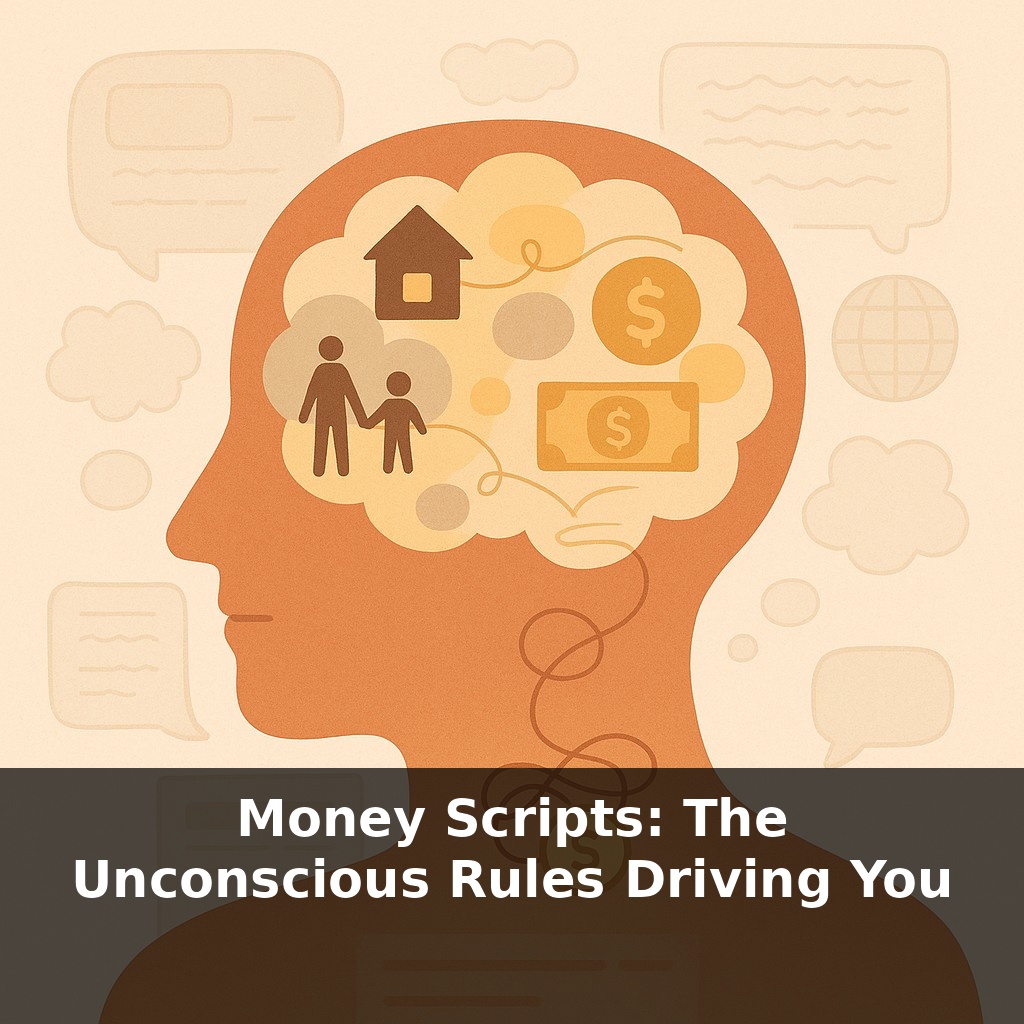
Money stress isn’t just “in your head”—it’s often in your history. By the time you were about seven or eight, you’d already absorbed most of your core beliefs about money from parents, caregivers, culture, and even what was *not* talked about at home. Researchers call these beliefs “money scripts,” and they often sound like quiet background lines: “Rich people are selfish,” “I’m just bad with money,” “More money will solve everything,” “Talking about money is rude.”
These scripts run fast and automatic. You might feel guilty getting a raise, overspend the moment you feel lonely, or avoid opening bills—not because you’re irrational, but because an old script is firing. Studies show these hidden rules are powerful enough to influence your savings, debt, credit score, and even the kinds of partners you choose.
In this episode, we’re going to start finding those scripts—and gently testing whether they still deserve a role in your life.
Some of these scripts are surprisingly harsh. In one study, over one in five people agreed with the line “I don’t deserve money”—and their credit scores were, on average, 78 points lower. That’s not about math; that’s about identity. Scripts can sound like moral judgments: “Good people don’t care about money,” “If I have more, someone else gets less,” or “Wanting wealth makes me greedy.” Others are soothing but risky, like a dessert that’s all sugar: “It’ll work out somehow,” “Future me will handle it,” “I deserve this today.” Today, we’ll start noticing which ones echo in your own thoughts.
When researchers map these patterns, some clusters show up again and again. Think of them as “families” of money scripts—each with its own emotional flavor and predictable behaviors.
One set leans toward *money avoidance*. These are the beliefs that push money away: “Having money is bad,” “People with wealth are corrupt,” “If I earn more, I’ll lose friends.” Klontz & Britt found that when these are strong, people tend to have lower net worth even when their income is similar to others’. Not because they’re lazy or incapable, but because they may unconsciously sabotage raises, undercharge for their work, or delay basic financial tasks.
On the opposite side are *money worship* scripts. They sound like: “More money will fix my life,” “I’ll feel safe once I hit X number,” “You can never have enough.” These beliefs often drive overwork, chronic under-rest, or chasing risky investments. Ironically, people who strongly endorse them don’t necessarily end up wealthier—but they do report more stress and conflict around money.
Then there’s *status / vigilance* territory. Scripts like “My worth equals my net worth,” “I have to look successful,” or “You can’t trust anyone with money” can push you to either flaunt or fiercely guard what you have. That might mean overspending to keep up appearances, or staying so secretive that partners are left in the dark—both common sources of tension in relationships.
A quieter category is *money dependency*—beliefs such as “Someone else should handle this,” or “I need a partner to be financially okay.” These can keep you from building skills or confidence, even when you’re perfectly capable of learning.
None of these are diagnoses; most people hold a *mix* of them, and some are context-dependent. You might be avoidance-oriented with saving, worshipful around career income, and status-driven with gifts.
The important shift is this: instead of asking, “What’s wrong with me around money?” you begin asking, “Which script is talking right now—and where did I learn it?” That question turns shame into curiosity and opens the door to experimenting with new, more helpful lines.
Knee‑jerk money reactions are often your clearest trail markers. Say your friend gets a big promotion and you feel a sting instead of pure happiness. One inner voice mutters, “Must be nice,” while another adds, “I’ll never get there.” That mix of envy and resignation isn’t random; it’s a cluster of old lines surfacing at once.
Or think about payday. Some people feel a rush to spend before the balance “disappears,” buying small upgrades all weekend. Others instantly sweep everything into accounts and refuse small pleasures, then binge later. Two very different behaviors, but both can be driven by the same underlying fear: “This isn’t safe unless I control it *right now*.”
Notice, too, how scripts can clash. You might donate generously because “good people give,” then secretly resent that you’re not building savings. Or you might insist you’re “not materialistic,” yet feel oddly superior when your outfit or phone is the newest in the room. Tension, guilt, or a double standard around money is often a sign that more than one script is arguing behind the scenes.
Klontz once wrote, “We don’t have relationships with money. We have relationships with our *stories* about money.” As tech learns to read those stories—through spending trails, survey answers, even the words you use in chats—your future banking app might feel less like a calculator and more like a coach. The risk: if companies can nudge you toward healthier habits, they can also steer you toward products that mainly serve their bottom line.
You don’t have to “fix” your entire financial life to start shifting these patterns. Tiny experiments—pausing before a purchase, opening the bill you’d usually delay, saying “let me think about that” to a money request—are like gentle stretches for a tight muscle. Over time, they loosen old reflexes and make room for choices that actually fit who you are now.
Start with this tiny habit: When you log into your bank account or glance at your credit card app, quietly say one sentence out loud that you heard growing up about money (like “we can’t afford that” or “rich people are greedy”). Then add just three words to the end: “…and is that true?” Don’t try to fix anything or judge yourself—just notice the script and the feeling it brings up, then close the app like you normally would.