About half of people say money is their top source of stress… yet many who double their income don’t feel twice as happy. A high earner panics when the market dips, while a teacher with a modest paycheck feels steady. So what’s actually driving their sense of worth?
A person refreshes their banking app five times a week, heart rate spiking each time the number changes even slightly. Another quietly builds savings, rarely checks balances, and sleeps fine. Their accounts might be similar; their identities around money are not. Research shows that when “how much I have” starts to answer “how much I matter,” we slip into what psychologists call balance-sheet self-esteem. That’s when a dip in your account feels like a verdict on your value, and a big win feels like proof you finally are “enough.” This fusion doesn’t just feel bad; it shapes behavior—pushing some into risky bets, overspending to signal success, or under-spending from fear. In this episode, we’ll explore how self-worth actually forms, why money is such a tempting shortcut, and how to rebuild an identity where your net worth is a tool—not your report card.
Psychologists, behavioral economists, and neuroscientists point to a similar pattern: the people who feel most grounded around money don’t ignore it—they just don’t use it as a mirror for their identity. Their self-worth is fed elsewhere: through competence at work, close friendships, creative projects, community roles, or spiritual life. Money still matters, but more like seasoning in a dish than the main ingredient. This distinction quietly shows up in daily choices: whether you volunteer an opinion in a meeting, set boundaries with a client, ask for help, or say no to a “flex” purchase that doesn’t fit your values.
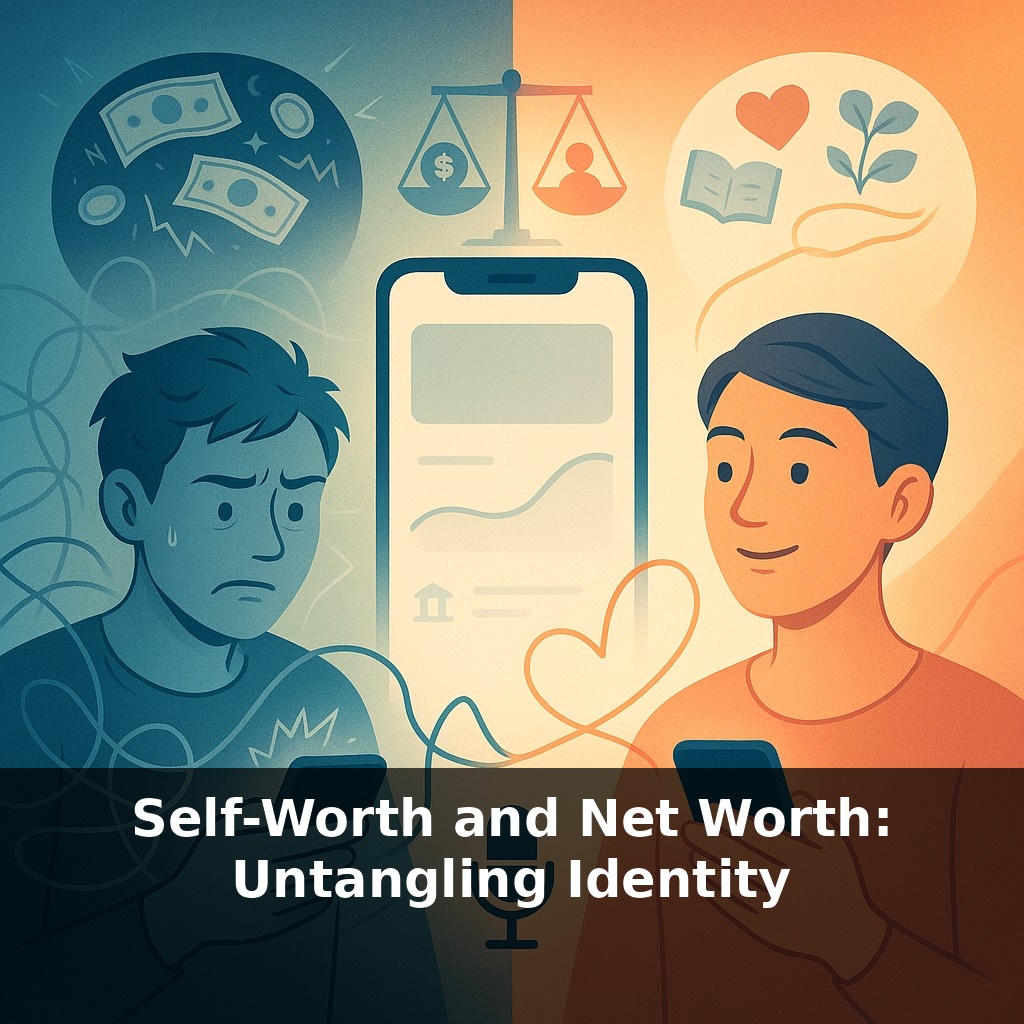
Money researchers sometimes talk about two ledgers running in parallel: your financial balance sheet and your “psychological balance sheet.” One tracks assets and debts in dollars; the other tracks things like mastery, connection, integrity, and impact. Problems start when those two ledgers get collapsed into one, and the only line item that seems to count is money.
You can see this in how people react to the same number. Someone with $5,000 in savings might feel safe because it represents months of discipline, or ashamed because it’s less than a friend’s bonus. The math hasn’t changed; the story about what that number “means” has. That story is where identity sneaks in.
Three ingredients tend to fuse money and worth:
First, comparison. Your brain is constantly running “relative value” calculations—social media, housing, schools, even hobbies become price-tagged status cues. Behavioral economists call this reference dependence: $80k feels rich in one circle and “behind” in another. If your reference group shifts upward, your felt worth can drop even as your income rises.
Second, narrative. Many of us absorbed scripts like “real adults own a home,” “success means a seven-figure exit,” or “good parents give their kids more than they had.” These aren’t neutral beliefs; they create performance targets. Miss the target, and the internal verdict isn’t “the goal was unrealistic,” it’s “I am behind.”
Third, control. Neuroscience studies show that uncertainty and loss of control light up the same threat circuits as physical pain. Money feels like a lever you should be able to pull, so setbacks can trigger outsized shame: “If this is off, something is wrong with me.”
Notice who’s missing from this picture: the parts of you that don’t fluctuate with markets—your reliability, curiosity, humor, how you show up when no one is scoring you. Those live on a different ledger entirely. When that second ledger is neglected, it’s easy for financial metrics to rush in and fill the void.
Organizations face a similar fork. Some firms define value purely by quarterly earnings; others weave in metrics like employee engagement, innovation, or social impact. The CECP data on purpose-driven companies outperforming over time suggests that broader definitions of value don’t just feel better—they can be more resilient. The same is true at a personal level: the more dimensions you measure your life on, the less any single dip can define you.
A startup founder sells her company for millions and, within a year, feels oddly hollow. For a decade, “I’m the scrappy CEO” was her entire story. Once the wire hits, the role dissolves—and without a deeper identity, the windfall amplifies confusion instead of security. In contrast, a nurse who will never appear on a rich list ends her shifts exhausted yet grounded; her inner scoreboard tracks lives helped, not digits.
You can see the split at small scales too. One person quietly renegotiates a salary after realizing their value to the team isn’t pegged to last year’s offer. Another stays in a toxic job because the title props up a fragile ego. Same labor market, radically different anchors.
Research on “contingent self-worth” shows that when people stake identity on any single domain—looks, grades, follower counts—they swing harder with every up and down. Money is just the most socially rewarded version. Diversifying the places you derive worth from acts like psychological risk management: one portfolio can drop without crashing your whole sense of self.
A culture built on rankings and dashboards makes it easy to treat every raise, valuation, or follower milestone like a scoreboard. As AI reshapes work and some roles vanish, those single-metric identities get brittle fast. Think of what happens when an athlete retires with no plan beyond the sport. The upside: schools, apps, even HR teams are beginning to track “belonging,” growth, and contribution, hinting at a future where “doing well” and “being well” are measured together.
So as your accounts rise or fall, notice what never appears on a statement: the calm after a hard choice, the friend who calls because you listen well, the quiet pride of learning a new skill. Let money fund the life you’re crafting, not narrate it. The more stories you can tell about who you are without numbers, the less any balance can shrink you.
Here’s your challenge this week: Every time you check your bank account, investment app, or think about your income, pause and say out loud, “My net worth is a number; my self-worth is my values, relationships, and character,” then list exactly three non-money things you’re proud of in that moment. Sometime in the next 24 hours, tell one trusted person, “I’m experimenting with separating who I am from what I earn,” and share one story from your life that made you proud but had nothing to do with money. For the next 7 days, do one thing daily that reflects your values but doesn’t change your net worth—like mentoring someone for free, creating something you don’t sell, or spending unrushed time with someone you care about—and jot the specific action and how you felt in your phone notes.