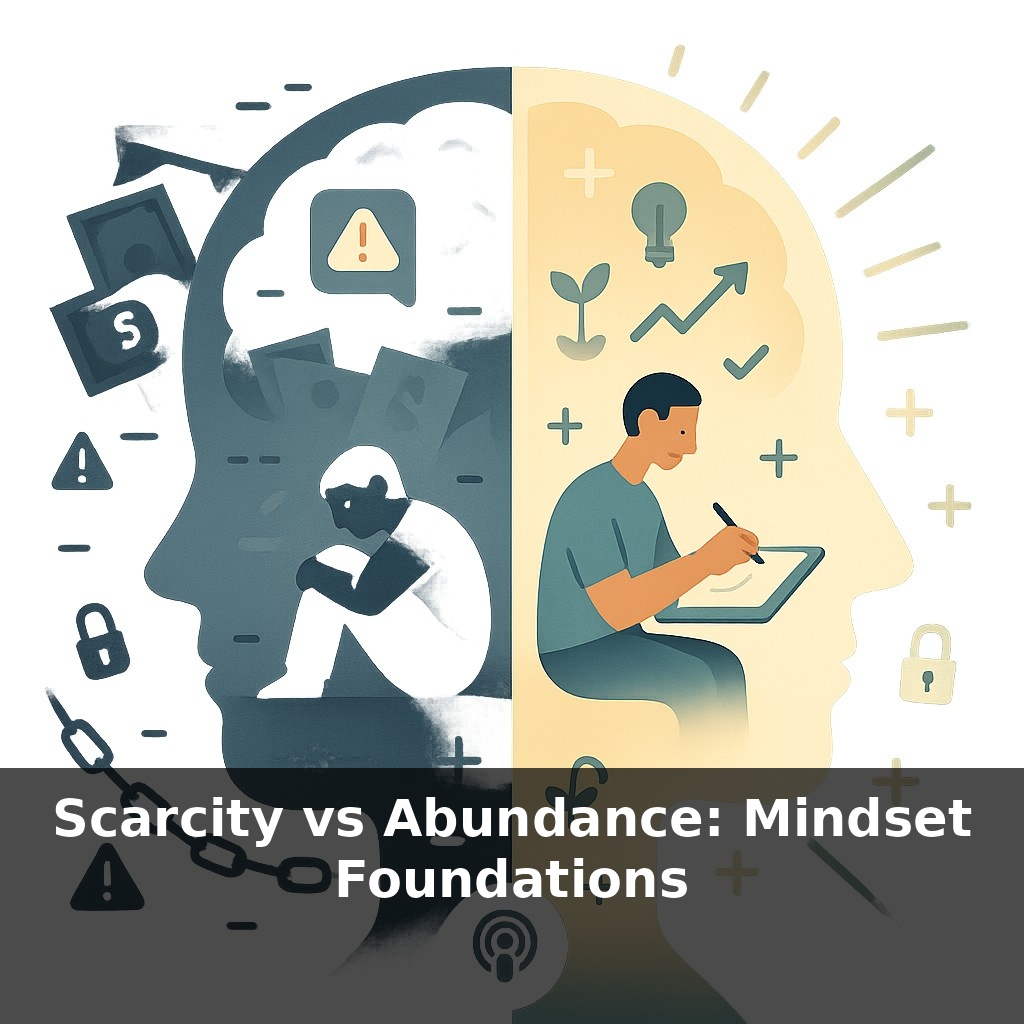
Money stress can quietly drain your brain power—researchers have found it can drag performance down by roughly a dozen IQ points. Now, picture two people: one staring at an overdraft alert, the other mapping out a dream project. Same income, totally different mental universe.
Here’s the twist: the difference between those two people isn’t just budgeting skills or willpower—it’s the *story* their brain is telling about what money means. One brain is running a script that says, “There’s never enough, every choice is dangerous.” The other is running, “Resources can grow, skills can be built, options can be created.” Same numbers in the bank, but one mindset keeps slamming on the brakes, while the other quietly taps the gas.
Psychologists call these the scarcity and abundance mindsets, and they don’t just shape how you feel about money; they steer what you notice, what you try, and what you believe is possible next. In this episode, we’re going to unpack how these mindsets form, how they silently shape your financial habits, and how to start shifting the script—without pretending your real constraints don’t exist.
Here’s where it gets tricky: your brain doesn’t ask, “Is there *actually* enough?” before it switches into scarcity or abundance. It reacts to cues—like a near-empty gas tank light, a friend’s vacation photos, or a surprise bill—and builds a story from there. Over time, those stories calcify into habits: which tabs you open, which risks you dismiss, which opportunities you don’t even label as “for people like me.” We’ll zoom in on those subtle cues, because that’s where your mindset quietly updates—or stays stuck—day after day, transaction after transaction.
Scarcity doesn’t just *feel* different from abundance; it literally changes what your brain can do in the moment. In lab studies, when people are reminded of not having enough—of time, money, or even social approval—their attention clamps down on whatever looks most urgent. That “tunnel” can help you survive a crisis, but it comes with tradeoffs: you discount long-term rewards, you overvalue short-term relief, and you’re more likely to grab options that stop the discomfort *now* even if they quietly cost you later.
That shows up in money choices in very practical ways. Under scarcity pressure, people are more likely to take on high-interest debt, skip employer matches on retirement accounts, delay dealing with overdue bills, or avoid opening financial statements altogether. Behavioral economists find that when the brain is occupied by “how do I get through this week?” it has less bandwidth to calculate “what sets me up for next year?” That doesn’t mean you’re irrational; it means the context is hijacking your decision resources.
Abundance cues push the system in the opposite direction. When people momentarily feel resourced—enough time, enough support, enough buffer—their thinking gets wider and more flexible. They notice options like negotiating bills instead of paying late fees, learning skills instead of chasing quick fixes, or starting micro-experiments in investing instead of waiting for the “perfect” amount of money to begin. Studies link this broadened focus to concrete behaviors: higher saving rates, more investment in education, and greater likelihood of starting side businesses.
One subtle twist: objective numbers don’t fully determine which mode you’re in. High earners with big mortgages and lifestyle debt can live inside constant scarcity tunnel, while lower earners with modest safety cushions and clear plans can operate with surprising spaciousness. What matters is your *perceived* slack—how much room you believe you have to recover from mistakes and to try new things.
Think of an emergency fund here the way doctors think of baseline fitness: it’s not glamorous, but it changes how your “financial body” handles every stressor, from a surprise copay to a sudden job loss. That baseline shifts your brain from “one wrong move and it’s over” toward “I can absorb a hit and still move forward,” and your choices follow.
Think about two friends earning the same salary. Alex gets a small bonus and uses it to clear space: pays one lingering bill, sets up a tiny automatic transfer into savings, and buys a book on salary negotiation. Bri, facing the *same* numbers, uses that bonus to plug a gap, then upgrades a few monthly subscriptions “because I deserve it after all this stress.” Fast-forward a year: Alex has a small cushion and a new skill; Bri has a slightly nicer lifestyle but no more breathing room. The difference isn’t virtue—it’s what each person does with the *first* bit of slack.
Companies show this pattern too. Some treat every quarter like an emergency drill, cutting experiments the moment revenue dips. Others protect a small “learning budget” even in lean times, so they can test new products or markets. Over a few years, that protected space turns into new income streams—and their culture starts expecting growth, not just survival.
As AI handles more “busywork” like bill pay and budgeting, the real leverage shifts to how you *use* the freed space. Some people will fill it with new learning, networking, or testing small income ideas; others will simply upgrade comfort and recreate pressure. Policy experiments like basic income hint at a future where the key skill isn’t just earning, but turning any extra capacity—time, money, attention—into systems that keep expanding your options.
So instead of asking, “Am I stuck in scarcity?” a more useful question is, “Where do I have a sliver of room to play?” Start tiny: redirect one impulsive purchase into a “future experiments” jar, or use 10 quiet minutes to learn one new money skill. Those small, repeated choices act like raindrops—barely noticeable alone, but over time they reshape the whole landscape.
To go deeper, here are 3 next steps: (1) Read the first two chapters of *The Soul of Money* by Lynne Twist and highlight every example of “enoughness,” then rewrite your top three highlights as personal money mantras you’ll keep in your notes app. (2) Open a free account with YNAB (You Need A Budget) or EveryDollar and create one new category called “Abundance Experiments,” funding it with a small, specific amount today (even $5) to practice directing resources instead of reacting to scarcity. (3) Queue up two podcast episodes that embody an abundance lens—Tim Ferriss’ interview with Naval Ravikant on wealth and happiness, and one episode of the *Afford Anything* podcast—and jot a single, concrete behavior from each (e.g., how they invest, give, or learn) that you’ll test in your own life this week.