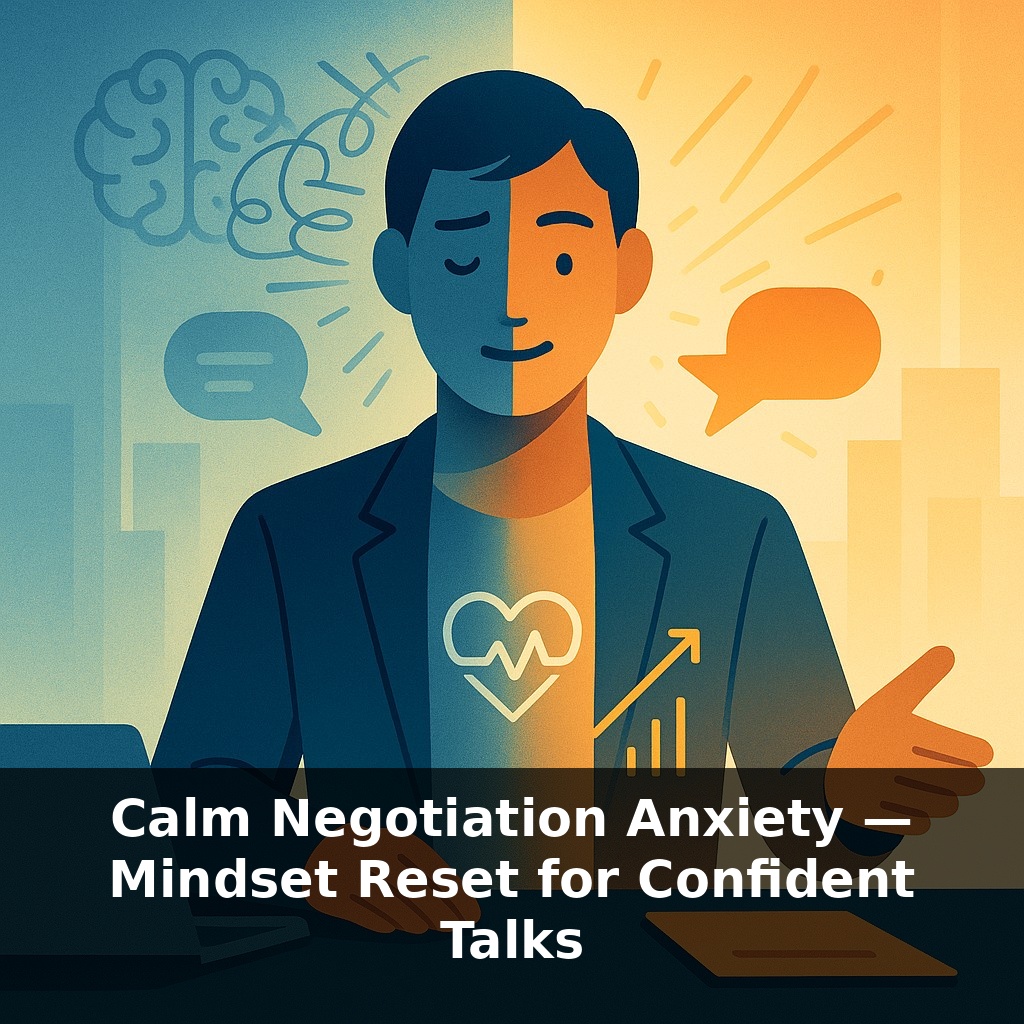
Calm Negotiation Anxiety — Mindset Reset for Confident Talks
📝 Transcript
A single sentence you say to yourself before a tough conversation can quietly add thousands of dollars to your career. You’re walking into a salary talk, heart racing, palms damp—yet the person across the table can’t see the one move that changes everything: how you label that rush.
Here’s the twist: your body’s stress response isn’t the enemy of good negotiation—it’s unused fuel. That racing pulse, tight chest, and buzzing thoughts are the same raw ingredients your system uses for focus and performance in a big game or on stage. The problem isn’t the signal; it’s what you do with it. Most of us walk into a negotiation treating that rush as a warning siren, then try to “calm down” by sheer willpower and self-criticism. That usually backfires, shrinking your perspective and making you cling to weak offers just to escape discomfort. In modern, interest-based negotiation, that’s expensive. You need mental space to ask better questions, notice hidden options, and protect your long-term reputation. This is where mindset reset, breath control, and preparation stop being “soft skills” and become performance tools you can practice and measure like any other business metric.
In practice, negotiation anxiety shows up less like drama and more like small, costly distortions: you talk faster than usual, forget a key question, accept the first “reasonable” number because your brain quietly prioritizes escape over accuracy. Research on decision-making under stress shows our field of view narrows; we miss side doors like extended benefits, scope changes, or phased timelines. That’s a problem in modern business, where the best deals rarely sit on the surface—they’re built through curiosity, iteration, and the courage to stay in the conversation a few minutes longer.
Most people try to “fix” negotiation nerves at the wrong layer. They argue with their thoughts: “Don’t screw this up. Act confident. Stop being nervous.” But anxiety in talks usually starts one step earlier—at the *story* you’re running about what a negotiation is and what it says about you.
If your default script is, “Negotiation is a test of my worth,” then every pause, every frown, every counteroffer feels like a verdict. No breathing trick can fully offset a story that harsh. The shift is to treat negotiation as *joint problem-solving under constraints*. Not fluffy cooperation—disciplined collaboration. You’re there to explore whether there’s a smart way to align two sets of goals, not to prove you’re flawless.
This is where history quietly helps. Classic, positional haggling assumed fixed pies and winners/losers. Modern, interest-based approaches grew out of a different question: “What are we each trying to accomplish, and how many ways could we get there?” That mindset doesn’t just sound nicer; it changes what counts as “success.” Instead of, “Did I beat them?” the scorecard becomes, “Did we uncover options that serve both sides better than the default?” That alone takes pressure off your ego and puts focus on the design of the deal.
Concrete example: a SaaS founder walks into an enterprise pricing call thinking, “They’ll crush our margins if I’m not tough.” She braces for combat and misses signals that the buyer cares more about implementation speed and internal adoption than raw price. Same founder, different script: “My job is to find the mix of price, rollout, and support that makes this a no-brainer for both of us.” Now questions come more naturally: “Where is failure most costly for you—budget, delay, or risk?” That curiosity tends to *increase* leverage, not give it away.
Think of it like a medical consult: the best specialists don’t start by defending their standard treatment; they start by diagnosing the full picture, then co-design a plan. You still protect your boundaries—your health, or in business, your minimum terms—but you’re not dueling; you’re evaluating fit.
Under this lens, nerves stop being proof you’re “bad at negotiating” and become expected noise when you’re learning a high-stakes skill. What matters is not eliminating discomfort, but staying in the conversation long enough, and clearly enough, for your preparation and questions to do their work.
Picture a product manager about to push back on a deadline set by a senior VP. Their first impulse is to silently accept, then complain to the team later. Instead, they pause and ask, “If we keep this date, where do you most need certainty—quality, scope, or launch timing?” The VP reveals that a board meeting, not the public release, is the real pressure point. Together, they design a slimmer demo now and full rollout later—no drama, just clearer fit.
Or take a mid-level engineer offered a promotion with vague responsibilities. Rather than debating title or salary first, she lays out three versions of the role on a one-page “menu”: expert IC, team lead, or hybrid, each with sample metrics. This externalizes the tension; they’re now both tweaking a draft rather than protecting their egos.
Even in vendor talks, you can shift gears by saying, “Let’s list every constraint on one whiteboard—yours and mine—then see what combinations we haven’t tried yet.” Curiosity becomes the structure that holds your nerves.
Calm negotiators may become the norm as tools and norms shift. AI coaches will soon mirror back your patterns like a precise, tireless sparring partner, letting you rehearse hard conversations before they’re live. Pay-transparency and stakeholder pressure will make “not asking” increasingly costly. Teams that treat talks as ongoing design reviews, not one-off showdowns, will adapt fastest—updating playbooks as markets move, the way good pilots constantly scan and adjust, not just trust the original flight plan.
Anxiety won’t vanish; it just gets less bossy as you rack up small, intentional reps. Treat each negotiation like tuning an instrument: you adjust questions, pacing, and boundaries, then note what sound you get. Over time, patterns emerge—where you rush, where you freeze—and that awareness quietly compounds into calm, reliable influence.
Try this experiment: Before your next potentially uncomfortable conversation (like asking your manager for a title bump or pushing back on a client deadline), rate your anxiety from 1–10, then deliberately slow your breathing to a 4-count in, 6-count out for two full minutes while repeating a specific intention like, “My goal is collaboration, not perfection.” Go into the conversation using just *one* pre-decided sentence as your anchor (for example: “What flexibility do we have on this?” or “Can we look at options that work for both of us?”) and use it at least twice. After the conversation, re‑rate your anxiety, and jot down exactly what your body did (sweaty hands, tight chest, etc.) at the most stressful moment and how quickly it settled compared to past negotiations.
From this course
Foundation: The Negotiation Workout
10 episodesUnlock all episodes
Full access to 10 episodes and everything on OwlUp.
Subscribe — $1.99/monthLess than a coffee ☕ · Cancel anytime