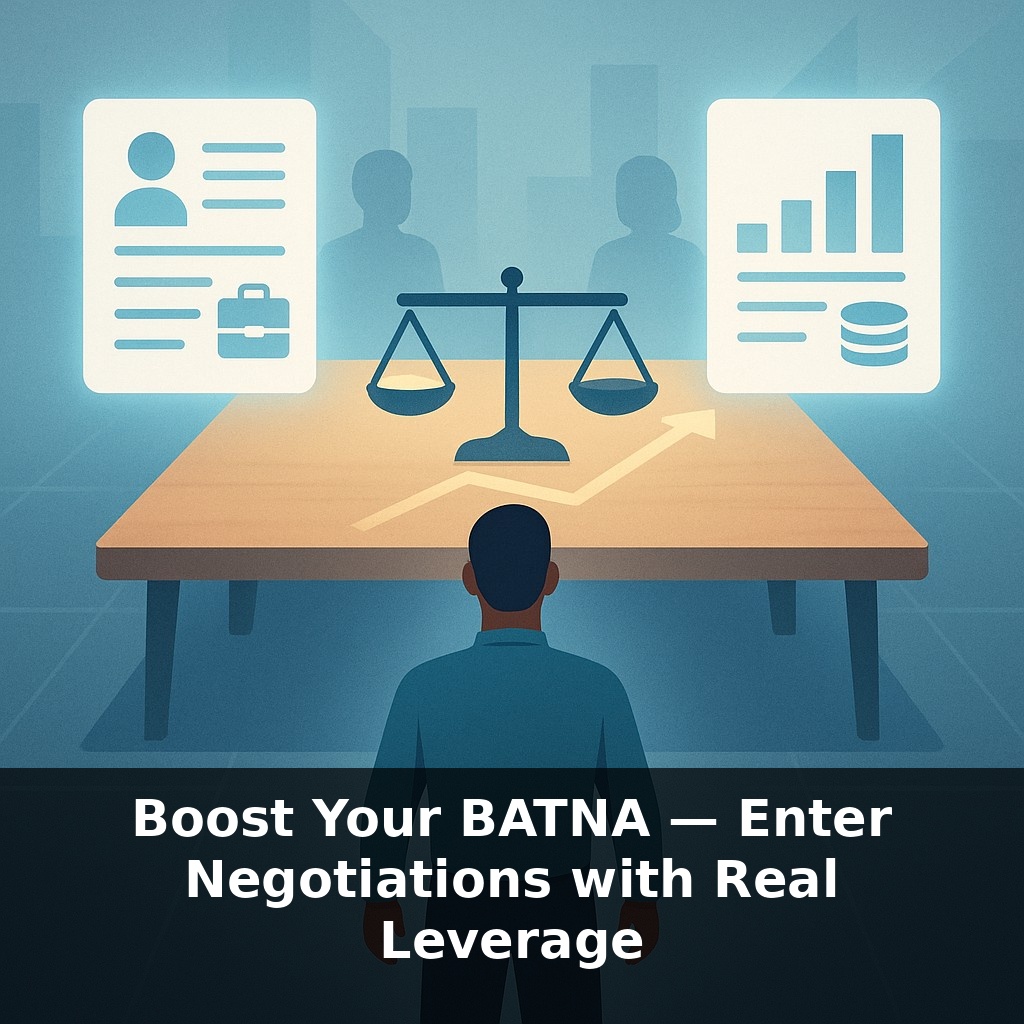
Negotiators who walk in with just one solid alternative often walk out with dramatically better deals—sometimes nearly a quarter better. Now picture two scenes: a job offer on the table, and a funding term sheet in your inbox. Same you, same skills… wildly different leverage.
You’ve already seen how mindset calms anxiety and how uncovering interests opens new angles. Now we’re going to quietly rewire the power balance *before* anyone sits down at the table. The twist: you don’t need to be more aggressive—you need to be less dependent.
Think about three common situations: a candidate with two job offers, a vendor with several serious customers, a founder in talks with multiple investors. Same person, same skills, but the posture in each conversation feels different. That difference isn’t confidence theater; it’s grounded in something you can deliberately engineer.
In this episode, we’ll zoom in on a habit top negotiators use long before the first proposal is exchanged: they treat “alternatives” like a pipeline to be actively built, tested, and, when useful, revealed.
Here’s where this gets interesting: alternatives aren’t just “nice to have backups”—they’re assets you can design, like a product roadmap. In the research, even one **concrete** option—not a daydream—nudges outcomes up by nearly a quarter. Yet most professionals treat this like weather: they just “hope” a better option appears.
Think of how Amazon staged its HQ2 process: parallel conversations, clear criteria, and timed reveals created a bidding environment, not a single yes/no moment. You can borrow that playbook on a smaller scale, long before salary talks, renewal calls, or partnership reviews ever begin.
Here’s the quiet move most people skip: before you try to “win” any negotiation, you should be running a parallel project—systematically upgrading what you’d do if this deal disappeared tomorrow. That upgrade has three layers: clarity, creation, and communication.
**1. Clarify your *real* next-best path**
Most people carry a fuzzy sense of “I could probably find something else.” That fuzziness makes you clingy. Instead, spell out your current path in unromantic detail: specific timelines, costs, risks, and upsides. In a partnership talk, that might mean knowing which three other channels you could grow, how long each would take, and what revenue you’d likely see in six months. Vague hope becomes usable information when it’s quantified.
**2. Actively create stronger options**
Research shows the gain comes from *actual* alternatives, not wishful thinking. That means deliberately opening second and third lanes:
- In sales: warming additional prospects before a renewal meeting. - In procurement: qualifying backup suppliers *before* the incumbent’s contract is up. - In internal negotiations: lining up support from another department or a different project you’d join if this one stalls.
The pattern: you’re not threatening anyone—you’re quietly reducing your dependence on a single path.
**3. Upgrade the *quality* of each path**
A weak, slow, expensive fallback quietly drags your confidence down. You can often improve it without anyone’s permission: shorten timelines, remove friction, add allies, or pre-negotiate pieces of it. For example, a startup raising capital can firm up a revenue-bridge plan with customers and a credit line; suddenly, “no” from an investor is inconvenient, not existential.
**4. Decide what to reveal—and how**
The misconception is that secrecy always helps. In reality, there’s a spectrum:
- Fully private: when your backup is fragile or still speculative. - Selective signals: dropping *verifiable* facts (“We’re also in late-stage talks with two other suppliers”) without dramatics. - Structured transparency: carefully sharing deadlines or competing processes to create constructive urgency, not ultimatums.
Like a skilled physician presenting treatment options, you’re calm, precise, and credible—never theatrical. That credibility is what turns alternatives into real leverage instead of empty posturing.
Think about three everyday moves that quietly upgrade your position. First, in a SaaS renewal, a customer success lead maps out three upsell paths with existing clients. By turning those into scoped mini-pilots *before* a big enterprise pitch, the “fallback” becomes a credible growth lane, not a consolation prize. Second, a creative agency owner times outreach so that two promising prospects reach proposal stage the same week a major client’s retainer is up for discussion. She’s not bluffing; she’s sequencing her pipeline so her calendar, not her fear, sets the pace.
In medicine, a good oncologist doesn’t cling to one protocol; they line up clinical trials, second opinions, and supportive treatments. Each path is real, with dates, criteria, and tradeoffs. You can treat your next big negotiation the same way: as a portfolio of evolving routes, not a single, fragile bet. Over time, this habit turns “take it or leave it” moments into “choose the best of several” decisions—on *your* side of the table.
As platforms surface more options instantly, your “backup paths” will be mapped for you like routes in a GPS—complete with live traffic, tolls, and time estimates. The edge won’t be *having* routes, but knowing which ones fit your risk, timing, and values. Expect tools that stress‑test your plans the way wind tunnels test aircraft: simulating downturns, policy shifts, or black‑swan events so you see how your next move holds up when the weather suddenly turns.
Your challenge this week: in one upcoming discussion, quietly set a “walk‑toward” path, not just a “walk‑away” line. Sketch a version of success that doesn’t rely on that single yes—maybe a slower climb, a side project, or a different customer set. Options don’t just harden your stance; they loosen your thinking and widen what you’re willing to explore.