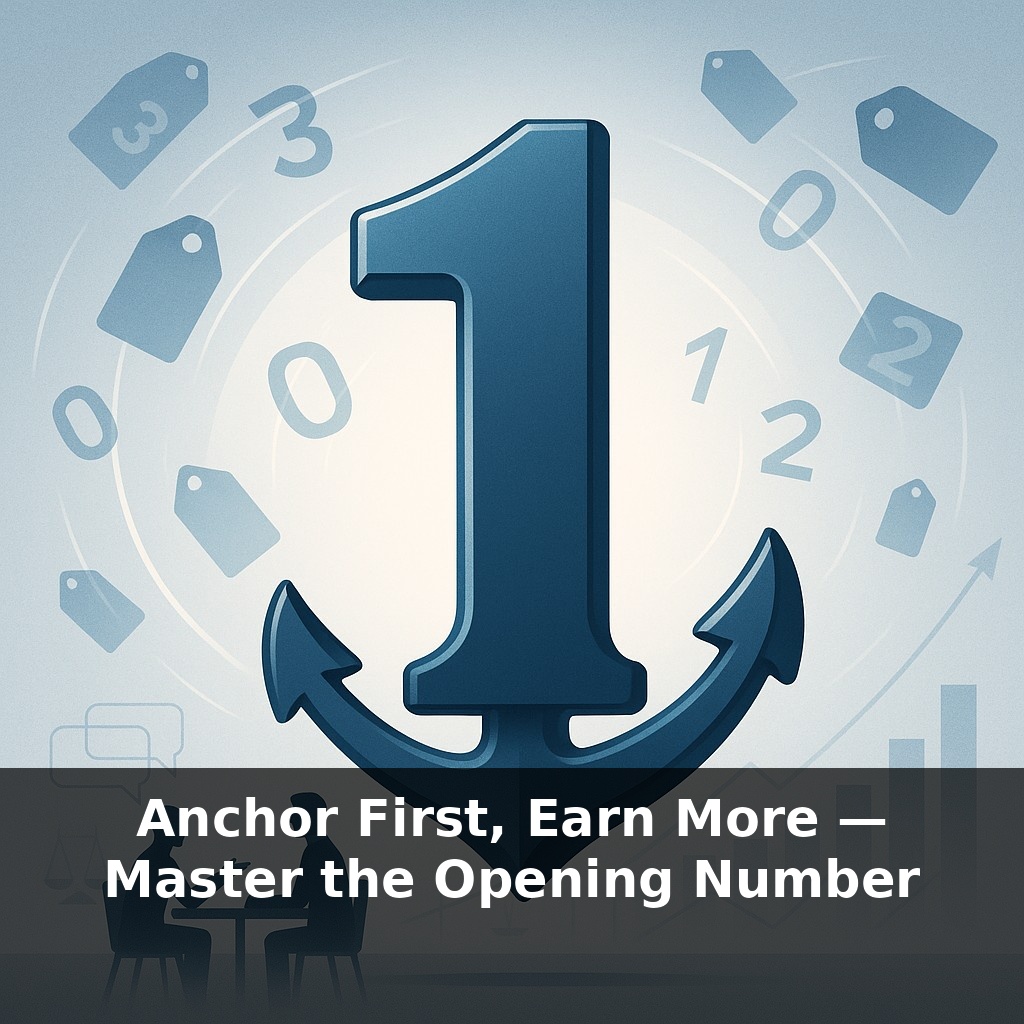
The first number you say in a negotiation can be worth more than every sentence that follows. A single, confident opening offer can quietly pull the final deal toward it—whether you’re pricing a startup, listing a home, or naming your salary in a tense performance review.
In the last episodes, we focused on backing your ask with research and a clear story. Now we’ll connect that groundwork to the moment that quietly decides far more than most people realize: the first concrete number you say out loud. Across dozens of studies and real-world deals, the pattern is unmistakable: whoever credibly names the opening figure often tilts the entire conversation in their favor.
This isn’t about being aggressive for its own sake. It’s about translating your market intel, your BATNA, and your narrative into a number that feels bold to you but reasonable to them. Think about a founder pitching valuation, a manager scoping a client contract, or a candidate in a final-round interview—each faces the same fork in the road: speak first and shape expectations, or wait and risk being pulled toward someone else’s frame. In this episode, we’ll unpack how skilled negotiators make that call.
Think of today’s focus as shifting from “what should this be worth?” to “what’s the first number they actually hear from me?” This is where your preparation collides with real-time judgment. Two questions now dominate: **Should you go first? And if yes, how far can you stretch without snapping credibility?** The answer changes if you’re selling a SaaS contract vs. renegotiating rent with a long-term landlord, or if you’re a prized candidate in a hot market vs. one of 200 applicants for a stable role. Context, power, and timing start to matter more than theory here.
Here’s the twist most people miss: “going first” is not one decision, it’s three smaller ones you stack together:
1. **Do I want to anchor at all?** You usually do when: - The market range is reasonably knowable (salaries, real estate, SaaS pricing). - You’ve done enough homework to sound calm and specific, not tentative. - You’re not clearly the weaker side with no alternatives.
You usually *don’t* when: - You truly lack price information and the other side clearly has it (e.g., you’re buying a niche service you’ve never purchased before). - You suspect they’re under severe pressure (end-of-quarter seller, landlord with long vacancy); letting them speak may reveal a surprisingly low floor.
2. **Where do I place the anchor inside the plausible zone?** Research shows that as long as your number still feels tied to reality, “high but defensible” beats “modest but safe.” In practice: - **Map the visible range** from your research (e.g., competitors’ rates, comparable salaries, recent deals). - **Mark three points:** your walk-away, your “good,” and your “thrilled” outcome. - Place your anchor a bit beyond “thrilled,” but still explainable with evidence. Think: “top 10–15% of the believable range,” not “twice what anyone else is paying.”
3. **How do I package the anchor so it lands as confident, not outrageous?** - Lead with *structure*, then *number*: “For this scope—global rollout, ongoing support, and 90‑day implementation—these engagements typically fall in the $220–260K range. I’d propose we start at $255K.” - Use **precise numbers** when you want to signal careful calculation: $127,500 often feels more reasoned than $130,000. - Anchor *once*, cleanly. Don’t immediately hedge (“…but I’m flexible”), or you dilute your own reference point.
Notice the pattern: the “strength” of your anchor isn’t just how high or low it is—it’s how **justifiable, specific, and calmly delivered** it feels in the first 30 seconds after you say it.
Think about how this plays out in different arenas. A startup founder pitching investors might say, “We’re raising at a $24.5M valuation,” after walking through traction and market comps. That extra precision nudges investors to argue within that ballpark instead of defaulting to “early-stage = low valuation.” A freelancer scoping a new client can frame a project as, “For a three‑month launch, my projects land between $18,000 and $22,000. For this one, I’d put it at $21,750,” then pause. Silence here is strategic; it gives the figure time to settle instead of inviting immediate discounting. In a promotion talk, a manager could say, “Given expanded ownership and recent wins, I’m targeting a move into the $185–195K band this cycle.” That range sets a corridor; even if leadership pushes back, discussion tends to stay inside those walls. Used this way, the first number behaves less like a wish and more like a clinical baseline in medicine: everything that follows is interpreted relative to it.
Anchors won’t stay static. As AI tools spit out “smart” first numbers, you’ll compete against algorithms that can scan thousands of deals in seconds. That raises a new question: do you *trust* the suggested anchor, or deliberately shade above or below it to signal ambition or flexibility? In cross‑border teams, you may also need a portfolio of anchors—like different lenses on a camera—swapping between them as norms, currencies, and risk appetites shift mid‑conversation.
Treat each first number as a live hypothesis, not a verdict. You’re testing how far the other side can lean without snapping the rope. Over time, patterns emerge: some rooms respond like dry ground to a sudden storm, others absorb boldness like steady rain. Your challenge this week: in one real negotiation, volunteer to go first—and record what actually shifts.