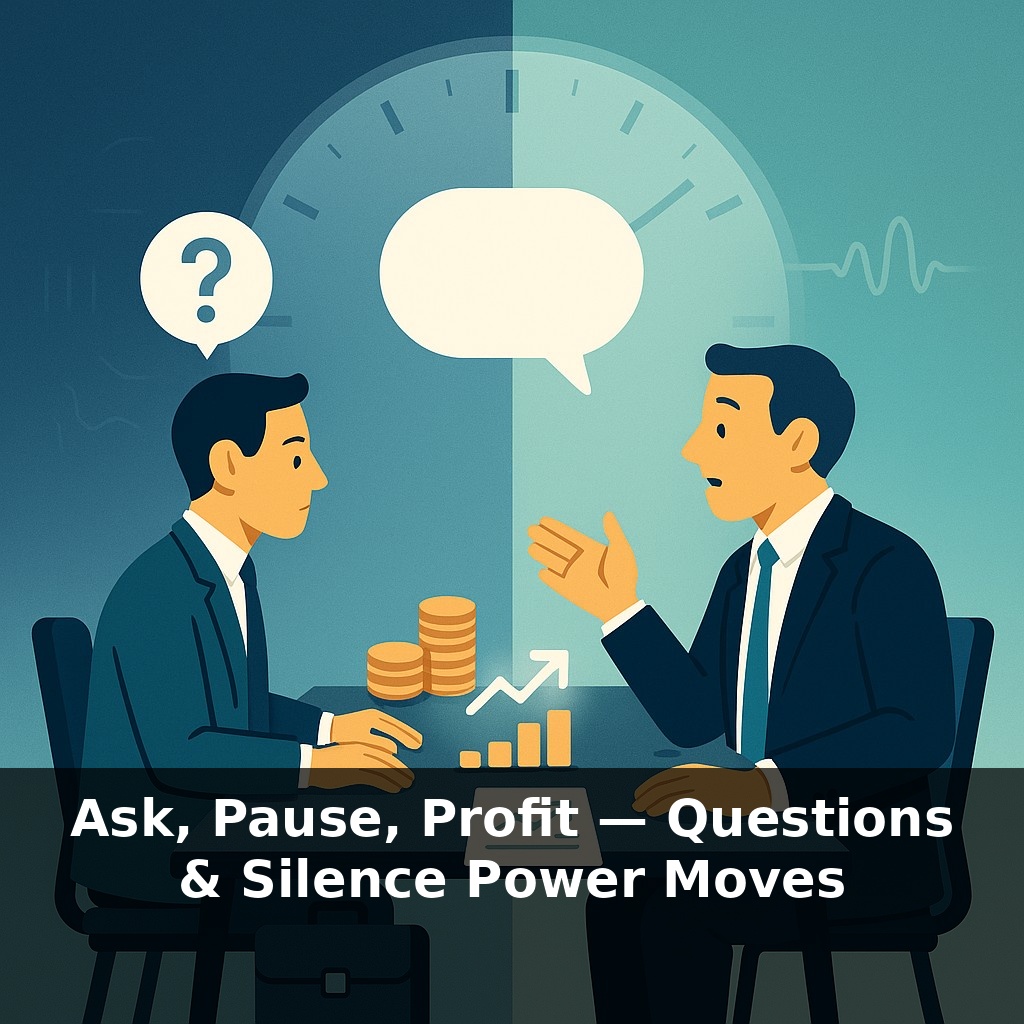
In one study, short pauses in negotiation created nearly half again as much value. Now jump into a tense salary talk: you state your case, then… say nothing. Five quiet seconds stretch. Your manager shifts, reveals budget details you were never supposed to hear. What just happened?
Forty‑six percent more joint value—from doing less talking. That’s not a rounding error; it’s a completely different way of thinking about influence. Up to now, we’ve focused on how to research quickly, frame your story, and set the first number. In this episode, we flip the spotlight: away from your pitch and onto your counterpart’s mind.
Top sales reps don’t “win” by out-arguing customers; they win by getting customers to explain themselves. Data from tens of thousands of calls shows they ask more—and better—questions, then resist the urge to jump in the moment there’s a gap.
The power move here is deceptively simple: ask, then pause. But which questions actually unlock useful information instead of defensiveness? And how long can you realistically stay quiet before it feels risky—or rude? That’s what we’re about to turn into a repeatable business habit.
Think of this episode as zooming in on the “how” behind those pauses and questions. You already know they work; now we’re treating them like tools on a workbench, not magic tricks. In practice, most professionals default to two modes: pitching hard or retreating fast. Neither leaves much space for the other side to surface what actually matters. Here, we’ll layer in calibrated “what” and “how” questions, plus timing tactics, so your counterpart starts doing the cognitive heavy lifting—laying out constraints, trade‑offs, and options you can later shape into concrete deals.
The trap most professionals fall into isn’t “not knowing” they should ask and pause—it’s *when* their instincts revolt. The stakes feel high, the room feels tense, and the inner monologue kicks in: “If I don’t say something, I’ll lose control.” That’s exactly where this skill shifts from theory to advantage.
Start with timing. Those 5‑second gaps don’t appear randomly; you create them at specific inflection points: - Right after your counterpart shares a partial answer (“We’re tight on budget this quarter…” *pause*). - Immediately after a number hits the table. - When you hear vague language: “maybe,” “soon,” “we’re considering.”
You’re not just being quiet; you’re running a small experiment: “If I don’t rescue this moment, what else will they volunteer?”
Next, precision. Instead of stacking multiple questions (“What do you need? And when? And who decides?”), treat each one like a single diagnostic test in medicine: one probe, then observe the response fully before ordering the next. Over‑testing confuses the picture; one clear lab result can change the whole treatment plan.
Three high‑leverage moves:
1. **Turn positions into constraints.** When they say, “We can’t go above $X,” follow with: “What needs to be true for you to move closer to Y?” Then hold the silence. You’re inviting them to co‑design the path instead of defending a wall.
2. **Surface the hidden scoreboard.** Ask: “How will you know this was a good deal six months from now?” Quiet. You’re nudging them to reveal the real metrics—career risk, internal politics, downstream costs.
3. **Shift from no to not‑yet.** When you hear “This won’t work,” try: “What would make this a bad decision for you?” Pause. Then: “What would you need to see to reconsider?” These paired questions map the danger zones and the potential bridge.
Notice the order: narrow, then widen; specific obstacle, then possible path. Your silence between each acts like a highlighter, telling them, “Stay with this thought; I’m not moving on.” Over time, this pattern trains counterparts to bring you richer, more structured information—because you’ve proven you won’t steamroll it.
In practice, this looks less like a grand tactic and more like a series of tiny, deliberate choices. You’re in a vendor review meeting. They’ve just walked through a slide deck, and everyone’s ready to rubber‑stamp the cheapest option. Instead of debating, you lean forward: “What trade‑offs are we accepting with this choice?” Then you *wait*. Someone mentions integration risk. Another brings up support coverage. A third realizes the “cheap” option could delay launch by a quarter.
Or you’re in a 1:1 with your manager about workload. Rather than arguing that you’re overextended, you ask, “How are you prioritizing projects across the team right now?” Pause. The answer surfaces unspoken rankings—and maybe a project they assumed you wanted, but don’t.
Used consistently, these small moves reposition you: from “the person with demands” to “the person who clarifies thinking.” That reputation compounds; people start coming to you earlier, with messier problems, where you have more room to shape outcomes before decisions harden.
As meetings move faster and calendars fill tighter, your ability to hold a room with a well‑timed “What else?” and a quiet beat becomes a filter for signal over noise. In cross‑functional projects, it’s the difference between nodding along and spotting the buried landmine. Think of it like adjusting studio lighting: a small tilt of the lamp and a brief stillness suddenly reveal texture others miss—misaligned incentives, fragile assumptions, quiet allies you didn’t know you had.
When this starts to feel natural, conversations turn into x‑rays: you glimpse pressures, hopes, and constraints beneath polished talking points. Treat each “ask, then hold” as sketching a rough map, not chiseling a verdict in stone. Over time, you’ll notice a shift—fewer tug‑of‑wars, more joint problem‑solving—and your calm curiosity becoming a quiet advantage.
To go deeper, here are 3 next steps: (1) Grab Warren Berger’s book *A More Beautiful Question* and, while listening back to the “Ask, Pause, Profit” episode, turn three of the guest’s power questions into your own “beautiful questions” you’ll test in your next client or team call. (2) Install a meeting assistant like Fathom or Otter.ai and, in your very next Zoom call, deliberately add a 5-second silent pause after each key question, then review the transcript afterward to see how the pause changed the depth of the responses. (3) Open up YouTube and watch a Chris Voss negotiation breakdown, then practice one of his calibrated questions (e.g., “What about this doesn’t work for you?”) in a live pricing or proposal conversation today, pairing it with the silence strategy from the episode to let the other person fill the space.