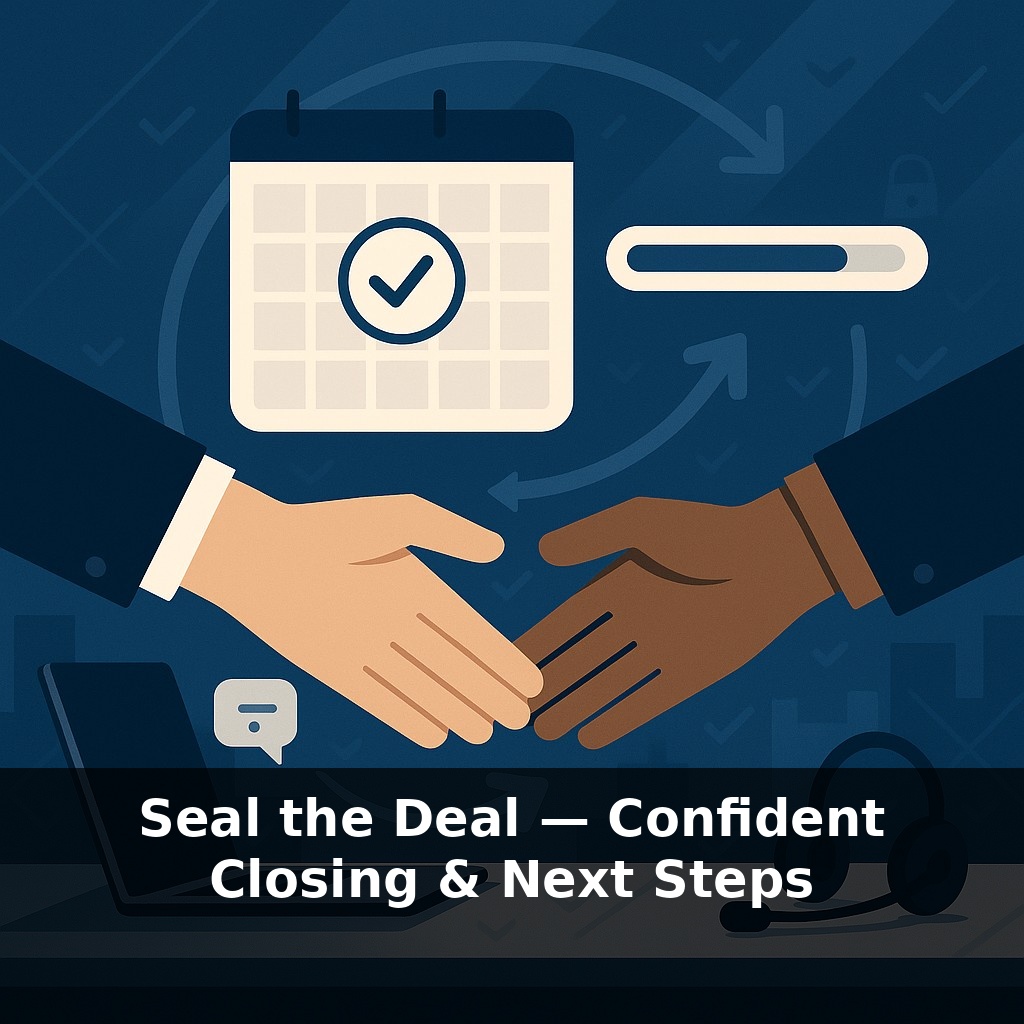
Deals with a scheduled next step are almost half again as likely to close—yet most reps still end calls with “I’ll follow up soon.” You’re in a final sales conversation. The fit is clear, the buyer is nodding. Here’s the twist: the close starts now, but the win happens after you hang up.
“Deals are won or lost in the follow‑through, not the flourish.” In earlier episodes we focused on how you open and steer the conversation. Now we’re zooming in on the last 10%: how you convert a promising discussion into a signed agreement and a clear path forward.
Here’s the uncomfortable truth: buyers rarely “ghost” at the end because they secretly changed their mind. More often, they get buried in other priorities, can’t easily explain your value to colleagues, or feel a vague risk they can’t quite name. Your job in the close is to remove that friction.
That means turning warm intent into concrete micro‑agreements: who needs to approve, what happens this week vs. next, what success will be measured by. Think of it like a relay race handoff—if the baton wobbles here, everything you ran before doesn’t count.
So how do top performers actually guide those last minutes of a call? They treat them like shaping wet clay: still flexible, but quickly hardening into a final form. Instead of asking, “Do you have any other questions?” and hoping for a yes, they deliberately surface what’s unsaid—budget jitters, internal politics, competing projects. Then they translate that messy reality into a simple path the buyer can repeat to their team. You’re not just asking for agreement; you’re co-designing the buyer’s internal pitch, the approvals path, and the first visible win they’ll be judged on.
The shift that unlocks better closing is subtle: stop chasing “yes” and start designing decisions.
That begins with a clear structure for the last part of your conversation. Think in three passes:
**Pass 1 – Confirm the decision criteria (in their words).** You’ve already explored needs; now you crystallize how the buyer will *judge* options. Ask things like: - “When your team looks at proposals next week, what will matter most?” - “Whose perspective will weigh heaviest, and what do they care about?” You’re surfacing the hidden scorecard, not pitching yet. This is where Forrester’s insight matters: the first vendor to make that scorecard feel clear—and aligned with a compelling future state—wins most of the time.
**Pass 2 – Run a ‘summary close’ as a mirror, not a monologue.** You’re not reciting features; you’re narrating *their* story back to them: - “You told me X is costing you Y. We mapped a path where by [timeframe] you’re at [target]. The checkpoints you said matter are A, B, and C. Did I miss anything?” Done well, this triggers commitment–consistency: people prefer to act in line with what they’ve just reaffirmed publicly. If they correct you, good—that’s live debugging of the deal instead of silent objections later.
**Pass 3 – Move from “decision” to “movie.”** Most closes fail because the future is fuzzy. Make it vivid and risk-aware: - “Let’s stress-test this. Suppose we move ahead. Walk me through what could derail this internally.” - “If you *don’t* change anything for six months, what does that look like for you and the team?” Here you’re gently invoking loss aversion—not with scare tactics, but by contrasting the cost of inaction with a specific upside.
Now tie in BATNA thinking. Without naming the jargon, explore: - “What other options are you seriously considering?” - “If you decided not to solve this now, what would you fall back on?” The goal isn’t to trash alternatives; it’s to help them refine what “good enough” really means. Often they realize the fallback is shakier than they thought, which opens room for a bolder commitment.
Throughout, your tone matters more than any line. Confident closers sound like advisers making a joint call, not predators circling a signature. When you calmly weigh trade‑offs, quantify downside and upside, and co-write the first 90 days, the actual “yes” is almost an afterthought—a natural consequence of a well-designed decision.
A useful way to test your close is to ask: could the buyer *replay* this conversation accurately to their boss tomorrow? If not, you’re leaving the outcome to chance. Think of a surgeon finishing an operation: the “close” isn’t when the last stitch goes in, it’s when the handoff notes are so clear that any colleague can step in and know exactly what was done, what to watch for, and what success looks like in the next 24 hours.
Translate that mindset into your deals with concrete moves. For example, instead of ending with “We’ll follow up,” say: “Here’s how this typically works with teams like yours,” and sketch a simple three-step arc: internal review, decision meeting, kickoff. Then, have them customize it out loud: “Given your process, what needs to change in this sequence?” Their edits reveal hidden stakeholders, approvals, and timing risks.
You’re not just summarizing; you’re co-authoring a mini playbook that survives contact with their real world.
As AI tools predict stall risk and draft “smart” nudges, closing skill shifts from remembering steps to judging *which* moment needs a human decision. Think of your judgment as the conductor and the tools as the orchestra: you choose tempo, they provide volume. Expect buyers to arrive with AI-summarized options and sharper BATNAs; your edge will be framing trade‑offs, ethics, and timing in ways a bot can’t yet weigh—and owning the decision, not just the data.
Treat each deal like a story you’re co‑writing: the buyer is the protagonist, you’re the editor tightening the final chapter. Great closers don’t rush the ending—they clarify stakes, align supporting characters, and proofread the next steps. As you improve, notice how “checking in” shifts into “directing the plot” without ever feeling pushy.
Here’s your challenge this week: In your next three sales conversations, *pre-schedule* a concrete next step before you end the call—this means locking in an exact date, time, and purpose for the follow-up (e.g., “Tuesday at 2pm to review the proposal and confirm the start date”). For each call, confidently restate the value you’ve discussed in one sentence, then ask a direct closing question like, “Are you ready to move forward with this plan?” Track how many of those three calls end with either a clear “yes” or a clearly booked next step (no “I’ll think about it” endings allowed).