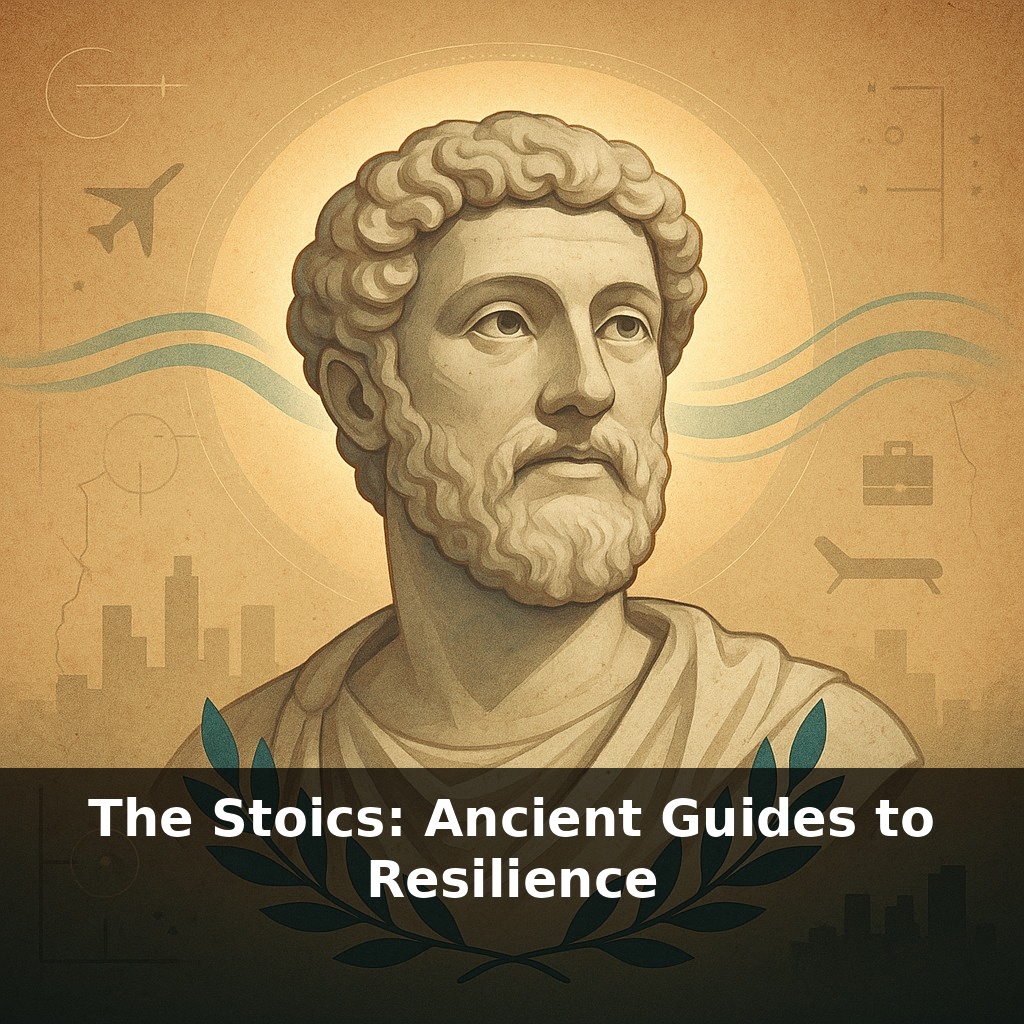
“Stoic” in English now means poker‑faced and emotionless—yet the original Stoics wrote detailed guides on how to feel deeply without being ruled by feelings. Today, fighter pilots, CEOs, and therapists secretly borrow their tricks. So what did the Stoics know that we’ve forgotten?
The odd thing about the Stoics is how… practical they were. They weren’t armchair philosophers debating abstractions; they were ex-slaves like Epictetus, emperors like Marcus Aurelius, and statesmen juggling wars, plagues, and politics. Their question wasn’t “What is virtue in theory?” but “How do I get through *today* without becoming a worse person?” That’s why Epictetus could fit a survival kit for the soul into a short handbook—and why a fighter pilot like James Stockdale could lean on it in a prison camp decades later. Modern research is catching up: those ancient habits of mind map surprisingly well onto what psychologists now call cognitive restructuring and values-based living. In this episode, we’ll look at how to borrow a few of their daily moves—not to blunt your feelings, but to stay steady when life tilts unexpectedly.
Instead of starting with theory, the Stoics started with a blunt filter: “Is this up to me, or not?” That single question quietly shapes how you respond to traffic jams, layoffs, arguments, even your phone’s notification buzz. Modern leaders use similar filters—some call it “sphere of control,” others “locus of control”—to decide where to spend their limited time and energy. The Stoics pushed it further: they treated each day as a small experiment in living this distinction, then audited the results at night, like a coach replaying game footage to refine tomorrow’s moves.
Epictetus had a harsh way of stress‑testing that “up to me / not up to me” filter: he told students to practice losing things in their mind before life took them away in fact. Not to become numb, but to discover what remained when titles, possessions, and even health slipped out of their hands. The core experiment was simple: if something can be taken from you, it can’t be the foundation of your peace.
This is where Stoicism quietly parts ways with a lot of modern “optimize everything” culture. Instead of asking, “How do I get more good outcomes?” Stoics ask, “Who am I when the outcomes don’t go my way?” Their answer was virtue—specific traits like wisdom, courage, justice, and self‑discipline. Those weren’t abstract labels; they were the *only* metrics of success fully within your control.
So a Stoic judge can’t guarantee a fair verdict will be popular, but can control whether she listens carefully, follows the law, and refuses a bribe. A Stoic parent can’t script a child’s future, but can shape the home climate: consistent, fair, and honest, even under stress. A Stoic leader can’t prevent a market crash, but can choose transparency over spin, and responsibility over blame‑shifting.
This focus on character over circumstances shows up starkly in James Stockdale’s account. He didn’t know if he’d leave the prison alive; he *did* know he could decide whether to betray others under torture, whether to keep some form of order among prisoners, whether to keep thinking of himself as a moral agent rather than a victim of pure fate. That shift—from “Will I get out?” to “How will I conduct myself while I’m here?”—turned a completely uncontrollable environment into a field for deliberate action.
One practical way the Stoics reinforced this was through voluntary difficulty. They would occasionally eat plain food, wear rough clothing, or walk instead of ride, even when they could afford comfort. The point wasn’t macho hardship; it was rehearsal. If you’ve proven to yourself you can handle less, then when life unexpectedly offers you less, you’re not starting from zero.
Your challenge this week: once a day, *deliberately* choose a small, non‑harmful inconvenience—and then pay close attention to the story your mind tells about it. For example, leave your phone in another room for an hour, take a colder shower than usual, or pick the longest grocery line. As you do it, silently say: “This discomfort is not up to me now; how I respond *is*.” At the end of each day, jot one sentence: “Today, when I chose X, I reacted by Y.” After seven days, scan those sentences and ask: Are my reactions closer to panic and resentment—or to curiosity and steadiness?
A quiet way to test this in normal life is to watch how you handle *micro‑stakes* situations. Say your flight’s delayed, your teammate misses a deadline, or your kid spills juice on your laptop. Those moments reveal your “default settings” under pressure. A Stoic‑in‑training treats each as a live drill: not “How do I fix this instantly?” but “Can I respond in a way I’d be proud to replay?”
Think of an engineer shipping code in small commits. They don’t wait for a crisis to see if the system holds; they run frequent, controlled tests. You can do something similar with your day: notice where you overinvest in things you can’t steer—likes, praise, perfect plans—and where you consistently show up well, even when outcomes wobble.
Three concrete arenas to watch this week: - Digital: How you react to delay, silence, or criticism online - Work: How you handle unfairness or sudden change - Home: How you speak when you’re tired and nobody’s watching
As climate shocks, economic swings, and AI disruptions stack, Stoic ideas may shift from niche to necessary infrastructure. Tomorrow’s “resilience literacy” class could sit beside math: students rehearsing ethical choices in VR crises, or leaders running simulations that test integrity under pressure. Stoic cosmopolitanism might guide AI treaties, asking: does this code treat every person as kin? Like urban flood defenses, such habits stay invisible—until the storm hits, and they quietly hold.
Stoic texts were often pocket‑sized for a reason: they were meant to be carried, smudged, argued with. You can treat yours the same way—scribbling questions in the margins, stress‑testing ideas against your day like a scientist with field notes. The aim isn’t perfection; it’s slowly widening the gap between what hits you and how you hit back.
Start with this tiny habit: When you feel even a flicker of annoyance (a slow email, a noisy neighbor, a delayed train), silently say to yourself: “Is this *up to me* or *not up to me*?” If it’s not up to you, take one slow breath in and out, and imagine placing the problem outside an invisible circle around you—your “Stoic control circle.” If it *is* up to you, decide on just one next move you can make in under two minutes, and do only that.