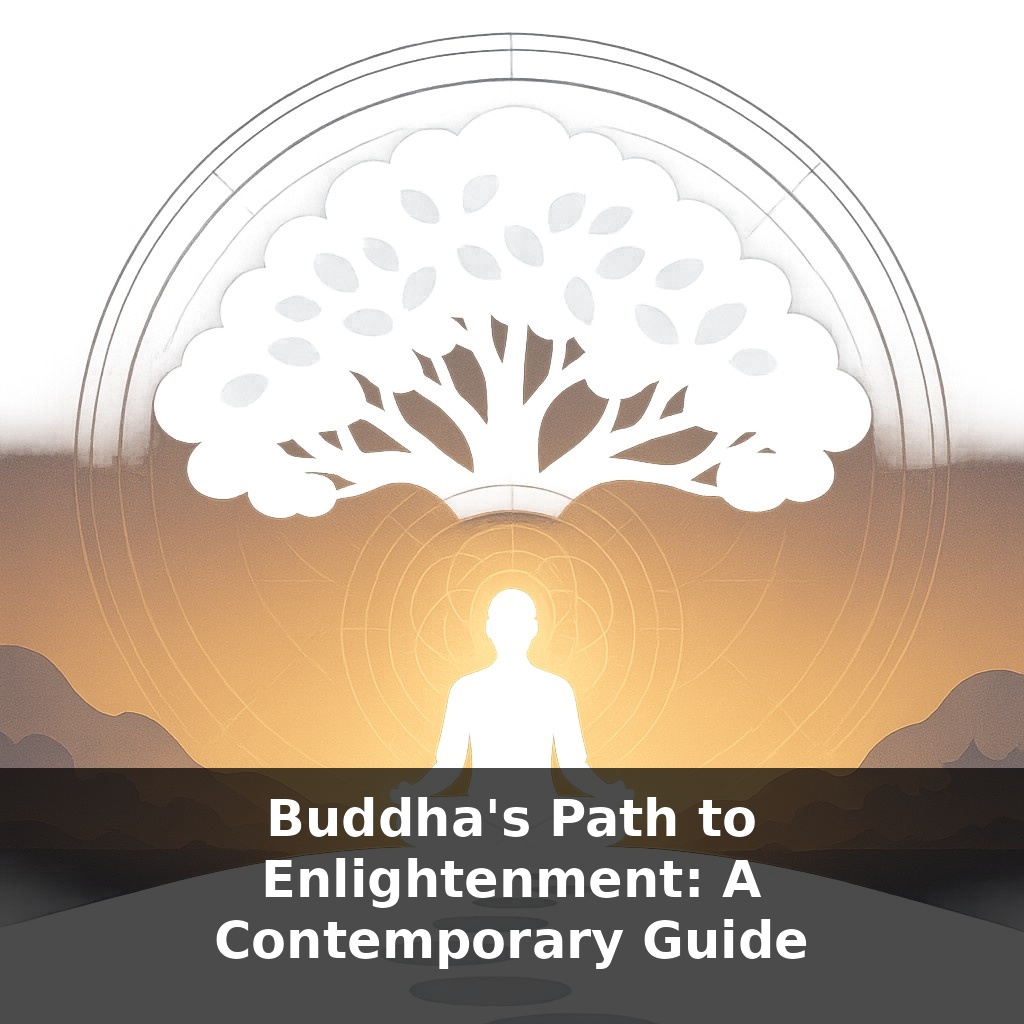
About two and a half millennia ago, one person sat under a tree and claimed the root of suffering could be understood and undone. Today, hospitals and CEOs quietly borrow his methods to treat burnout and anxiety—often without mentioning his name. Why does this ancient map still work?
A 2014 meta‑analysis in JAMA found that an 8‑week mindfulness course can calm anxiety as effectively as some medications, yet the syllabus is basically a stripped‑down slice of the Buddha’s path. We’ve taken a philosophy of liberation and turned it into a productivity upgrade. But the original map is much bigger than “stress reduction mode” or a 10‑minute meditation break between Zoom calls. It’s a complete redesign of how you speak, work, consume, and relate to your own thoughts—right in the middle of ordinary life. Instead of asking you to escape the world, it asks you to experiment inside it: in the checkout line, on your commute, during an argument. In this episode, we’ll trace how that broader Eightfold Path can translate into small, testable moves—shifts in attention, speech, and decision‑making that make daily life a training ground for clarity and compassion.
So where do we start without turning our life into a self‑help project or a quasi‑religious bootcamp? Early Buddhist texts show the Buddha talking not just to monks, but to merchants, kings, parents and craftspeople juggling obligations, debt and conflict. The path was always meant to plug into messy, busy lives. Today, the same logic quietly shapes therapy protocols, meditation apps and even how some teams run meetings: less reactivity, more deliberate pauses before speaking, a clearer sense of what actually matters. In this episode, we’ll treat your ordinary week as a lab: small experiments, clear observations, no need for incense or new beliefs.
Start with a puzzle the Buddha himself raised: why do two people face the same setback—lost job, harsh email, chronic pain—and one spirals while the other steadies? His answer wasn’t “luck” or “personality,” but habits of view, intention and attention that can be trained, moment by moment, long before the crisis hits.
Classical texts describe this as a gradual training. Not an instant download, more like a sequence of upgrades that change how your “mental operating system” handles input. Modern versions tend to zoom in on meditation blocks, but the early sources begin elsewhere: with how we see, speak and spend our energy.
First, view. In the discourses, “right view” isn’t about signing up to a creed; it’s about seeing patterns accurately. For example: noticing that chasing every impulse rarely brings lasting satisfaction, or that anger tends to boomerang. You already run informal experiments here: you try venting on social media, you see the aftertaste. Buddhist training makes that experimental stance deliberate: track cause and effect in your inner and outer life with forensic curiosity.
Then intention. Before words leave your mouth or fingers hit the keyboard, there’s a micro‑moment of leaning: to help, to score a point, to hide, to impress. Early teachings point you to that pre‑verbal tilt. The practice isn’t to become saintly overnight, but to nudge the default: a little less cruelty, a little more honesty, a little less autopilot. Over weeks, that shift quietly alters your relationships—and your own self‑talk.
Ethical guidelines around speech, livelihood and action sit downstream of this. They’re often caricatured as rulebooks, yet the texts frame them as experiments in removing unnecessary turbulence. Try not lying, not trash‑talking colleagues, not building a career on selling what harms people, and then observe: does your mind get lighter or heavier?
Neuroscience adds another angle. Brain imaging of long‑term meditators shows strengthened networks for attention and emotion regulation, but those brains also belong to people embedded in vows about how they speak, work and consume. Contemplative science is only starting to test what happens when you combine mental training with systematic shifts in ethics and worldview.
Your everyday life becomes the data set. Commutes, inboxes, family dinners are all chances to watch how perception, intention and action chain together—and to tweak one link at a time.
Consider a workday that keeps glitching: tense meeting at 9:00, derailed focus by 11:00, doom‑scrolling by 3:00. The Buddha’s training suggests treating each “glitch” as a prompt, not a failure. In that 9:00 meeting, “right view” might be a quiet note to yourself: “Everyone here is stressed, not evil.” From there, “right intention” could be as small as asking one clarifying question instead of firing off a sarcastic comment. After the meeting, “right mindfulness” is noticing the echo in your body—tight jaw, racing thoughts—before you unconsciously forward the tension into your next email.
Companies like SAP and Aetna have tested similar micro‑shifts: pre‑meeting pauses, short check‑ins about impact before launching new projects, explicit norms against email sniping. Their internal reports show not just lower stress, but fewer avoidable conflicts. Training your mind in this way is like refactoring legacy code: you don’t rewrite your whole life at once, you systematically clean up one buggy function at a time, so crashes become rarer and easier to debug.
A decade from now, a hospital visit might include a prescription for a brief daily meditation, delivered through a clinician‑monitored app that adapts to your mood in real time. Classrooms could start with 90‑second “attention drills,” much like warming up a muscle. Tech teams might run “intention reviews” alongside security audits, stress‑testing how features tug user habits. Even climate activists may pair policy work with contemplative retreats, so outrage hardens less and stamina lasts longer.
The deeper experiment isn’t becoming perfectly calm; it’s becoming more readable to yourself. Notice how certain apps, rooms, or people reliably tilt your mind—like seeing “settings” on your own dashboard. Over time, you can design days the way urban planners design walkable cities: fewer bottlenecks, more quiet pockets, clearer lines of sight.
Here's your challenge this week: For the next 7 days, pick one “mini-suffering” each day (like impatience in traffic, anxiety about messages, or irritation with a coworker) and consciously run it through the Buddha’s 4-step process from the episode: pause, name the discomfort, notice the craving underneath it, and then breathe into it for 10 slow breaths instead of reacting. Each evening, spend 3 minutes replaying one of those moments in your mind and silently repeat the phrase from the episode, “This is how it feels when craving is present,” while you re-experience it. By next week, you’ll have practiced transforming at least 7 real-life moments of stress into mini training sessions on the path to awakening.