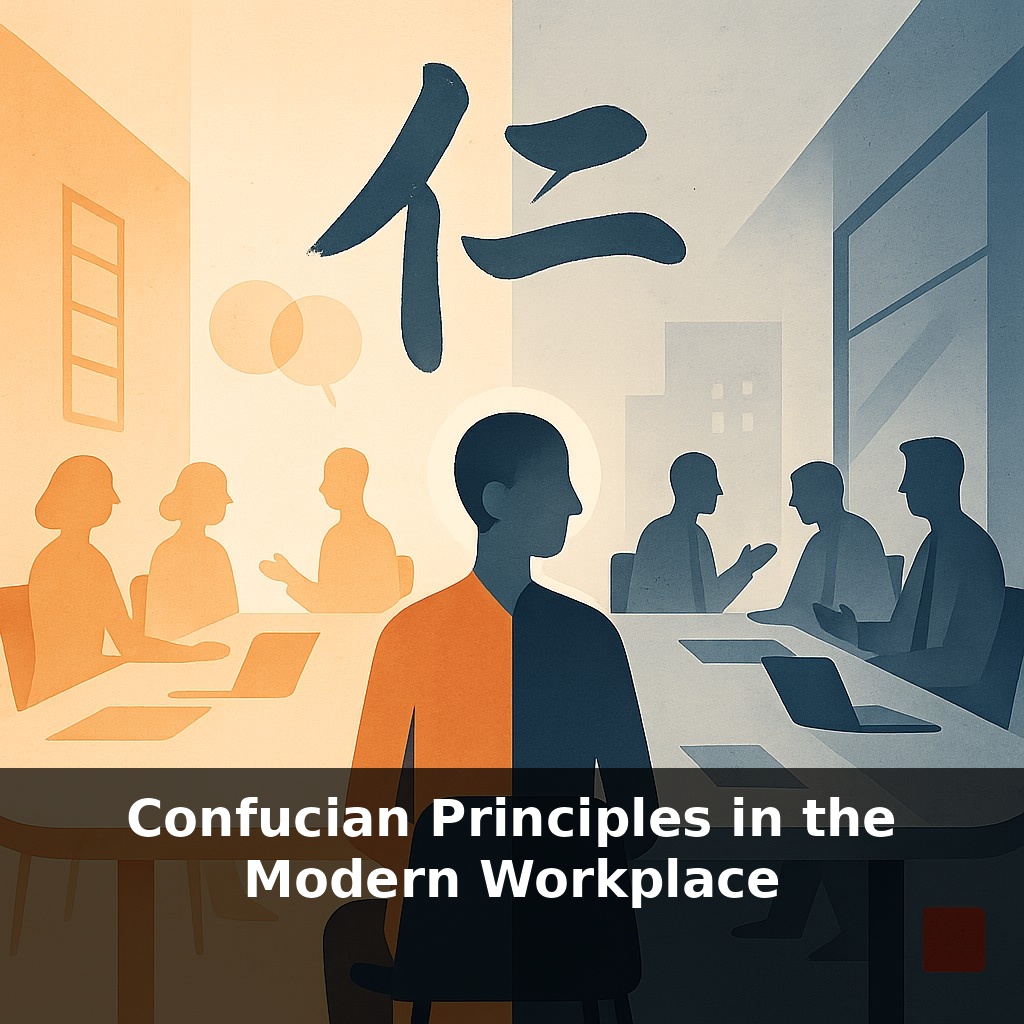
“Ren” — Confucian benevolence — appears over a hundred times in the Analects, yet many modern bosses can’t define it, let alone practice it. You’re in a meeting: deadlines tight, tempers rising. Do you lean on rank, or on character? That quiet choice may shape your whole workplace.
Hofstede’s data shows many Confucian‑heritage cultures sit comfortably with steeper hierarchies than the U.S.—yet today’s employees also demand voice, fairness, and room to challenge bad decisions. That tension is exactly where other Confucian ideas step in: li shaping everyday interactions, yi pushing leaders toward what is right rather than merely profitable, zhong anchoring commitment, and he orienting everyone toward workable peace instead of silent compliance. In practice, this isn’t about reviving feudal obedience; it’s closer to careful product design. You keep the “structure” of roles and responsibilities, but iterate the user experience so that status never excuses disrespect, and loyalty never silences truth. Modern firms from Toyota to smaller startups are already running this experiment—sometimes consciously, often without naming it Confucian at all.
That raises a practical question: how do these ideas actually show up between 9 and 5? In many offices, hierarchy is visible in titles, pay bands, and who sits where, yet the day‑to‑day experience is shaped more by countless micro‑interactions than by org charts. Think of performance reviews, project kickoffs, and tough feedback conversations as “pressure tests” that reveal what a culture really believes about respect, obligation, and long‑term trust. When tension spikes—missed targets, stalled innovation—leaders either default to control or consciously lean on a thicker moral vocabulary.
Start with a simple stress test: who speaks first in your meetings, and who speaks last? In many East Asian firms, senior voices still open and close discussions, but the most effective Confucian‑influenced workplaces quietly hack that script. A project lead might set the frame, then explicitly ask the most junior engineer for a view before anyone else weighs in. Status is acknowledged, but curiosity takes the floor. That small sequencing choice turns abstract values into operational norms.
One way to read Confucian practice at work is as “relational design.” Instead of asking only, “What decision is correct?” leaders also ask, “What pattern of interaction will keep this relationship trustworthy over time?” In performance reviews, that means trading one‑off verdicts for ongoing counsel: more “Here’s how I’ll help you grow over the next year” and less “Here’s your fixed label for the past year.” The 2019 Deloitte finding—that moral conduct matters more than technical brilliance in defining a good boss—makes sense here: employees are judging how safe it is to be honest around you.
Conflict is another revealing arena. A rigid reading of harmony can tempt managers to smooth things over quickly, or to move disagreements offstage. Contemporary Confucian‑inspired teams experiment instead with “ritualized candor”: scheduled forums where blunt critique is expected, followed by private, face‑saving conversations to repair any strain. The point isn’t to avoid friction, but to keep it bounded, purposeful, and recoverable.
To avoid authoritarian drift, some companies pair this with explicit “upward duty.” If deference flows downward, responsibility for speaking uncomfortable truths must flow upward. Japanese manufacturers, for example, have long given line workers formal authority to stop a production line over quality concerns; the cultural subtext is that loyalty includes protecting your superior from future shame.
Think of it like building software with legacy code: you don’t scrap hierarchy altogether, but you wrap it with new interfaces—feedback channels, mentoring practices, transparent decision logs—so that people can challenge and collaborate without crashing the system. When this works, employees aren’t just complying with their managers; they’re in a long‑term moral project with them, where trust becomes an asset everyone is actively maintaining.
At one Korean tech firm, leaders quietly rewrote meeting norms: senior managers arrived last and spoke second, not first. The standing rule was that the person closest to the code or customer opened with a short brief, then the most affected team responded. Only then did rank enter. Over six months, the number of design changes proposed by junior staff doubled, and deadlines slipped less because risks surfaced earlier.
A Singaporean logistics company wove a “ritual of correction” into weekly operations. Every Friday, one team member presented a mistake—never someone else’s—along with what they did to repair the damage. Managers were required to share at least once a month. That pattern signaled that moral courage and repair mattered more than spotless records; resignation rates in that unit dropped noticeably within a year.
Borrowing from sports, a Taiwanese manufacturer set up rotating “captains” for cross‑functional projects. Formal authority stayed with managers, but captains owned the team’s ethical and relational standards for the project’s duration.
Leaders experimenting with these ideas may find their role shifting from “decision center” to “moral router,” directing attention to who is affected, not just what is efficient. Cross‑border teams will need translators of meaning, not only language—people who can explain why a pause before speaking signals respect, not hesitation. As analytics track behavior in real time, a new question emerges: can dashboards reflect character, or only performance?
Bringing these ideas into work is less about slogans and more about habits: who you back under pressure, whose risk you quietly fund, whose warning you act on. Your challenge this week: notice one moment each day when you could trade convenience for character—and choose the slower, more considerate path at least twice.