Introduction to Ancient Philosophy
📝 Transcript
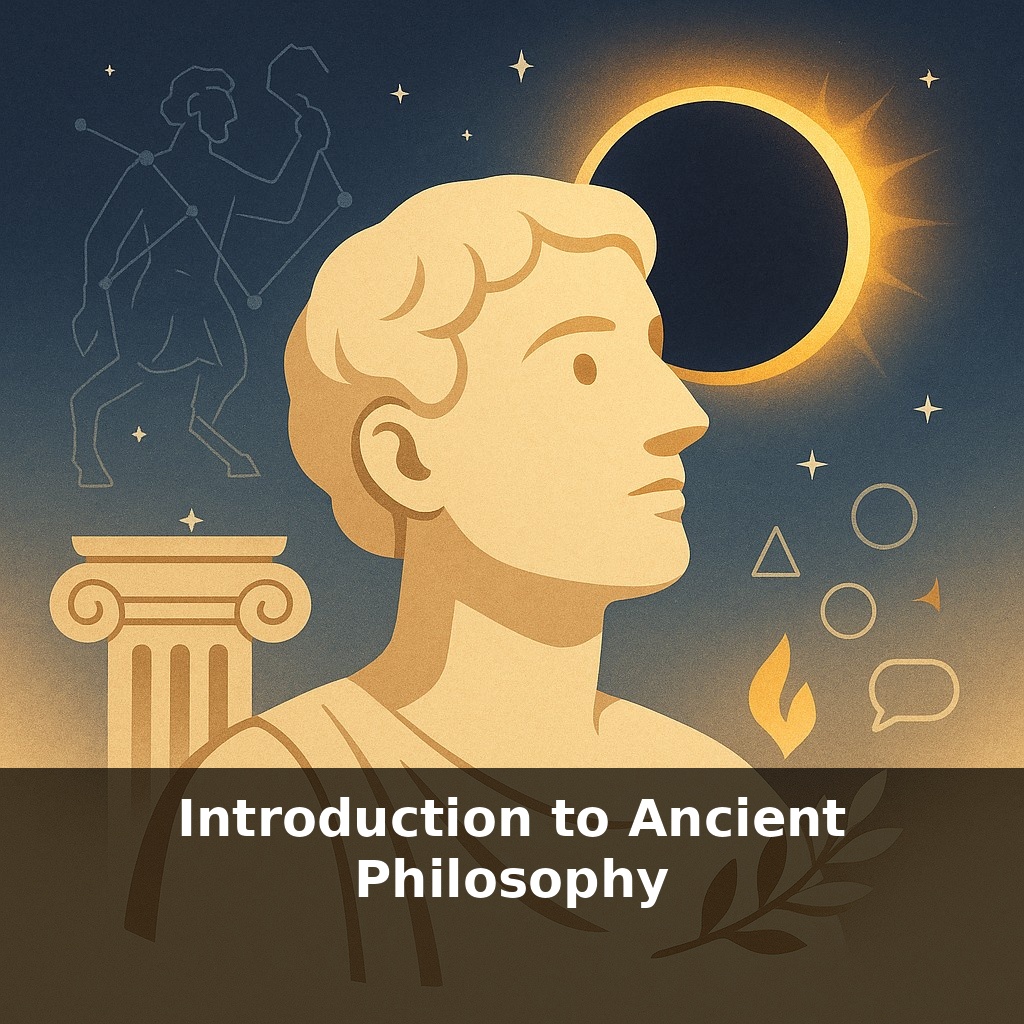
A man in ancient Greece was sentenced to death—for asking too many questions. Another guessed an eclipse centuries before telescopes. Today, their ideas quietly shape your beliefs about reality, truth, and how to live. This episode starts where myth ends and philosophy begins.
Instead of telling stories about gods to explain thunder or fate, early Greek thinkers tried something different: they treated the world a bit like a puzzle you could actually solve. They asked what everything is made of, whether the universe has a hidden order, and why some lives feel more meaningful than others. Their answers weren’t just abstract; they influenced how cities were governed, how justice was argued in courts, and how people faced danger, grief, and success. Some claimed everything is constant change; others insisted there must be something stable beneath the chaos. Some trusted disciplined reason; others insisted our senses mislead us. In this series, we’ll meet the characters behind these clashes and see how their battles of ideas still echo in debates about science, politics, and personal purpose today.
Some of these thinkers argued over the building blocks of nature; others were more worried about how to face fear, pleasure, or injustice without falling apart. They didn’t agree on what ultimately matters, but they shared a method: ask clear questions, test ideas against experience, and follow the argument even when it’s uncomfortable. In this series, we’ll move from early “proto-scientists” on the coasts of Ionia to teachers in bustling Athens and later philosophers advising emperors. Think of it as tracing the storm fronts of ideas that still shape the climate of modern life.
If you’d walked through an ancient Mediterranean city, you wouldn’t have found “philosophy” sealed away in quiet libraries. You’d have seen it in courtrooms, marketplaces, and city councils—where arguments about knowledge and character decided who got exiled, who was believed, and what counted as justice.
Early thinkers didn’t just debate in the abstract; they built tools. Logic was one of the sharpest. Aristotle, for instance, tried to map out reliable patterns of argument the way a doctor maps symptoms to illnesses: if certain claims are true, what must follow, and what’s a dangerous fallacy that only looks convincing? That effort still underpins how lawyers build cases, how scientists design experiments, and how we’re supposed to spot misleading headlines.
Others turned inward and asked: if our senses can mislead us, and our reasoning can be biased, what can we trust? Skeptical schools in the Hellenistic period made doubt into a discipline. Rather than collapsing into “nothing is knowable,” many of them developed careful habits: setting arguments against each other, suspending quick judgments, and seeing what beliefs actually survive pressure. That attitude lies behind modern peer review more than inspirational slogans about “thinking for yourself.”
At the same time, rival schools sketched different models of a good life under pressure. Stoics trained people—soldiers, merchants, even emperors—to distinguish what’s up to them from what isn’t, then anchor their identity to the former. Epicureans quietly built communities on the edges of cities, practicing modest living, shared friendship, and deliberate limits on desire. Both approaches claimed to offer not just ideas, but therapies: ways to respond when fortune suddenly turns.
Over centuries, these projects—logic, disciplined doubt, practical training—crossed languages and empires. Commentators in Alexandria, translators in Baghdad, and teachers in late Roman schools preserved and reworked them. By the time medieval universities emerged, they were inheriting a conversation already a millennium old, not starting from scratch.
Your challenge this week: pick one ordinary decision you make every day—choosing news, spending money, or reacting to a disagreement—and trace it back. Ask: what am I assuming about what counts as a good reason, a good life, or a trustworthy source? Then try to name which ancient stance that most resembles: Stoic resilience, Epicurean comfort, skeptical suspension, or something else. For seven days, repeat this with different decisions. By the end, see whether your everyday habits secretly follow a coherent “school”—or whether you’ve stitched together a private philosophy from mismatched pieces.
When a storm rolls toward a city, meteorologists watch pressure, wind, and temperature to predict the impact. Ancient philosophers did something similar with human life: they tracked patterns in desire, conflict, and habit to forecast where certain choices would lead. Take Thales, for instance. He didn’t just predict an eclipse; stories say he leased olive presses after foreseeing a good harvest, then rented them out at a profit. That’s philosophy tied to a business move. Or think of Socrates in the marketplace, stopping people mid-errand to probe why they trusted a leader or pursued a career path. His conversations worked like stress tests on people’s priorities, revealing cracks they hadn’t noticed. Later, Epicureans treated friendships almost like a carefully tended garden, pruning relationships that brought more anxiety than nourishment. Stoics, advising generals and emperors, used daily reflections the way athletes use post-game reviews—studying where they stayed composed or lost control, then adjusting for the next “match” against fortune.
Ancient debates don’t stay in the past; they reappear every time a new tool reshapes daily life. Think of AI systems deciding who sees a loan offer or a job ad: behind the code lurk old disputes about responsibility, character, and what counts as a good outcome. As digital platforms amplify some voices and silence others, arguments about who should rule and how power should be checked move from the agora to comment sections, boardrooms, and international regulation meetings. Climate agreements, too, quietly depend on rival visions of duty to strangers and future generations. In that sense, new technologies act less like revolutions and more like stress tests on the ethical frameworks we’ve been refining for millennia—revealing which principles bend, which break, and which can be stretched to guide decisions their creators never imagined.
Ancient debates won’t hand you a script, but they can widen the stage you’re acting on. Treat each opinion you hold like a room you can walk into: who furnished it—parents, teachers, headlines, friends? Which pieces still fit, and which trip you as you move? The more rooms you inspect, the more deliberately you’ll choose where—and how—you actually live.
Here’s your challenge this week: Pick one ancient school from the episode—Socrates/Plato, Aristotle, the Stoics, or the Epicureans—and live by ONE of their concrete practices for 24 hours. For Socrates, spend one full day refusing to claim certainty: whenever you state an opinion, immediately follow it with one honest question that could challenge it. For Aristotle, track every major choice you make today and label it as “excess,” “deficiency,” or “golden mean,” then adjust one behavior toward the middle by tonight. For the Stoics, practice a morning “premeditation of adversity” about three possible setbacks, then, when one difficulty actually happens, pause and consciously separate what you can control (your judgment and response) from what you can’t. For Epicurus, deliberately choose one simple, low-cost pleasure (like a plain meal or a quiet walk) and compare how satisfied you feel afterward to a more “luxury” option you’d normally pursue.
From this course
Philosophy for the Modern World
9 episodesUnlock all episodes
Full access to 9 episodes and everything on OwlUp.
Subscribe — $1.99/monthLess than a coffee ☕ · Cancel anytime