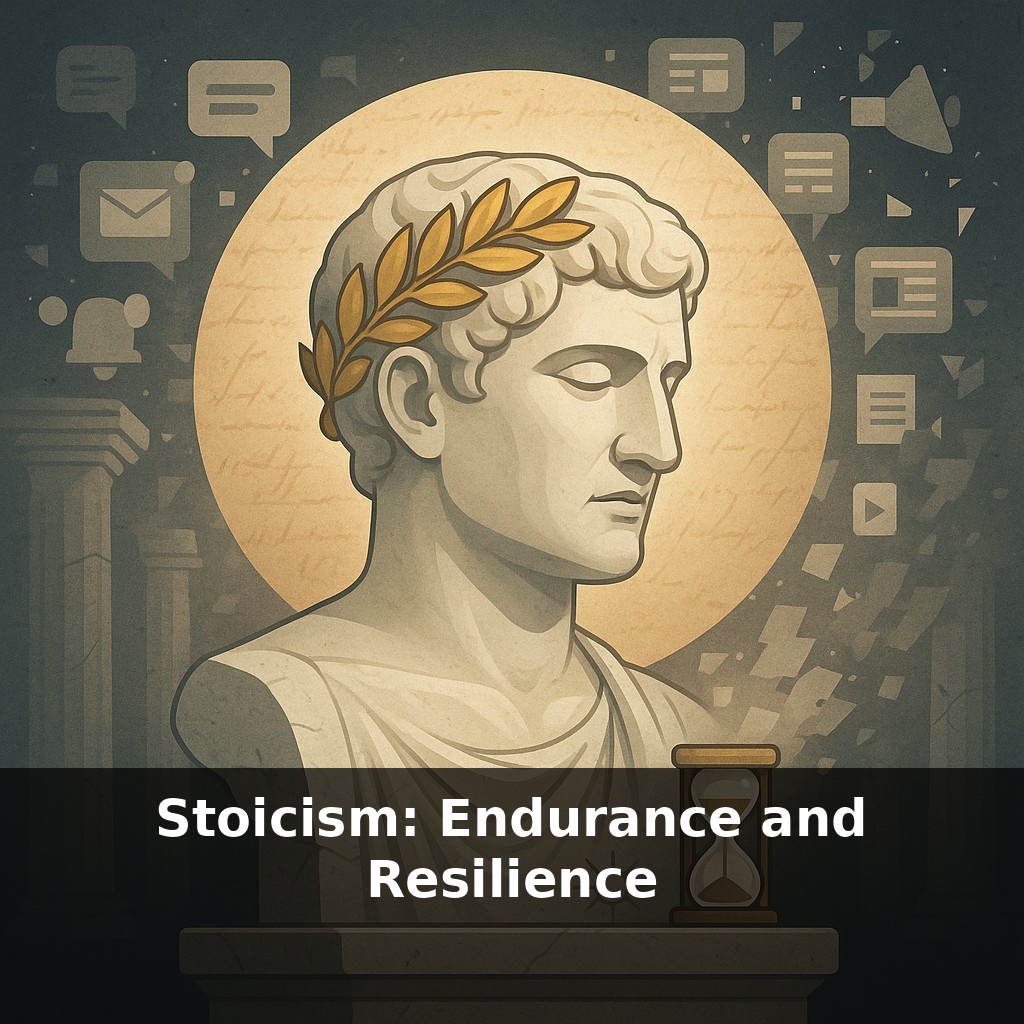
A Roman emperor writes private notes to stay calm during plagues and wars. Two thousand years later, those notes quietly sell millions of copies. Why are people in our hyper-digital chaos turning to an ancient philosophy built on endurance and inner toughness?
Somewhere between your calendar alerts and the latest news headline, you’re running a quiet experiment: how much chaos can you absorb before you snap? For most of us, the answer changes day to day—sleep, emails, a tense conversation can tilt the whole system. What drew ancient thinkers to their daily practices wasn’t abstract wisdom; it was the same pressure you feel when your phone won’t stop buzzing and every message feels urgent.
They noticed something crucial: endurance isn’t just surviving the hit; it’s shaping who you become because of it. Today, that insight meets neuroscience labs, therapy rooms, and resilience training in workplaces and militaries. We’re starting to see that the way you talk to yourself in small moments—getting cut off in traffic, being criticized at work—quietly rewires your capacity to face real crises.
The Stoics didn’t wait for disaster to practice; they treated ordinary days as training grounds. Epictetus told students to rehearse difficulties in advance, not to become pessimists, but to be less shocked when life swerved off script. Modern psychologists would call this exposure and cognitive rehearsal. It’s the same logic behind firefighters drilling for scenarios that might never happen: repetition reduces panic. When you deliberately meet small frictions—an awkward email, a delayed train—as practice reps, you slowly change one quiet variable: how much strain your mind can carry without cracking.
Marcus Aurelius, Epictetus, and Seneca didn’t agree on everything, but they shared a basic blueprint for becoming harder to knock over: change what you look at, what you practice, and what you live for.
First, what you look at. Epictetus’ line about being disturbed by judgments, not events, isn’t an invitation to pretend everything is fine. It’s a prompt to ask, in the moment: “What else could this mean?” A blunt email stops being “proof I’m a failure” and becomes “evidence I need clearer expectations.” That tiny swap—from insult to information—matters. In modern terms, you’re editing the story before it edits you.
Second, what you practice. Stoics used voluntary discomfort not as macho posturing, but as calibration. Seneca would sometimes eat the simplest food and wear rough clothes, then ask himself, “Is this what I feared?” Today, that might look like: taking a cold shower, walking without headphones, leaving your phone in another room for an evening. You’re not chasing suffering; you’re shrinking its power to surprise you. Absent-minded luxury makes you fragile. Periodic, chosen difficulty makes you less negotiable by circumstance.
Third, what you live for. Endurance without direction curdles into numbness. Stoics tied resilience to values: justice, honesty, courage, practical wisdom. Seneca’s exile wasn’t just output; it was targeted: letters to friends, essays on anger, consolation for grief. Under pressure, he asked, “What kind of person do I want to be while this is happening?” not “How do I get back to normal?” That shift—from outcome to character—is where growth sneaks in.
Modern studies on Stoic reflections suggest that even brief daily engagement with these ideas moves the needle on resilience. But the texts were never meant as inspirational posters; they’re closer to field manuals. The question isn’t whether Stoicism “works” in general, but how specifically you’ll deploy it: in your inbox, in conflict, in boredom, in loss.
Endurance, in this frame, is less about clenching your jaw and more about quiet, repeated choices: reframe, lean in, realign with your values—especially when it would be easier not to.
A coder gets a brutal code review and feels the familiar surge of shame. Instead of spiraling, she experiments: “If this is neutral data, what’s the most useful sentence I can pull from it?” She copies just that line into a note titled “Better next time.” Over months, that note grows; the sting shrinks.
A parent, exhausted after another meltdown at bedtime, adds a twist: before entering the room, they quietly choose one word—“patient,” “firm,” or “kind.” The goal isn’t a perfect night; it’s acting out that one word once, on purpose. The child may not change yet, but the parent’s sense of agency does.
Think of a distance runner who doesn’t only train on sunny days. They log slow miles in wind and rain so race day weather is just “another condition,” not a catastrophe. In the same way, people who deliberately set tiny “friction drills” into their week—waiting an extra minute before checking messages, taking the tougher conversation first—find that real crises feel slightly less absolute, slightly more workable.
If schools, militaries, and companies treat Stoic drills as basic literacy, cultural norms could shift from “avoid stress” to “use stress intelligently.” Paired with wearables, a spike in heart-rate during a tense meeting might trigger a pre-set prompt: “Name one thing still under your control.” Leaders could run “resilience debriefs” after failures, mapping which judgments helped or harmed, much like pilots review flight data, turning rough landings into shared mental flight simulators.
Resilience isn’t a finish line; it’s more like learning to read shifting weather. Some days you’re walking into headwinds, others you’re catching a tailwind you didn’t earn. Stoic practice invites a quiet curiosity: given today’s conditions—mood, news, setbacks—what small, deliberate move keeps you aligned with who you’re trying to become?
Before next week, ask yourself: When something annoys or stresses me today, what part of it is actually in my control (my words, my tone, my schedule, my attitude) and what part isn’t—how will I deliberately respond only to the part I can shape? In the middle of a tough moment this week, if I paused for 10 seconds and asked, “What would a Stoic like Marcus Aurelius choose here—complain, or calmly do the next right thing?”, how might that change my behavior on the spot? Looking back on today before bed, where did I endure something passively that I could have turned into active resilience—by setting a boundary, reframing the setback as training, or choosing a wiser response next time?