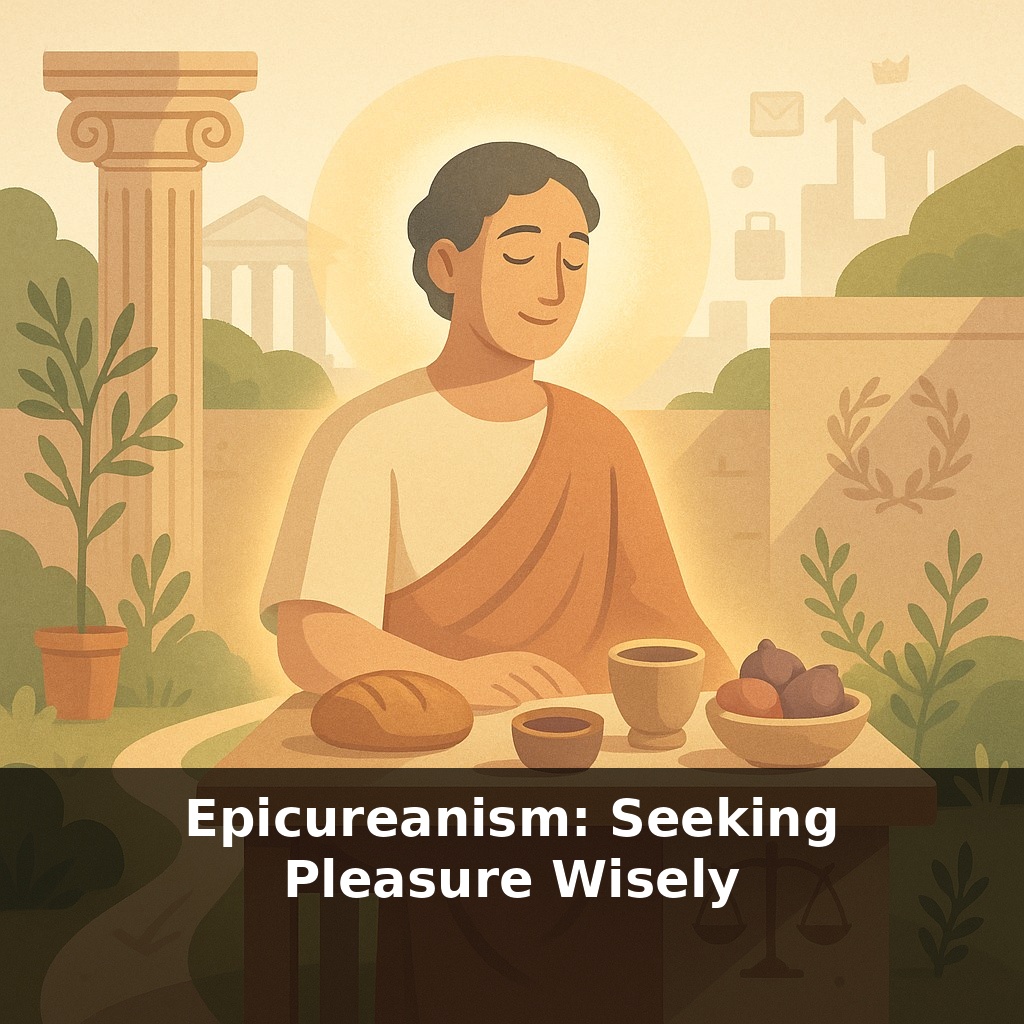
You can be happier without adding a single new luxury to your life. A Nobel Prize–winning study found that beyond a moderate income, extra money barely moves the happiness needle. So why do we keep chasing more, instead of learning how to enjoy what we already have?
Epicurus thought our real problem isn’t that life offers too little pleasure, but that we’re terrible at choosing which pleasures to pursue. We chase spikes instead of stability: the upgrade, the notification, the next big milestone. Each feels urgent, yet slips away almost as soon as we get it, pulling us into the next round. Epicureanism flips the script: the good life isn’t about stacking more highs, but about removing the constant sources of inner friction that keep us from enjoying what’s already present.
Instead of asking, “How can I get more?” Epicurus asks, “What could I subtract so that what I have becomes quietly satisfying?” That might mean pruning certain goals, rethinking how you spend your free time, or noticing which kinds of plans leave you strangely drained the next day. In this episode, we’ll explore how a 2,300-year-old philosophy can help you curate your desires, not just your possessions.
Epicurus starts from the body, not the bookshelf. He asks: Are you sleeping enough? Are you tense all day without noticing? Do you have even one person you can be fully honest with? From there, he divides our wants into three types: some are natural and necessary (like food and rest), some are natural but unnecessary (like fancy versions of the basics), and some are neither natural nor necessary (like status games). The twist is that our culture constantly upgrades the second and sells us the third as if they were urgent needs. Epicurean practice is learning to quietly downgrade them again.
Epicurus thinks most of our trouble comes from misclassifying our wants. He’s not asking you to live on bread and water; he’s asking you to notice which patterns of wanting keep quietly backfiring.
Here’s his basic map of wants, pushed into modern life:
First, the “natural and necessary.” These are the non-negotiables that keep your body and mind functional: decent food, shelter that feels safe enough, rest that actually restores you, and a small circle of people you trust. If these are shaky, everything else wobbles. Scroll through social feeds at midnight, drink more coffee to “fix” the fatigue, and you’re rearranging deck chairs instead of stabilizing the ship.
Second, “natural but unnecessary.” These feel good, but only as upgrades on basics: better coffee, softer sheets, a nicer playlist during your commute. They’re not a problem by themselves; they become one when they silently migrate into the “I can’t live without this” category. That’s when an internet outage or a flight delay ruins a whole day, because you’ve accidentally tied your mood to fragile comforts.
Third, “neither natural nor necessary.” These cluster around image and comparison: being seen at the right places, owning things that impress the right people, matching the lifestyle of colleagues you don’t even like. They borrow your attention and pay you back in anxiety. Social media amplifies this tier relentlessly, nudging you to build a life that photographs well but doesn’t actually feel good from the inside.
Epicurus’s move is not moralizing but troubleshooting. When something in your routine leaves a hangover of restlessness, he’d ask: which tier did that come from? You might notice that a long walk with a friend calms you, while an evening of half-working, half-scrolling leaves you wired and oddly empty. The content of the day matters less than which layers of wanting you’ve been feeding.
Over time, this becomes less about strict rules and more like tuning an instrument: you keep adjusting which wants you endorse, until the background noise of your days is low enough that small, ordinary moments can actually register.
Consider three snapshots from an ordinary week. On Monday, you accept back-to-back meetings, say yes to a side project you don’t want, and answer late-night emails out of fear of seeming uncommitted. You go to bed buzzing and oddly brittle. On Wednesday, you leave work on time, heat leftovers, and call a friend while walking slowly around your block. No productivity, no “optimization,” yet you sleep deeply. On Saturday, you wander into a store, get hooked by a flash sale, and buy something you didn’t know existed an hour ago. You enjoy it briefly, then feel a faint regret when you see the bill.
Epicurus would treat these not as moral successes or failures, but as data points. Which pattern leaves your body softer, your shoulders lower, your thoughts less jumpy the next day? Behavioral research on time-use diaries shows that unhurried conversations and activities with clear edges (it begins, it ends, you can fully step away) consistently rank as more restoring than fragmented multitasking. Your week is a quiet laboratory; each small choice is a test of what actually supports your baseline.
Legislators and designers may quietly become curators of attention rather than architects of craving. Expect debates over “maximum persuasive design,” like setting speed limits for apps that hijack focus. Doctors could prescribe weekly “low-stimulation evenings” or small, in-person circles the way they now prescribe exercise. As remote work normalizes, companies might reward employees for protecting off-screen time, treating quiet like a shared infrastructure instead of a private luxury.
Your challenge this week: once a day, pause before a small choice—snack, scroll, event, reply—and ask, “How will this feel *after* it’s over?” Treat each pause like checking the weather before heading out. At week’s end, review which choices left you clearer, softer, less tense. That’s your personal map for seeking pleasure more wisely.