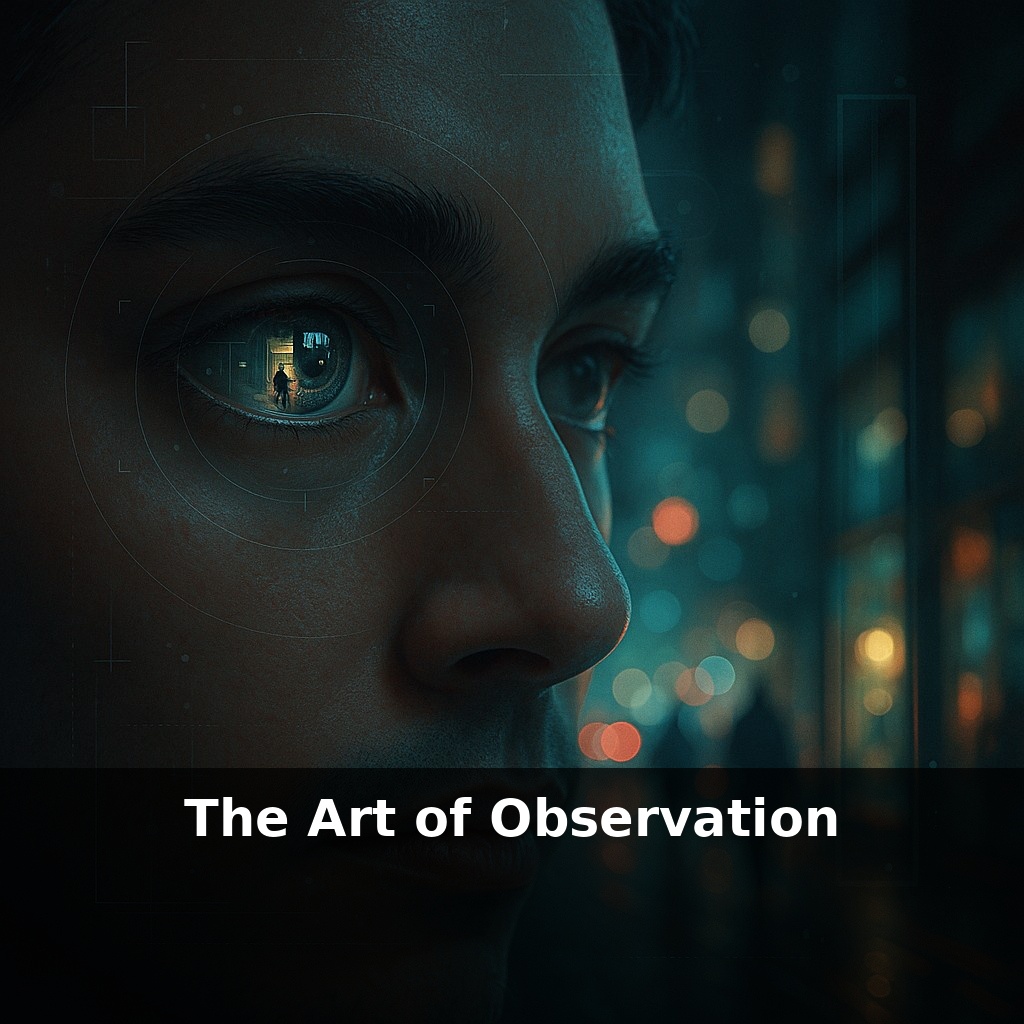
The Art of Observation
📝 Transcript
Right now, most people glance at a photo for barely two seconds before swiping past. Yet a few images stop us in our tracks. You’re walking down a busy street; thousands of details hit your eyes, but one tiny reflection in a window could be the entire story.
Most photographers think the real work starts when the camera comes out. In reality, the photograph begins long before that—when you’re just standing there, apparently “doing nothing,” while your brain quietly sorts the chaos in front of you. That sorting is the art of observation: learning to notice the small visual tensions, repetitions, and oddities that everyone else’s eyes slide past. It’s less about staring harder and more about tuning what you pay attention to. A street corner becomes a live draft of potential images: the way three red objects briefly align, the gap in a crowd that opens and closes like a breathing lung, the one person standing perfectly still in a rush of motion. Without changing your location or your gear, refining how you look can turn any ordinary scene into a set of deliberate choices instead of accidental snapshots.
Observation isn’t just about noticing more things; it’s about noticing the *right* things at the right time. Your brain is constantly filtering, like a ruthless editor cutting 90% of the footage. Training your observation is really about retraining that editor—teaching it which visual hints might turn into strong photographs. This is why NASA runs astronauts through photo drills on Earth and why Ansel Adams obsessed over where to stand: they were rehearsing their seeing long before pressing the shutter. As you move through a scene, light shifts, people re-arrange, reflections appear and vanish. Observation lets you recognize these brief alignments *while* they’re unfolding.
Think of observation in three layers: scan, study, and anticipate.
First, the scan. This is your wide-angle mode. You’re not hunting for a subject yet; you’re mapping the scene. Where is the brightest area? Where are the darkest pools? Where are lines naturally pointing—roads, railings, shadows, rows of people? That’s your visual skeleton. Eye‑tracking research shows those lines literally steer where people look, so part of observation is simply getting good at spotting the built‑in paths for the viewer’s eye.
Next, the study. Here you slow down and start asking specific questions: – What’s repeating—colors, shapes, gestures? – What’s breaking the pattern? – If I hid 70% of this frame in shadow or blur, what would I want to remain?
This isn’t about instantly “seeing a masterpiece.” It’s about calmly testing small hypotheses: “If I move two steps left, that lamp post will line up with that person’s shoulder instead of sprouting out of their head.” Ansel Adams’s “knowing where to stand” becomes a practical, repeatable act: walk, pause, re‑evaluate, walk again.
Then comes anticipation. NASA trains astronauts to do this under time pressure: they learn to recognize the *start* of an interesting configuration—clouds rotating into place over Earth, light skimming across modules—so that when the peak moment arrives, they’re already framed and ready. You can do the same on a sidewalk. Notice a shaft of light on the ground and think, “In 20 seconds, someone will walk through that.” Notice two people converging on a background sign and think, “Their silhouettes might overlap in a clean way right… there.”
Over time, this shifts from effortful to intuitive. Neuroplasticity research backs this: repeated, focused looking literally reweights what your brain flags as important. You stop being impressed by how sharp your camera is and start being picky about *where* and *when* you’re willing to point it. Gear becomes a recording device, not a source of ideas.
In practice, observation is less “waiting for inspiration” and more running tiny visual experiments all the time: If this moves there, if that light changes here, if I shift my height by a few centimeters—would the frame suddenly make more sense? The camera only answers the questions your eyes have already learned how to ask.
A market is closing for the night. Stalls are half‑empty, lights are uneven, people are tired. One photographer walks through and sees “nothing special.” Another pauses. She notices three shop shutters in different stages of being pulled down, each with a person framed beneath; she waits half a beat until all three gestures rhyme, then shoots. Same place, same time—different level of attention.
Or take a rainy intersection. Most passersby see only inconvenience. A more observant photographer watches how car headlights rake through puddles, briefly turning footprints into bright arrows pointing toward a lone umbrella. She shifts a meter to line those glowing tracks toward the subject’s face, then waits for a clean moment in the traffic.
In a park, kids run everywhere. Instead of chasing chaos, you might notice one quiet bench where shadows of branches cross like goalposts. You pre‑frame it and let the game come to you, capturing the exact instant a child’s leap breaks perfectly through that shadow “net.”
As AR viewfinders and AI assistants whisper “optimal” compositions into your frame, your role shifts from finder to *decider*. The real leverage won’t be in spotting a leading line but in sensing which fleeting micro‑gesture, mismatched expression, or awkward pause actually means something. Think less like a collector of scenes and more like an editor on location, constantly asking: “Of all that could happen in front of me, which three instants would I fight to keep if everything else vanished?”
As you keep refining how you look, scenes start to unfold like chapters instead of single frames: a stranger’s hesitation before a doorway, the brief overlap of reflections and faces, the way light crawls across a wall. Your challenge this week: spend one walk a day camera‑off, silently composing three frames per minute, noticing what nearly disappears.
From this course
Photography Thinking: See Like a Photographer
6 episodesUnlock all episodes
Full access to 6 episodes and everything on OwlUp.
Subscribe — $1.99/monthLess than a coffee ☕ · Cancel anytime

