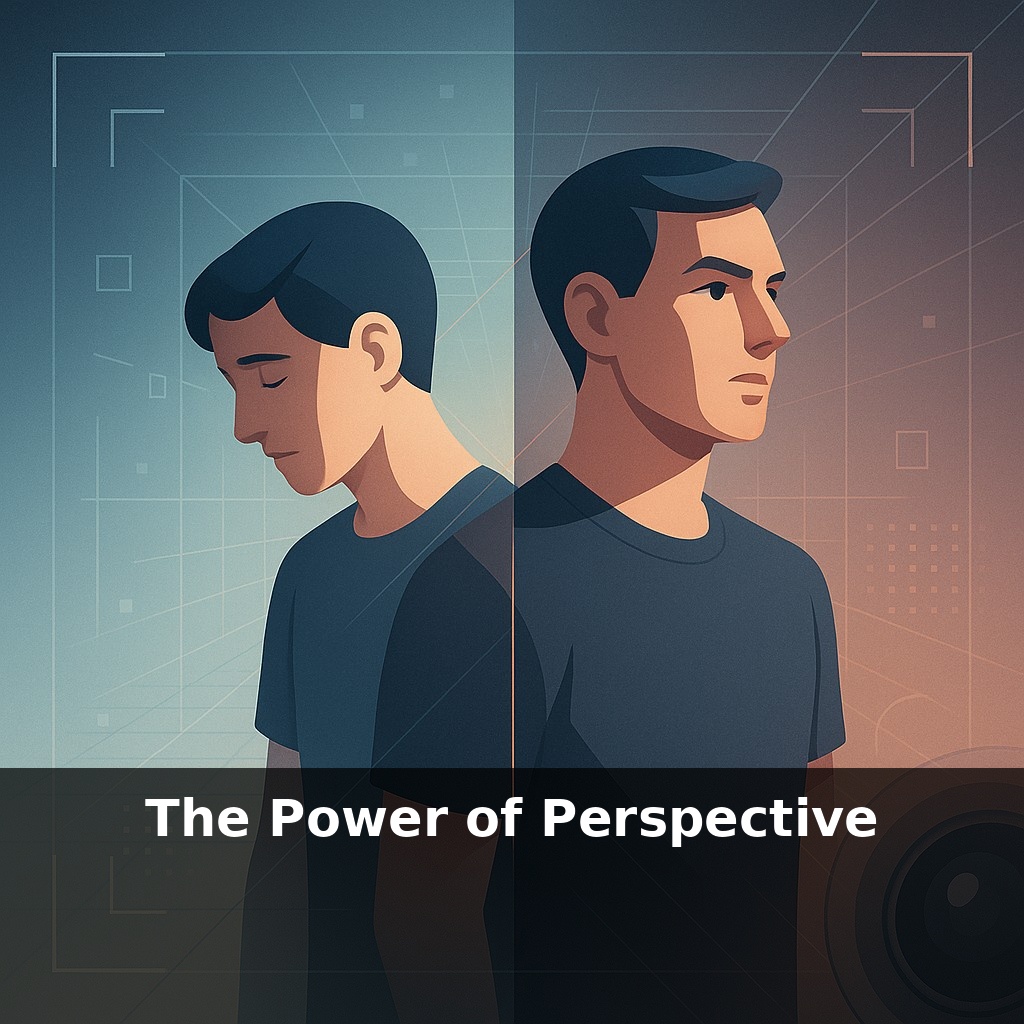
The camera can stay in the same spot, the light can stay the same, the subject doesn’t move—and yet the story completely changes. Shift the viewpoint a little higher or lower, and a casual snapshot turns into a confession, a confrontation, or a quiet act of attention.
Perspective is where craft quietly becomes control. Most people think it’s a matter of lens choice, but the physics is simpler and more ruthless: move your body, change the picture’s logic; stay put, and your framing is just decoration. Camera–subject distance sets the relationships between objects—how big a face feels against a skyline, how close a hand seems to a door, how steep a street appears under a cyclist. Focal length only crops that arrangement tighter or looser. That’s why a wide shot, later cropped, shares the same structural feel as a “proper” close-up taken from the same spot. Once you accept this, every step forward or backward stops being a guess and becomes a deliberate edit in three-dimensional space. You’re no longer just pointing the camera; you’re deciding who looms, who shrinks, and what kind of world your subject seems to inhabit.
Stand in a city street and look straight ahead: buildings stack neatly, horizon cuts a calm line, people feel equal. Now crouch near the curb and angle the camera upward—suddenly the same scene carries a charge: towers lean, faces gain edge, sky eats pavement. Tilt down from a balcony and crowds flatten into patterns instead of individuals. These shifts aren’t just “creative angles”; they quietly decide whose experience we’re centering. Drones widen this choice even further, letting you trade sidewalk perspective for a map-like overview in seconds, turning everyday routes into abstract diagrams of movement and space.
Stand in one spot and treat your feet like a zoom ring. Take a step forward: backgrounds stretch, gaps between objects widen, noses edge toward caricature, streets start to feel steeper. Step back: the scene compacts, distant elements slide closer together, a person can feel pinned against a wall they’re actually several meters from. You’re not just “getting closer” or “backing up”—you’re rewriting how space behaves inside the frame.
Change height and you start to rewrite relationships between people. Lower the camera until it’s near a child’s eye line, and adults expand into a ceiling of torsos while the kid in front becomes the entire world. Raise the camera above a crowd and individual bodies shrink into tiles in a pattern. The same person can read as vulnerable, equal, or dominant before they say a word, purely because you decided to kneel, stand, or climb.
Now rotate the camera. A small tilt can either echo the natural lean of a running body or inject unease into a quiet room. Push it farther and verticals slip into diagonals, turning static walls into vectors that seem to shove the subject around. This is one reason architectural photographers obsess over angle: even a modest downward tilt pulls the top of a building inward, signalling instability that the real structure doesn’t have.
Tools try to undo these choices after the fact. Smartphone apps can snap horizons straight and “correct” leaning lines in a blink, measuring vanishing points faster than you can zoom in. But every heavy correction stretches pixels, shaves off edges, and subtly rewrites shapes. Rely on it too much and faces warp, corners smear, textures lose bite. The file is technically fixed, but the space inside it feels oddly synthetic.
Angle also taps into bias. Studies show viewers tend to read low viewpoints as powerful, but that effect shifts across cultures and contexts. A politician shot from below may gain authority in one audience and aggression in another; a survivor photographed high above might evoke empathy or, just as easily, distance. The frame doesn’t just show someone, it positions us in relation to them—ally, opponent, or distant observer.
Watch how a small shift changes everything in practice. Photograph a friend sitting on steps, once from the level of their shoes and once from above their head. In the lower view, the stairs stretch behind them like a ramp; from above, they compress into stacked stripes. Nothing moved but you, yet the scene flips from “going somewhere” to “boxed in.” Try a city corner: stand tight to a wall and aim down the street, then cross and shoot from the opposite side. In one frame, the wall becomes a foreground force that slices the frame; in the other, it almost disappears and the junction reads as open. Or follow a cyclist: first, stand where they pass and shoot side‑on; next, place yourself where they’re heading and let them ride toward you. Side‑on feels descriptive, like a diagram of motion; head‑on feels confrontational, as if you’re in their way. Changing camera height, distance, or side of an action is like choosing a position in a chess game: each square alters which moves suddenly become possible.
Drone laws, light‑field cameras, and AR won’t just add new toys; they’ll add new obligations. You might choose a view the way a director chooses a cast member: some angles become too charged for casual use. Editors could “walk around” moments after they happen, picking a balcony‑high view or a street‑level one in post. Verified capture data may turn into a kind of visual passport, proving that a frame’s vantage point—and its implied attitude toward the subject—actually existed.
Every frame becomes a quiet choice about where you stand—ethically as well as physically. Angles can flatter, accuse, or simply witness, the way a journalist decides between headline, sidebar, or footnote. As tools let us glide between vantages after the fact, the real skill will be noticing: where *should* we place ourselves for this moment—and why?
Before next week, ask yourself: 1) “Where am I currently stuck in an ‘I’m right, they’re wrong’ mindset, and if I deliberately stepped into the other person’s shoes for five minutes (their worries, pressures, hopes), what new explanation for their behavior suddenly becomes possible?” 2) “Thinking about the story from the episode where a setback became an advantage only after the perspective shifted, which current ‘problem’ in my life could secretly be preparing me for a skill, relationship, or opportunity I’ll need a year from now?” 3) “If I zoomed out on my life like the guest did—imagining my situation from the 10,000-foot view or from my 80-year-old self’s point of view—what would suddenly feel less urgent, and what would I realize actually deserves more of my attention this week?”