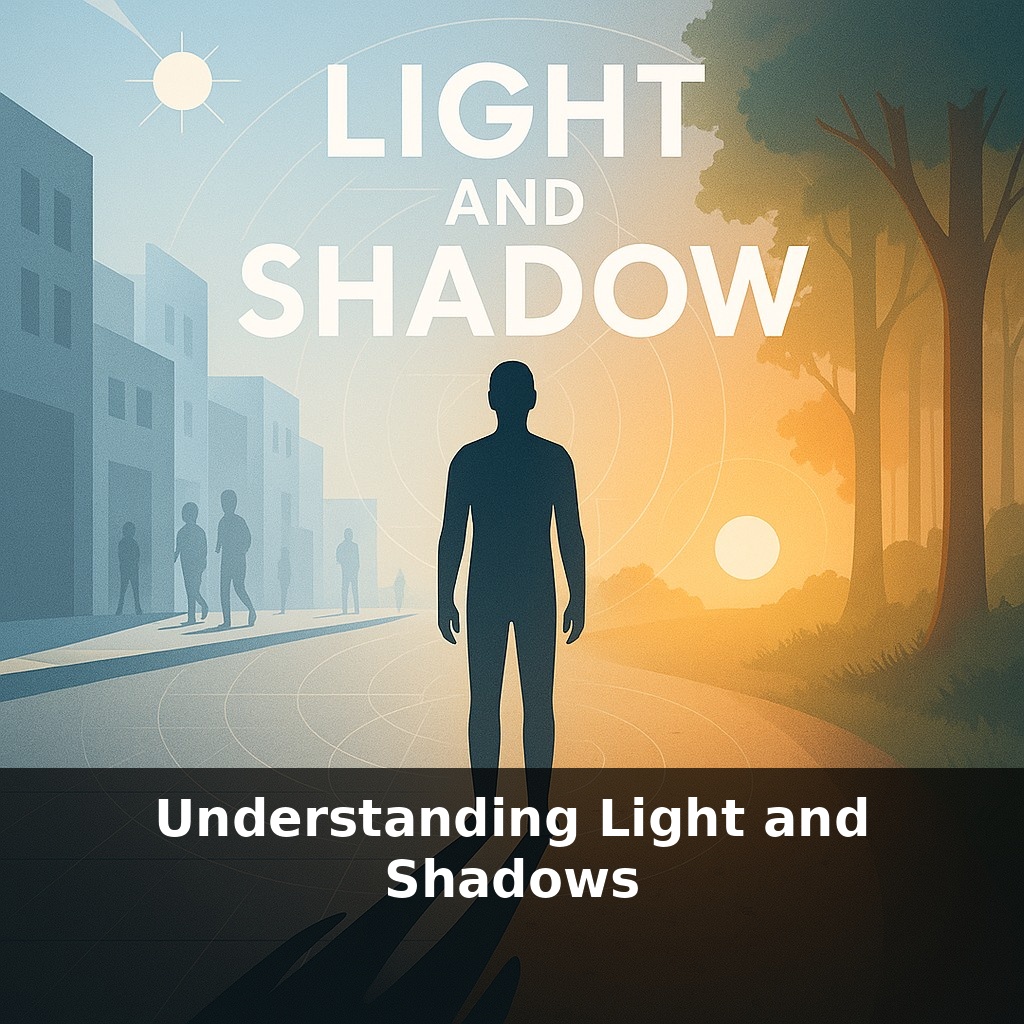
Midday sun can be about a thousand times brighter than a cozy living room. You’re on a street at noon: faces squint, shadows slice across eyes. Later, same street at sunset: long soft shadows, calm expressions. Same place, same people—totally different story.
Stand in a forest clearing and look down: your shadow might be razor‑edged or almost disappeared into the ground. That change isn’t random—it’s light direction, quality, and intensity quietly rewriting the scene for your camera.
Up to now, you’ve noticed how time of day reshapes faces and streets. Now we’ll stretch that awareness: how far is the light, how big is it, how hard is it, and what story do the shadows tell?
Photographers don’t just “find” nice light; they learn to read numbers and angles the way musicians read notes. Lux becomes a clue, not trivia. A lamp at 100 lux, a window at 10,000, the sky at 100,000: each suggests a different exposure, a different mood, a different way your sensor will struggle or succeed.
This episode is about turning that invisible math into something you can see—and then deliberately shape.
When you walk into a scene now, don’t just think “bright” or “dim”—start asking what your camera can actually hold. Your eyes juggle far more contrast than your sensor, so that glowing window beside a dark sofa isn’t just pretty; it’s a test of what gets clipped or buried. This is where dynamic range stops being a spec sheet brag and becomes a real constraint you can feel. Raise your hand toward the sun and watch how many brightness steps you can notice from palm to sky. Your sensor sees fewer steps; your job is to decide which ones matter and shape the light and shadows to fit.
Stand in front of a window on a bright day. Take one step closer, then another, then another. Your face doesn’t just “brighten”—watch how the shadow under your nose softens, how pores and wrinkles either leap out or melt away. You didn’t change the window, only your relationship to it. That’s the first quiet truth: apparent light size matters more than the bulb or the sun itself.
A light is “big” or “small” relative to your subject. The sun is enormous, but from Earth it’s a tiny point, so in a clear sky it carves hard shadows. A cloud drifts in and suddenly the whole sky becomes the light source: vastly larger relative to you, so edges blur, contrast eases, skin looks smoother. Indoors, a bare flash a few meters away is a tiny, hard light; bounce it off a wall or umbrella and it becomes a broad, forgiving one.
Now add distance. Move a lamp from 1 m to 2 m and the illumination doesn’t just “get weaker”; it falls fast enough that your camera responds in whole‑stop jumps. Push it twice as far again and you’ll notice something else: the shadow pattern barely changes. Farther away, a light acts smaller and more uniform—intensity drops, but direction and hardness stay almost the same.
This is why portraits lit by a far streetlamp feel stark and graphic, while those by a close window can be gentle yet still bright. Same brightness at the sensor? Possibly. But the geometry of size and distance decides whether cheekbones slice or roll.
Then there’s angle. Skim light across a brick wall and every bump pops; walk around to front‑light it and the texture nearly vanishes. You’re not just revealing shape—you’re deciding which surfaces get to speak in the frame. Turn a subject 10° at a time and you’ll see entire stories appear and disappear in the way shadows connect, separate, or hide.
As you notice these shifts, start asking: which shadows are helping describe form, and which are just distracting? Instead of fearing them, you can nudge them—by changing your position, the subject’s, or the apparent size and distance of whatever is lighting the scene.
A street at night is lit by the same few lamps, yet every parked car looks different. A black car becomes a mirror, slicing those lamps into sharp streaks. A white van turns them into dull, soft patches. The paint didn’t change; the way it accepts or fights the light did. Highly reflective surfaces echo the brightest parts of the scene and exaggerate small shifts in angle. Matte surfaces average everything out, hiding abrupt changes in brightness but also muting subtle shape.
Now think about shadows not only as absence of light, but as shapes you can design. A cyclist passing a fence throws a moving barcode across the pavement. Tilt your camera slightly and those stripes can frame the rider, intersect their face, or vanish from the composition. Same light, same fence, three very different reads.
One useful exercise: when you walk, pause at any strong shadow line and trace it with your eyes until you find the object and light source that created it. You’re training yourself to reverse‑engineer the scene, the way a chess player reconstructs a position from a few pieces.
Soon, “getting the light right in-camera” may matter less than capturing enough data to reshape it later. Relighting tools won’t just brighten faces; they’ll let you slide shadows around like furniture, testing versions of the same moment: quiet, tense, theatrical. That shifts skill from gear choices toward taste and intent. If light becomes endlessly editable, the real question turns into: which version of this scene feels truest, not which one was “correctly” lit.
As you start noticing how light sculpts scenes, try treating streetlights, phone screens, and neon signs as a moving toolkit rather than background clutter. Watch how car headlights rake across faces like stage spots, or how a laptop glow isolates someone in a café. Each stray source is a potential brushstroke for the small dramas you choose to frame.
Before next week, ask yourself: How does the direction of light in my everyday spaces (like my desk, kitchen, or window) change throughout the day, and what new shadows do I notice at each point? When I move a single object—like a mug, a plant, or a lamp—closer to or farther from a light source at home tonight, what happens to the shape, edge, and intensity of its shadow, and what does that teach me about hard vs. soft light? The next time I’m outside near sunrise or sunset, can I pause for two minutes and ask: where is the light coming from, how long are the shadows, and how would I recreate this exact mood with just one light if I were photographing or sketching it?