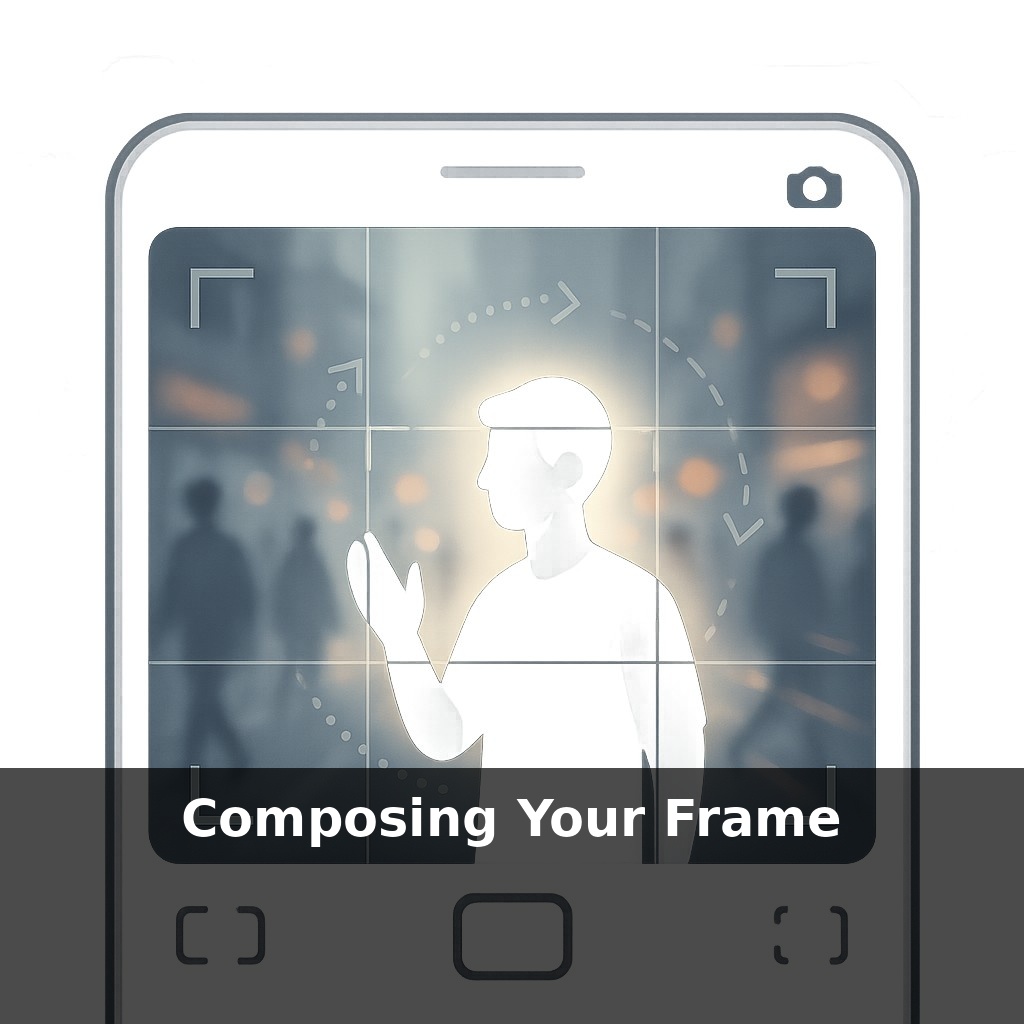
Your camera already decides where people look—usually not where you intend. A tiny shift of your subject, just a little off-center, can change the entire story of a scene. You’re raising the camera, the moment is happening fast… and how you frame it will decide what survives.
Most people think composition is about “making things look nice.” In practice, it’s closer to directing attention on a busy street: you can’t control everything, but you can control where people turn their heads first, and what they notice next. That’s where a few quiet, repeatable patterns come in. They don’t care if you’re on a phone, a drone, or a bulky camera; they only care about how the human eye likes to wander.
As you start to notice those patterns, framing becomes less guesswork and more like spotting currents in a river. Lines in the pavement suddenly matter. Empty sky stops feeling like “wasted space” and starts working like a pause in a sentence. Even a quick snapshot of your friend at a café becomes a chance to decide: should the viewer feel relaxed, tense, curious, or pulled forward? The frame is still the same rectangle—but you’re about to use it very differently.
Painters were arguing about where to place horizons and figures long before lenses existed. John Thomas Smith was writing about the “rule of thirds” in 1797, yet the same grid now quietly sits inside your phone’s camera app, waiting to be switched on. And those strange urges you have—to follow a road into the distance, or trace a river’s curve—are the same instincts that leading lines tap into. Modern sensors, ultra‑wide lenses, even drones just give you more ways to exploit those instincts, like adding new tools to a workbench you’ve barely started using. The frame hasn’t changed; our options inside it have exploded.
Balance is where composition quietly becomes psychological. Your viewer is constantly, almost subconsciously, weighing elements in the frame: bright vs dark, big vs small, busy vs calm, close vs far. If one side feels “heavier,” their attention tilts and sticks there. If everything is equal, their eye can drift without friction. You’re not just placing objects; you’re juggling visual weight.
Visual weight comes from several sources: – Brightness and contrast: a small bright shape can outweigh a larger, dull one. – Color: saturated colors feel heavier than muted tones; warm colors usually pull harder than cool ones. – Detail: textured or busy areas feel weightier than smooth, simple ones. – Faces and text: people and words usually trump everything else.
Try thinking in pairs. If your subject pulls heavily to the left, what quietly balances it on the right—another object, a patch of brightness, a doorway of negative space? NatGeo editors obsess over this not because they love symmetry, but because balance decides whether an image feels stable, tense, or about to tip over. A climber high on a cliff with nothing opposite them in the frame feels precarious; add a distant peak on the other side and the story changes to “small human in vast order.”
Symmetry is the blunt instrument of balance: place the spine of a tree, a building, or a face dead center and mirror both sides. It can feel formal, even confrontational. That’s why center framing works so well for powerful subjects—the composition says, “This is unavoidable.”
Then there’s depth. Foreground, midground, and background are like three lanes in a track race. You can stack interest in only one lane for simplicity, or deliberately distribute it: a hint of texture up close, your main subject mid‑frame, a quiet shape in the distance. That layering doesn’t just add dimension; it spaces out the beats of how the viewer experiences the image.
Cropping afterwards is your second chance at all of this. Shift a horizon slightly, trim a bright edge, nudge a face off the dead center: tiny changes in balance can rescue an almost‑photo from feeling strangely off.
Watch how your next street photo changes if you treat moving people like players on a field. A lone runner in the lower right, with open pavement ahead, feels like a fast break; add a slow‑walking couple near the opposite side and the “play” suddenly becomes a quiet standoff. You didn’t move the buildings—only the active pieces.
Try this with ordinary objects. Photograph a coffee mug close to the lens and a laptop farther back. Slide the mug slightly higher and to one side until the laptop no longer feels like it’s “arguing” for attention but supporting the scene, like a midfielder hanging back so the striker can take the shot.
Foreground objects can act like defenders: a chair leg, a plant stem, a doorframe edge that partially blocks the view. Tilt your camera so these “defenders” either cleanly frame your subject or step aside; avoid letting them slice awkwardly through faces or important shapes.
Your challenge this week: every time you shoot, deliberately add or remove ONE element in the frame, then compare which version feels calmer, tenser, or clearer.
AI tools will soon act less like auto‑mode and more like a quiet co‑director, nudging you: “Tilt a little; that window is stealing the scene.” Augmented‑reality hints might glow around areas that feel too “heavy,” or fade where a supporting detail could live, much like a music producer riding faders during a mix. As feeds get louder, the photographers who thrive will be those who treat these aids as suggestions, not scripts—using them to refine their own sense of balance, not replace it.
In the end, composing your frame is less about memorizing rules and more about learning to “hear” when an image feels off, like a guitar string slightly out of tune. As you shoot, notice when tension or calm appears before you can say why. That sensitivity is your real toolkit—and every frame you adjust is another tiny calibration of that inner meter.
Before next week, ask yourself: 1) “If someone snapped a photo of my life today, what 3 things would be front and center in the ‘frame’—and do those actually reflect what I care about most?” 2) “Where am I letting other people (my boss, social media, family expectations) arrange the frame for me, and what’s one specific boundary or conversation that would start shifting that control back into my hands?” 3) “If I intentionally reframed one recurring frustration this week—like my commute, a tricky coworker, or a messy home—what story could I tell myself about it that would change how I show up in that moment?”