Why Physics Matters: Understanding Reality
📝 Transcript
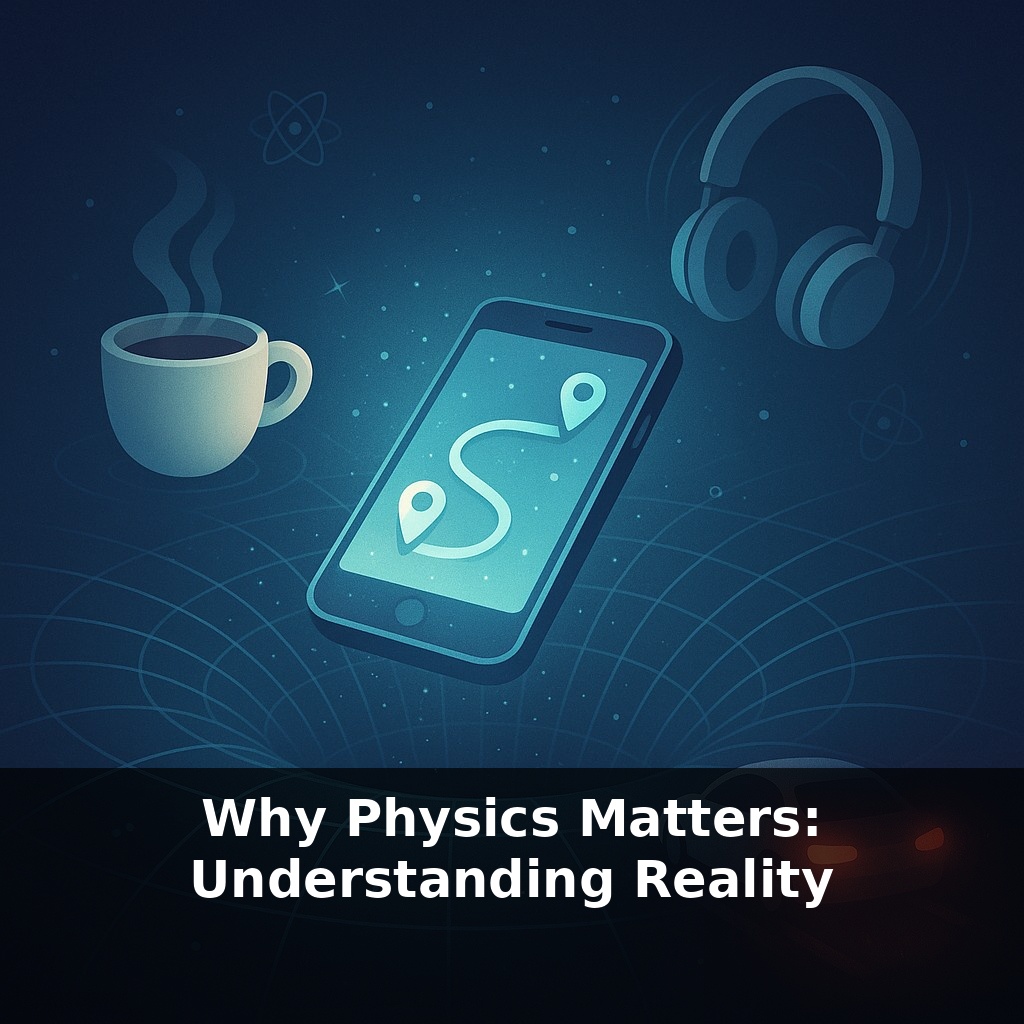
Right now, as you listen, your phone is quietly correcting for Einstein’s relativity so your maps don’t drift by kilometers each day. No lab coat, no equations on a board—just physics, invisibly deciding where you are, how you connect, and what reality feels like.
Physics isn’t just about distant galaxies or particle colliders—it’s in the way your coffee cools, your headphones play music, and your brakes stop the car. Every time steam fogs a bathroom mirror, you’re seeing molecules trading energy; every rainbow on an oily puddle is light interfering with itself. We usually treat these as background scenery, but they’re live demonstrations of the same rules that govern supernovas and black holes. The remarkable part is that those rules are both simple and stubborn: once discovered, they keep working everywhere we look, from lab benches to lightning storms. Just as a good recipe scales from one cupcake to a whole tray without changing the basic steps, physical laws scale from atoms to oceans. This series is about learning to notice those rules in action—and, slowly, to read reality the way a musician reads a score.
But there’s a twist: the universe doesn’t care whether its rules feel intuitive to us. Our brains evolved to dodge predators and find food, not to grasp why time ticks differently on orbiting satellites or how particles can behave like smeared-out waves. That mismatch is why physics can feel both alien and thrilling. The payoff for pushing past that discomfort is huge. The same mindset that let us detect ripples from black holes billions of light-years away also helps engineers squeeze more efficiency from LEDs and design scanners that peer painlessly inside the human body.
Open your maps app and your screen fills with color, icons, and roads—but underneath, the system is juggling signals from satellites moving thousands of kilometers above you, radio waves skimming through the atmosphere, and ultra-precise atomic clocks. Those tiny timing differences—tens of microseconds per day from relativistic effects alone—would send your blue location dot drifting off into fields and oceans if they weren’t corrected. The part you see is “app.” The part you don’t see is physics carefully keeping the world lined up.
That quiet, invisible role is everywhere. When protons race around the Large Hadron Collider at 6.8 trillion electronvolts, magnets and vacuum systems are tuned with the same equations that guide power lines and MRI machines. Those protons lap a 27‑kilometer ring about 11,000 times every second, and our confidence that they’ll behave comes from laws hammered out with pendulums, glass prisms, and copper wires long before anyone dreamt of giant colliders.
Physics also refuses to stay in its lane. The same electromagnetic theory that describes a radio antenna can tell you how a neuron fires; the same thermodynamic ideas that limit an engine’s efficiency set bounds on how small and frugal your next laptop can become. When an LED wastes far less energy as heat than an incandescent bulb, that’s not an accident of clever engineering alone—it’s a negotiation with nature’s rules about how electrons can move and how light can be produced.
Here’s where the story gets stranger. For all this success, most of the universe is still a blank in our ledger. Galaxies spin too fast, cosmic expansion accelerates too much, and our existing laws, as powerful as they are, don’t fully account for what telescopes see. So physicists introduce names—“dark matter,” “dark energy”—as placeholders for whatever is tugging and stretching spacetime behind the scenes, and they build detectors deep underground and observatories in space to hunt for clues.
And sometimes, the universe answers. Those faint gravitational waves we’ve caught from black‑hole collisions billions of light‑years away are not just exotic trophies; they’re fresh data points testing how far our current picture of reality can stretch before it needs to be redrawn.
Stand near a busy road and you’re watching a physics experiment in disguise. Every car that slows, stops, and accelerates again is burning fuel to fight friction and air resistance—two quiet “taxes” reality charges on any motion through air and over pavement. The smoother the road surface, the more streamlined the car’s shape, the less energy vanishes as heat in tires and turbulent air. That’s why wind‑tunnel testing matters: it’s not just about speed, it’s about how gently you can persuade the air to move aside.
Look up at a thunderstorm and you’re seeing another negotiation with nature’s limits. Rising warm air, condensing water droplets, and electric charge building in clouds all follow rules that also show up in jet engines and power plants. When lightning finally jumps, it traces the shortest, easiest path through a maze of invisible electric stresses, like water probing cracks in dry soil until it finds a route.
Even something as quiet as a glass resting on a table is part of this story: atoms in the table push back just enough to support the glass’s weight, a microscopic stalemate that keeps your kitchen from collapsing.
Open‑source code once looked niche; now it quietly runs banks, hospitals, and your browser. Physics has the same trajectory: today’s “esoteric” work on quantum materials, ultra‑cold atoms, or plasma control is seeding tomorrow’s tools. Quantum networks may harden your bank login. Fusion research could reshape energy geopolitics. New space‑drive physics might redraw job maps the way aviation once did, making orbital factories or lunar mining logistical, not sci‑fi.
Your challenge this week: pick one everyday object—a kettle, a fridge, a bike—and trace how many different branches of physics had to work for it to exist. Don’t just stop at “electricity” or “metal”: chase the chain back through materials, motion, heat, signals, even manufacturing tools. By the time you’re done, “just a gadget” will start looking more like a condensed history of how deeply we’ve learned to converse with reality.
Next time you turn a tap, flip a switch, or stream a song, treat it like a tiny doorway into deeper rules: water pressure ties back to collapsing stars that forged heavy elements; circuits echo the same equations guiding distant pulsars. As we push those rules in new regimes—colder, faster, smaller—we’re not just upgrading gadgets, we’re extending what “real” can be.
Try this experiment: Grab a laser pointer, a piece of aluminum foil, and a pencil, and make a tiny pinhole in the foil to create your own “single‑slit” diffraction setup. In a dark room, shine the laser through the pinhole onto a wall a few meters away and watch how what you thought was a simple straight beam becomes a spread-out interference pattern—bright and dark bands instead of just a dot. Then slowly move the foil closer and farther from the wall and notice how the pattern changes, connecting what the episode said about light behaving as both a wave and a particle to something you can literally see dancing on your wall.
From this course
Physics for the Curious: The Rules of Reality
8 episodesUnlock all episodes
Full access to 8 episodes and everything on OwlUp.
Subscribe — $1.99/monthLess than a coffee ☕ · Cancel anytime