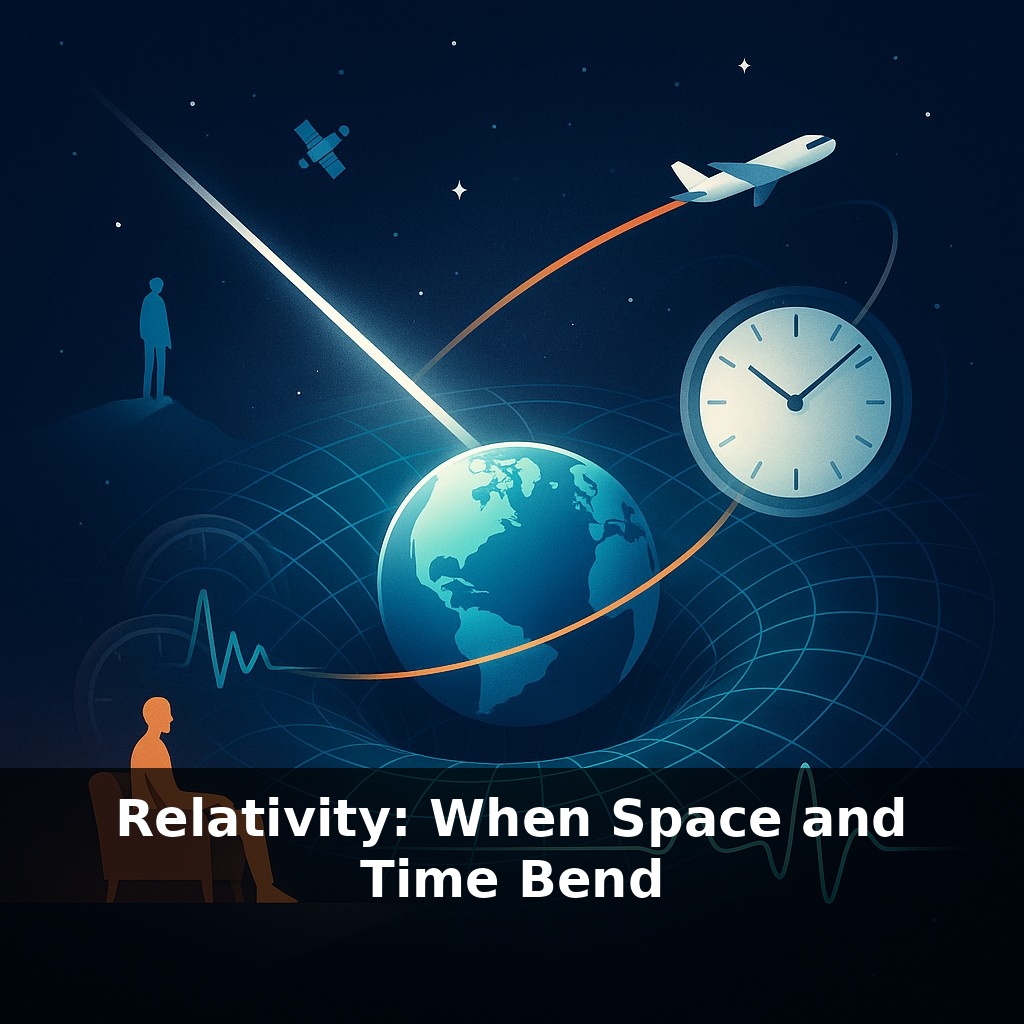
You age faster on your couch than on the top floor of a skyscraper. A jet streaks across the sky; its clocks quietly slip out of sync with the ones in your kitchen. A beam of light passes them both—and, strangely, it keeps the same pace for everyone watching.
Step off Earth’s surface—onto a satellite, into an elevator, up a mountain—and space-time itself reshuffles the rules you live by. Your heartbeat, the tick of your watch, the path of a thrown ball: all quietly renegotiated with the cosmos, because you dared to change your motion or altitude. Einstein’s leap wasn’t just “time runs differently”; it was that space and time fuse into a single thing you can bend, stretch, and twist by moving fast or piling up mass–energy.
This bending isn’t science fiction; it’s measured, budgeted, and engineered into modern life. Particle beams at CERN must respect space-time’s geometry the way chefs respect oven temperatures: get it slightly wrong, and your experiment “recipe” fails. Astronauts’ trajectories, satellite orbits, and even radio signals slant and curve through a landscape that looks flat to us, but is anything but. Today, we’ll step into that landscape.
Relativity steps in wherever “fast” or “massive” stops being just adjectives and starts rewriting outcomes. In particle colliders, engineers treat beams of protons like chefs tracking a fussy sauce: a tiny misjudgment in expected paths or arrival times and the whole “dish” fails. In medicine, PET scanners lean on particles that obey relativistic rules, quietly converting matter to light we can detect. Even finance isn’t exempt: the fiber routes high-frequency trades take are planned with light’s speed limit as a hard constraint, not a suggestion.
Einstein’s first move was surprisingly modest: he asked for bookkeeping rules that *everyone* could agree on, even if they were moving differently. Two simple demands powered Special Relativity: the laws of physics look the same for all constant-velocity observers, and that universal speed cap for light doesn’t budge. From just those, strange consequences spill out—not only stretched time, but also compressed lengths and a reshuffling of what events can possibly influence each other.
Length contraction means that, from your perspective, fast-moving objects are literally shorter along the direction of motion. It’s not an optical illusion; it shows up in particle physics labs. Muons created high in Earth’s atmosphere should decay before reaching the ground, given their known lifetime. On paper, almost none should arrive at detectors on the surface. Yet we see plenty—because from our frame, their “clocks” run slow and the distance they must cross is effectively squeezed. Two effects team up to let them survive the trip.
Relativity also redraws the map of cause and effect. Events are points in space-time, and their separations fall into three categories. If a signal moving at or below light speed can connect them, they have a “timelike” or “lightlike” separation: one can cause the other. If not—if even light can’t get from one to the other in time—they’re “spacelike” separated, and no influence can link them without breaking the cosmic speed law. Different observers may disagree on the order of spacelike events, but not on which events can be causally related.
General Relativity raises the stakes by letting that whole causal structure depend on where and when you are. The presence of mass–energy doesn’t just curve paths; it changes which routes are even *available* to light and matter. That’s why light skimming past the Sun bends, why signals near a black hole can be trapped, and why LIGO can “listen” to distant collisions: ripples in this structure travel outward at light speed, subtly flexing the possible paths rulers and lasers can follow. Relativity, in the end, is less about weird clocks and more about who can talk to whom, and how.
A surgeon planning a proton therapy treatment doesn’t say, “Relativity, please.” Yet the software steering those beams quietly accounts for particles living longer and flying farther than a Newtonian chart would allow, so tumors get the dose and healthy tissue doesn’t. In astronomy, lensing surveys map how galaxies behind a cluster appear stretched and multiplied; from those distorted outlines, researchers reconstruct the hidden mass in between, much like a radiologist infers a tumor’s shape from bent X‑ray paths. Even weather satellites rely on carefully modeled signal paths: radio pulses curve and shift frequency as they traverse Earth’s layered environment and its varying gravitational potential, so forecasters trust corrected data to predict storms. One analogy from cooking: following a sea-level recipe on a high mountain, you must tweak temperature and time because water boils differently; engineers similarly “adjust the recipe” for any system precise enough that space-time’s local conditions start to matter.
Soon, tests won’t just check if our current gravity theory is “right,” but how far it can stretch before it cracks. ISS experiments with ultra-cold atoms nudge us toward a recipe that blends quantum rules with Einstein’s. Sharper timing in satellites could guide self-driving ships through crowded harbors and sync financial trades like an intercontinental metronome. And as gravitational-wave detectors grow more sensitive, they may eavesdrop on the universe’s “first storms,” hinting at hidden ingredients in cosmic history.
Relativity’s real invitation is to treat motion and gravity less like background scenery and more like ingredients in a recipe you can tweak. As detectors sharpen and clocks grow subtler, we’re not just checking Einstein’s work; we’re probing where his menu ends. Somewhere beyond, a deeper theory waits, folding quantum graininess into this supple cosmic kitchen.
Try this experiment: Take two perfectly synced digital clocks (your phone and a laptop, or two phones) and run a “mini time dilation test.” Leave one clock stationary on a table, then take the other on the fastest round-trip you can manage today—drive or bike a fixed loop while recording GPS speed, or ride a fast elevator repeatedly in a tall building for 15–20 minutes. When you’re done, compare the times down to the second and note that, in principle, relativity predicts a tiny difference because the moving clock experiences time slightly differently. You almost certainly won’t see a measurable shift, but the power is in realizing that if you scaled this up to GPS-satellite speeds and altitudes, this same effect has to be corrected for every single day or your navigation would be wildly off.